Aaron Rubin had a complaint about success. His martial arts apparel business was selling uniforms from New York to customers across the country, and California was a particularly good market. To compete on delivery speed, he put orders on planes. The parcels arrived quickly. The shipping bill did too.
He noticed that UPS was collecting more from the business each year than he was taking home himself. There was something exquisitely annoying about that arrangement. Rubin was doing the selling, sourcing and worrying; the carrier appeared to have negotiated the better end of entrepreneurship.
His calculation was simple. A package that cost about $20 to send from New York might cost about $8 if it began its journey in Nevada. Twelve dollars separated the warehouse he had from the distribution network he wanted. He could see the saving. He could not afford a second warehouse.
“I just wanted that bill to be lower,” he later recalled. That desire helps explain Aaron Rubin, co-founder and CEO of ShipHero. He can talk about building a public company, but his account of the beginning comes down to the price of moving a box. The ambition grew around the irritation.
Rubin’s illustrative comparison, recalled in 2020
An apparel business, without the fashion instinct
Rubin came to commerce through computers. While studying at Stevens Institute of Technology in New Jersey, he began working on an online martial arts business with a family friend. The business was earning enough that he took leave from college. He never returned. A career had arrived before the degree.
Knowing how to sell martial arts clothing did not mean he had entered the business as a devoted martial artist. He has been frank about the mismatch. He found himself designing Brazilian jiu-jitsu apparel, dealing with factories and learning sourcing, although programming was the work he wanted to do. “I’m not a fashion guy,” he said. His ShipHero shirt and LVK cap made a persuasive supporting argument.
The financial crisis nearly ended the earlier business. Sales fell and previously misunderstood finances left him facing debt. He rebuilt, with Brazilian jiu-jitsu becoming an important part of the recovery. The ventures included the daily-deal site BJJHQ and 93 Brand. They gave him experience of inventory, demand and the unromantic work between a purchase and a delivery.
Eventually the business could finance another attempt. Software offered a return to work he enjoyed, with a problem he had already spent years paying to understand.
The software had to survive a warehouse
ShipHero began in 2013. Rubin was confronting a gap between the software available and the business he actually ran. Traditional warehouse systems had been built around wholesale and manufacturing. His world involved online orders, individual customers and the daily question of what had to leave the building next.
At one end of the market were tools that printed shipping labels. At the other were expensive systems with long implementations. His own team built software for its warehouse. Other merchants saw it and wanted to use it. A tool made for one operation began to suggest a business serving many.
That distinction matters. A label is the visible ending of a much longer sequence. Someone must receive the stock, record where it lives, find the right item and bring it to a packing station. A convincing shipping confirmation cannot repair an incorrect item in the box.
Rubin’s experience put those steps close at hand. The warehouse supplied the questions, and the software had to produce answers people could use while doing their jobs. It is a demanding setting for a product demonstration: eventually somebody has to pick an actual order.
Twelve months to customer one
Knowing the problem did not make the new company quick to build. Rubin’s recollection is that the team expected to earn its first dollars within a few months. The first customer took a year. The second took another four months. Engineering optimism had met a calendar.
His co-founder returned to outside employment during the early struggle. Rubin considered stopping. He continued partly because employees had already left other jobs to join the venture. Their decision created an obligation he felt he had to meet.
The company also took time to learn sales. Rubin says it went five years before hiring its first salesperson. He and a product colleague handled inbound conversations from the Shopify app store. Building something useful did not automatically tell potential customers that it existed.
There is useful candor in that admission. A programmer can improve a feature in front of him; persuading strangers to hear about it requires a different sort of work. Rubin’s later assessment allows for both the quality of the product and the opportunities lost by failing to sell it actively. Persistence kept the company alive. It still needed customers to notice.
“Not quitting for 11 years.”
Aaron Rubin, looking back in 2024
A company that grew inside its customers
By 2020, ShipHero’s growth was easier to see. Revenue rose from $5 million in 2019 to $22 million in 2020. Rubin explained that much of the increase came from existing customers expanding their online operations. The software was already in place when those customers needed to do more.
Canadian Tire was one example. Store facilities became increasingly important to online ordering, including collection and shipping from stores. The relationship expanded as the retailer used capabilities it had previously deployed on a smaller scale.
Rubin described two kinds of buyers: growing direct-to-consumer brands that had outgrown their tools, and larger organizations learning the particular demands of individual online orders. Their starting points differed. Both needed the warehouse to keep up with the promise made at checkout.
That gives the business a revealing measure of progress. A customer’s success can mean more activity passing through an existing system. The software becomes part of the workday, and the workday gets busier. For a founder whose first concern was his own shipping expense, it was a way to grow alongside other merchants’ practical problems.
Fifty million dollars, with the receipts attached
In June 2021, ShipHero raised $50 million from Riverwood Capital. The transaction valued the company at $225 million. It was its first institutional capital, after years of building with comparatively limited outside funding.
Rubin made a point of explaining where the money went. It all entered the company. Employees sold no stock in the transaction, and he retained majority ownership and control. Those details give the announcement a different texture from a personal payday. The money came with work still to be done.
The plans were concrete: improve the software and expand the fulfillment capacity the company operated at the time. Rubin’s product list included photographs of departing orders, faster labels, mobile receiving and better placement of fast-moving inventory. Venture finance had arrived in the company of warehouse chores.
His January 2022 writing about spreadsheets and label printers returned to the same practical boundary. Manual tools can serve a young business; rising order volumes expose their limitations. Data entry consumes time, inventory information needs updating and routine tasks accumulate. The argument for more capable software was grounded in that accumulation. A business can outgrow a method long before the method stops looking familiar.
Two businesses, two jobs
ShipHero had added its own fulfillment operation in 2019, using its software to run warehouses for merchants. Operating those facilities provided a place to learn about the work the product was meant to support. It also put the company on both sides of the relationship between software supplier and warehouse operator.
The company dates the separation of that operation into LVK to 2023. LVK’s public debut under its own name followed in August 2024, led by Maggie Barnett, who had served as ShipHero’s chief operating officer. LVK continued to use ShipHero’s warehouse management system.
The distinction keeps Rubin’s story in focus today. ShipHero builds warehouse software for brands and third-party logistics providers. LVK handles fulfillment. The experience of running facilities remains part of the company’s history, while the two names describe different jobs.
For Rubin, the underlying problem has retained its shape through those changes: how can an operation move orders accurately, at a cost that leaves the merchant a business worth running? The answer has required both software and an understanding of the people expected to use it.
Warehouse management for brands and third-party logistics providers.
The former fulfillment operation, publicly launched under its own name in 2024.
The interesting part is the process
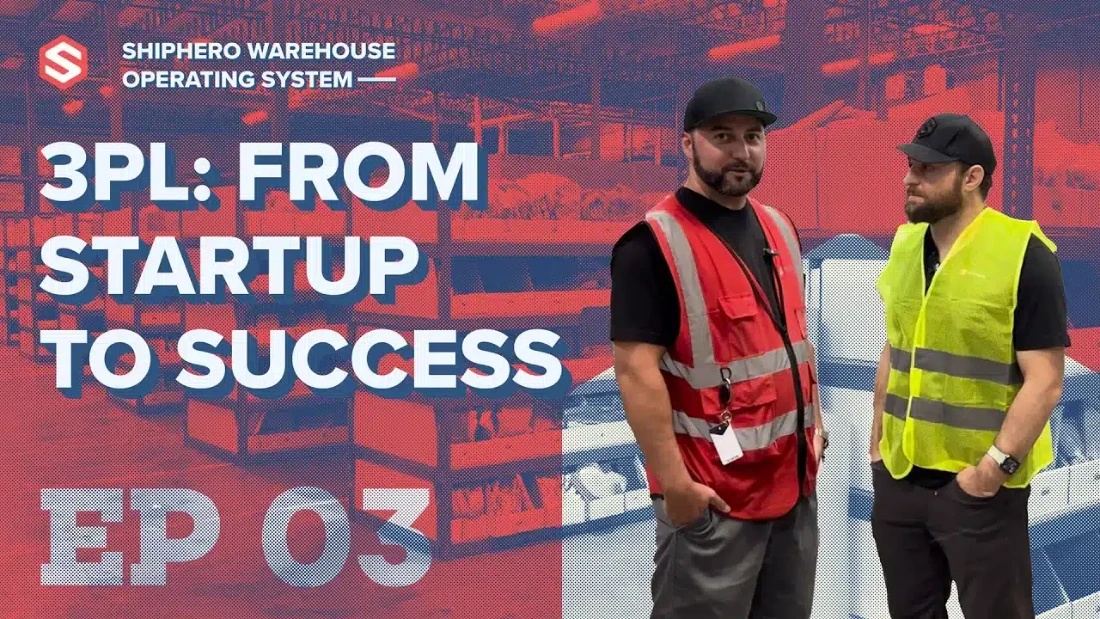
Watch Rubin with Randall Guernsey in ShipHero’s Warehouse OS series and his interests become quite specific. Guernsey had built Golden Egg Solutions, later acquired into the operation. Rubin asks about customers, the moment a small team needs warehouse software, staff retention and the processes that let a business grow.
The conversation includes an employee named Tyler, whom Guernsey almost did not hire after a missed first interview. Tyler got another chance and later took on process work nationally. Rubin enjoys the detail. It is the sort of story that disappears when a company is described only through its funding.
He is especially interested in whether supervisors understand a proposed change well enough to challenge it. Workers who can ask how a new process will behave in a difficult case are participating in its design. That observation is more revealing than a general declaration about listening.
Rubin’s own 2020 essay questioned familiar management rituals, including budgets, project managers and committees. He presented them as choices carrying costs as well as benefits. The essay described a particular moment in ShipHero’s development, before institutional investment. Its enduring question is a fair one: what problem does an added process actually solve?
Still asking what the tool is for
His conversations about newer technology keep returning to use. In a discussion with Nabil Malouli, Rubin describes early bets on Shopify and iOS devices, and weighs hardware and artificial intelligence against their effect on real warehouse work. Novelty alone does not settle the matter.
“We want warehouses that use ShipHero to beat warehouses that don’t use ShipHero,” he says. That is a competitive ambition expressed through the performance of customers. It also explains his interest in bringing third-party logistics owners together to exchange experience. Running a warehouse involves decisions a product manual cannot answer.
His public discussions have widened beyond software. In May 2025, he joined a FreightWaves question-and-answer program on tariffs, bonded warehouses and changing cross-border trade conditions. The merchant’s concerns are still present: what stock will cost, where it can go and which apparent saving deserves closer inspection.
Rubin has said he wants to build a public company. He has also spoken about the satisfaction of seeing colleagues establish families and buy homes. There is a long distance between that aspiration and the original $12 saving. His story connects them through years of work on ordinary transactions. Somewhere, an order is waiting to be picked. The larger ambition still has to earn its place beside the box.
Keep the conversation going
- ShipHero · official website
- Aaron Rubin on LinkedIn
- Aaron Rubin on X
- Essays by Aaron Rubin
- The Peel · watch on YouTube
- Warehouse technology · watch on YouTube
- Tropical MBA · the early story
- Retail Brew · growth and independence
- The 2021 funding announcement
- LVK · the August 2024 launch
- FreightWaves · May 2025 conversation