A shopping cart is a wonderfully optimistic object. It assumes that somewhere, behind the photograph and the size selector, the right item exists in a place from which somebody can send it. Bill Gibson has spent much of his working life around the less photogenic half of that arrangement. At Deposco, the company he leads as founder and CEO, the interesting action begins when the order has to become a parcel.
His question is deceptively ordinary: can the business deliver what it has just sold? In his public conversations, Gibson returns to inventory, timing, and the connection between a customer’s expectation and an operation’s ability to meet it. A brand may have a persuasive storefront. It also needs to know what is on the shelf. The confirmation email, unfortunately, cannot do the picking.
That perspective gives Gibson’s career a useful continuity. He has worked in supply-chain software, moved through venture investing, and led a business that sells the tools connecting orders with fulfillment. The setting has changed as shopping has spread across websites, marketplaces, and stores. The obligation at the end of the transaction remains remarkably recognizable: somebody expects their purchase.
Before the checkout became the whole business
Gibson’s professional story begins in 1993, as an account executive at Manugistics, a supply-chain software company. His education includes a bachelor’s degree from the University of Pennsylvania and an MBA from the University of Virginia’s Darden School of Business. That combination puts business training beside an undergraduate background in English and literature. It is a pleasingly varied preparation for an industry fond of turning perfectly good nouns into acronyms.
He subsequently worked at Grotech Ventures and became a managing partner at The Albermarle Group. Those chapters placed him on the investment side of company building before his CEO tenure at Deposco, publicly listed as beginning in 2011. The sequence matters. Selling enterprise software, evaluating businesses, and running one offer different views of the same question: what makes a product useful enough for customers to keep depending on it?
- 1993Account executive
Manugistics - Before DeposcoGrotech Ventures
The Albermarle Group - 2011CEO tenure begins
Deposco - 2026Inventory tools arrive
inside Shopify POS
The market he describes in his later interviews was full of operational gaps. Ecommerce was expanding, while many supply-chain systems had been designed around earlier retail patterns. Serving shoppers across channels often meant attaching new pieces to older machinery. Gibson’s interest lay in bringing those activities together so that the order and the inventory could share a current picture of the business.
That connection was already visible in Deposco’s presentation at MODEX in Atlanta in 2016. Its focus included fulfilling orders and handling returns through stores, with real-time visibility across inventory locations. A shop could participate in a broader fulfillment network. The operating questions extended beyond its own sales counter. The point helps explain the continuity in Gibson’s work: years before the Shopify POS announcement, Deposco was addressing how stores could help serve shoppers arriving through other channels.
The money followed the connection
In March 2021, Deposco announced a $35 million investment led by NewSpring, with participation from Aspen Capital Group and existing investors. It was the company’s first institutional investment round. The planned uses were specific: broaden the product suite and expand its presence in international markets. For a business concerned with connections, the investment bought room to make more of them.
Gibson’s explanation centered on a shift toward demand-driven, digital supply chains. He argued that businesses needed a unified view of supply and demand and the ability to serve customers in real time. That is an operational argument with a commercial consequence. If a retailer cannot connect the sale to the stock, growth can create fresh opportunities for disappointment along with additional revenue.
Led by NewSpring, with Aspen Capital Group and existing investors participating. Deposco’s first institutional investment round.
The personal response was quieter than the financing headline. Sharing the news on LinkedIn, Gibson said he did not post often and thanked the team, customers, partners, family, and friends. His point of emphasis was relationships and shared experience. In a career that includes venture capital, he chose a public moment about capital to acknowledge the people around it.
The international intention became visible in the United Kingdom. In 2023, Deposco’s European rollout included a deal with Easy Bathrooms, which planned to add 65 storefronts over the following years. The retailer would use Bright Warehouse to improve inventory visibility and fulfillment. Deposco also had a London office. The arrangement illustrated the problem crossing borders: a business adding physical locations needs a dependable account of what it owns and where it can send it. Expansion creates more places to sell, and more decisions about how to serve each sale.
Peak season has terrible manners
On the eCom Logistics Podcast in 2024, Gibson reached for a boxing comparison while discussing peak season. Invoking Mike Tyson, he described the annual pressure that arrives when plans meet actual demand. It is an apt image for a period when retailers have spent months preparing and customers have very little interest in how much preparation occurred.
His practical concern was the connection between commerce and real-time fulfillment. Accepting an order carries consequences if the business cannot supply it. The podcast conversation also covered logistics providers whose responsibilities now stretch across different clients, sales channels, and service needs. Software has to accommodate that variety while helping operators keep track of what is available and what must happen next.
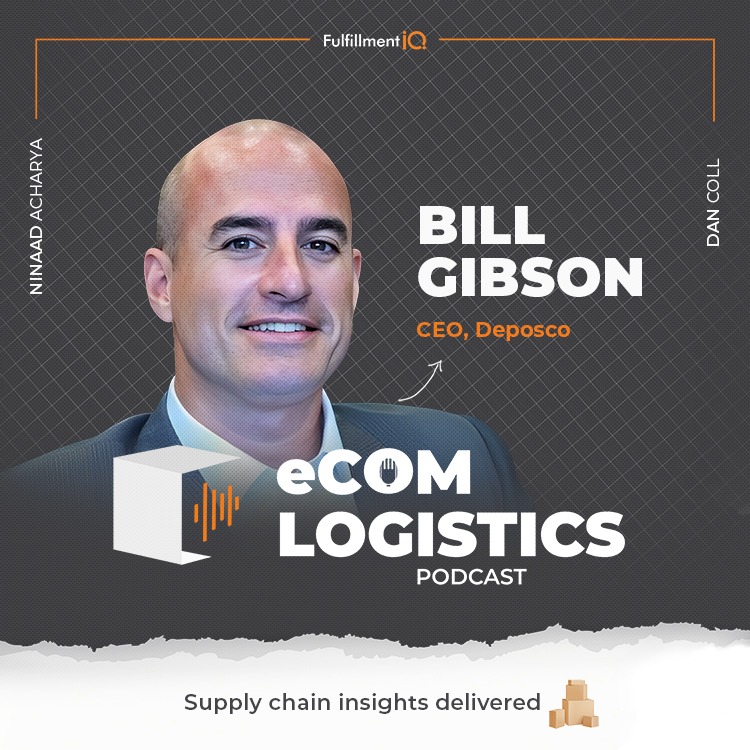
His emphasis on adaptability extends beyond the holiday rush. A third-party logistics provider may serve brands with different requirements through the same operation. A retailer may need its stores to participate in fulfillment. Those situations demand more than a record of yesterday’s activity. They require information that helps somebody decide what to do with the order in front of them.
The Lights behind the software
Gibson calls Deposco colleagues the Lights. In a LinkedIn post about workplace recognition, he put his team first and thanked them for the company’s community. The nickname sits comfortably beside Deposco’s Bright product naming. It also makes an otherwise abstract software business sound like a group of people who know one another.
There are small glimpses of the person in those public remarks. He has expressed pride in being a Darden alumnus. His profile lists French at full professional proficiency. His posts lean toward acknowledgments and shared company milestones. They offer a modest, specific portrait: an executive willing to use his own platform to direct attention toward colleagues and relationships.
Recognition has accompanied the business. Gibson was named among The Software Report’s Top 50 SaaS CEOs of 2023. Deposco appeared on the Inc. 5000 in each year from 2021 through 2025. Its 2025 position was No. 4,659. Those are dated milestones in a longer operating story; their value here is in showing the persistence of the business he has been leading.
“We’re in the outcomes business.”
Bill Gibson · Growth Investor conversation, 2024
An algorithm still needs a place to stand
By February 2025, Deposco was extending its work into Supply Chain Intelligence, beginning with shipping. The application was designed to identify trends and underlying causes, compare performance, and recommend actions. Its proposed territory included carrier choices, inventory positioning, routing, and packaging. These are the kinds of details that can make an apparently straightforward delivery surprisingly expensive.
For Gibson, the appeal was clearer decision-making. He described a unified operational view that would let leaders diagnose problems and make improvements. The ambition fits the earlier interviews: give people information they can use while the decision still matters. A shipping dashboard earns its place when the person reading it can work out what to change.
Implementation supplies the human complication. In discussing AI adoption, Gibson has emphasized expertise, onsite design, monitoring, change management, and established implementation methods. A new capability still has to enter a workplace with existing habits and responsibilities. Someone needs to understand the process, trust the information, and use it. The software purchase only begins that work.
This helps explain the consistency of his language as Deposco has added AI capabilities. The technology changes the available tools. His stated standard keeps returning to the work customers need to accomplish. Faster analysis has a practical destination: a person deciding how to run an operation with fewer avoidable mistakes and a clearer view of the consequences.
The argument arrives at the counter
In May 2026, Gibson joined a unified retail roundtable alongside executives from Shopify, EVEREVE, and Psycho Bunny. Data quality, organizational alignment, and the role of existing systems all entered the discussion. Gibson also argued that a technology partner can bring useful perspective from activity across many brands, giving an individual business context it would struggle to generate alone.
His description of Deposco was compact: “We’re an outcomes company disguised as a software company.” It is a line with a little mischief in it, but the practical standard is demanding. The customer has to experience something better. Otherwise, the disguise has consumed a budget and left the original problem sitting at its desk.
In August 2026, that argument acquired a very concrete setting. Deposco announced a native Shopify POS extension bringing inventory visibility, order routing, purchase orders, transfers, and receiving into the store interface. Gibson described the aim as letting associates manage tasks in one place. The pitch was close to the shelf: fewer interruptions between checking what exists and helping the customer buy it.
The path from Manugistics to that store counter covers more than three decades. Along it are investment firms, a financing round, international expansion, and a growing collection of software capabilities. Gibson’s recurring interest remains the handoff between a promise and its execution. The shopping cart can afford to be optimistic. His business concerns the people who have to make it right.
Continue the conversation
- Deposco ↗
- Bill Gibson on LinkedIn ↗
- Growth Investor: listen on Apple Podcasts ↗
- Growth Investor: listen on Spotify ↗
- eCom Logistics: the 2024 conversation ↗
- The 2026 retail roundtable and replay ↗
- Shopify POS announcement ↗
- The $35 million investment announcement ↗
- Supply Chain Intelligence announcement ↗
- AI implementation and people ↗
- Deposco’s 2025 Inc. 5000 announcement ↗
- Deposco’s European expansion ↗