The Family That Took Its Earphones Apart So Beyonce Could Hear Herself
How a Portland sound engineer's spare-bedroom experiment - taking a pair of earphones apart to build a custom set for his wife - became the in-ear monitor brand touring artists and studio producers trust in more than 90 countries.
In 2010, in a spare bedroom in Portland, Oregon, a sound engineer named Vitaliy Belonozhko did something most people would consider a small act of vandalism. He took a working pair of in-ear monitors, pried them open, and harvested the parts. He was not building a product. He was building a single custom set of earphones for one customer: his wife, Anastasia. That teardown is the closest thing 64 Audio has to a founding document.
Fifteen years later, the company Belonozhko started with his three brothers - all of them musicians and sound engineers - makes some of the most respected in-ear monitors in the world. Its products ship to more than 90 countries. They sit in the ears of touring artists mid-set, of front-of-house engineers running the mix, of studio producers checking a master, and of audiophiles who will spend as much on a pair of earphones as on a decent laptop. The brand line is two words: Hear Everything. It is less a slogan than a specification.
The name carries the origin with it. 64 Audio began life as 1964 Ears, and when the company grew up and shortened its name, the “64” stuck. It is a family business first and a hi-fi company second - the founder is one of four brothers, all of them players and engineers, and the story the company tells about itself is one of immigrants who, in its own words, “crossed oceans, started over, and set down roots.” That is not a detail you would invent for a marketing deck. It is the reason the products feel obsessive rather than merely optimized.
What they actually makeEarphones that behave like studio gear
64 Audio builds in-ear monitors, or IEMs - the sealed earphones that block outside noise and feed sound directly into the ear canal. The company makes two kinds. Custom monitors are built from a scan or physical impression of your ear, so the shell fits only you. Universal monitors use a shaped, one-size-fits-most housing you can buy off the shelf. Both share the same engineering, and both are assembled in-house in Vancouver, Washington, across the river from the Portland scene where the company began.
The problem 64 Audio set out to solve is one every musician who has worn IEMs knows in their body. Seal a miniature speaker inside your ear canal and the air in there has nowhere to go. As the driver pushes, the trapped air pushes back on your eardrum. Over a two-hour set, that pressure wears you down - the effect known as listener fatigue. Older IEMs made the trade look unavoidable: seal tightly for isolation and accept the fatigue, or loosen the seal and lose the bass.
The idea worth stealingA hole in exactly the right place
64 Audio's answer was almost embarrassingly physical. Instead of choosing between isolation and comfort, it drilled a controlled vent - a pneumatically interactive valve it calls apex, for Air Pressure Exchange - that lets the trapped pressure bleed off while keeping most of the isolation intact. The eardrum gets to move naturally. The soundstage opens up. You can listen longer. The company was later issued U.S. patents covering the technology.
Sealed vs. vented - the pressure trade
Air is trapped. The driver's motion presses on the eardrum with nowhere to escape. Isolation is high, but so is fatigue, and the soundstage collapses inward.
A controlled vent bleeds off pressure while retaining most isolation. The eardrum moves freely, bass stays intact, and the sound feels wider and less tiring.
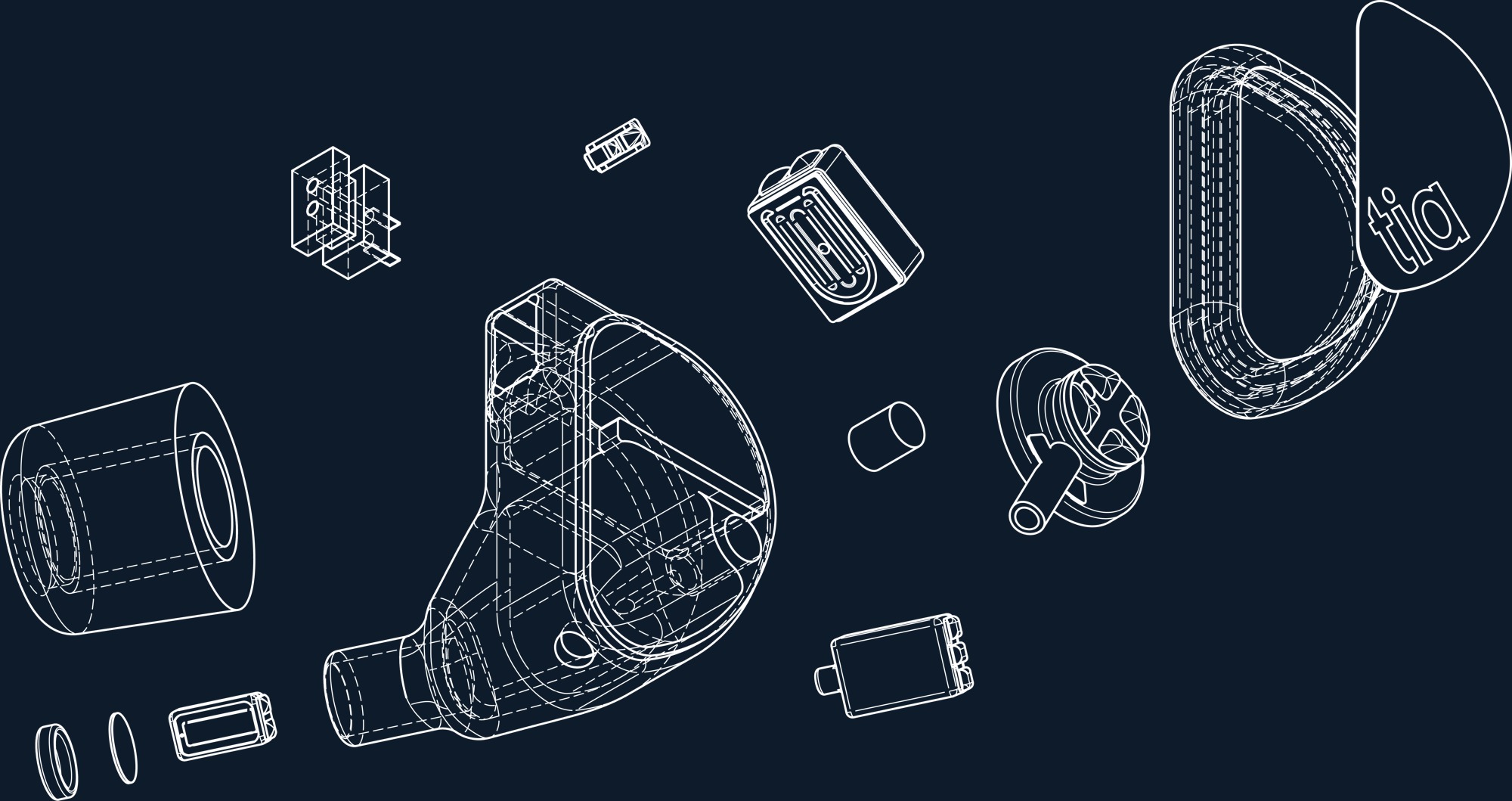
The second idea is tia - Tubeless In-Ear Audio. Conventional IEMs route sound from their tiny drivers to your ear through small internal tubes, which add resonance and blur the highs. 64 Audio removed the tubes. The tia design fires the drivers into open acoustic chambers, which the company says cleans up the treble and widens the sense of space. Paired with apex, it defined the modern 64 Audio sound. A third patent, LID (Linear Impedance Design), is a circuit that stops the multiple drivers in a single earpiece from fighting each other electrically, so the intended sound signature survives contact with whatever you plug into.
The product ladderFrom six drivers to eighteen
The reason those patents matter commercially is that 64 Audio uses them across an entire price range. The same core technology shows up whether you spend a few hundred dollars or a few thousand. What changes, mostly, is how many drivers are packed into each earpiece - and each of those drivers is a balanced-armature unit smaller than a grain of rice.
More drivers, more of the frequency range covered
One R&D investment, a whole staircase of buyers
Prices are approximate and vary by configuration and region.
Who buys itWin the pit, and the living room follows
Getting there is its own small ritual. For a custom pair, a customer sits for an ear impression - or, increasingly, a digital 3D scan - and 64 Audio prints a shell that matches the geometry of that single ear canal. The company adopted 3D printing for its acrylic shells years before it was common, and later patented parts of the process. The payoff is a seal that stays put through a two-hour set and a fit no universal earbud can copy. The cost is patience: a custom build is made to order, not pulled off a shelf.
64 Audio's customer strategy runs in an order most consumer brands get backwards. It won the professionals first. Front-of-house engineers, monitor engineers, touring musicians and studio producers are the hardest audience in audio - they use the gear every night and can hear a flaw instantly. Reported users include Beyonce and John Mayer, and the brand is trusted by studio producers such as Michael Brauer. Earn that crowd, and the audiophile market follows the credibility rather than the marketing.

How the business runsPatents instead of funding rounds
Here is the quiet part of the 64 Audio story: there is no headline-grabbing venture round to point at. The company sells direct to consumers through its own online store, alongside a network of authorized dealers and pro-audio channels, and it manufactures its own IEMs rather than outsourcing the hard parts. Custom monitors are built per order from an ear impression or 3D scan; universal models, cables, swappable apex modules and accessories fill out the catalog. The competitive advantage is not capital. It is a decade of manufacturing craft - 3D-printed shells, in-house assembly, and a small stack of patents - that a well-funded newcomer cannot simply buy.
That puts 64 Audio in a specific corner of the market: high-end IEMs, where it competes with names like Ultimate Ears Pro, JH Audio, Empire Ears, Campfire Audio, Vision Ears and Westone. What distinguishes it is the combination of a pro pedigree, the apex/tia/LID patent trio, and a product range that stretches from working musicians to obsessive listeners without diluting the engineering.
Where it fitsThe certainty business
Strip away the aluminum and the driver counts, and what 64 Audio really sells is confidence on stage. When a performer can hear their own voice cleanly over a wall of sound, they sing more accurately and protect their hearing at the same time. That is the job a four-figure earphone is doing - not looking impressive, but removing doubt. It is a narrow market, and a durable one, because the people who need it most are the people who can hear exactly what they are paying for.
The catch, honestly, is the price and the fit. Custom IEMs require an ear impression and a wait; the flagship models cost as much as serious instruments. For a casual listener with a phone and a playlist, this is far more earphone than the moment calls for. 64 Audio has never pretended otherwise. It built for the ears that work for a living, and let everyone else find their way to it.