The first thing Zogo had to learn about money was who wanted to spend it. A financial education app could sound perfectly sensible, look perfectly respectable and still leave a bank unmoved. There is a considerable distance between approving of young people learning about money and signing a contract to help them do it.
- Zogo turns financial concepts into short lessons, quizzes and rewards.
- Banks, credit unions and other organizations buy the platform and sponsor incentives.
- Its early pivot changed the payer from parents to institutions.
- Its next bet puts education inside the financial apps people already use.
That distance is where this Austin company found its business. Zogo gives learners an approachable way into budgeting, credit, investing and other financial subjects. It gives institutions a branded reason to stay in touch with those learners. The quiz serves both parties. Whether it serves them equally well is the interesting question.
The expensive first draft
Zogo began among Duke University students in 2018. Early reporting identified Bolun Li and Simran Singh as its founders; later accounts include Simon Komlos. Li recalled a high-school bank presentation that left classmates looking at their phones. The bank had brought its logo and its lecture. The students had brought somewhere else to be. His account makes the original problem wonderfully ordinary: attention.
The first proposed answer was an allowance app. Children would complete financial lessons, parents would supply the money, and local banks would put their branding on the experience. In a later founder retrospective, Li said development firms quoted more than $100,000. He exchanged 8% of Zogo for 3,000 hours of iOS development instead.
“No bank wanted it, except an NGO paid $1k for a pilot.”
Bolun Li, recalling the first product
Bank conversations changed the proposition: institutions wanted to reward customers themselves. Li says he sketched a replacement and 12 banks agreed to pilots priced above $10,000 each before it was coded. Those are his recollections, rather than audited sales records. But the change is clear. Zogo retained the lesson and the reward while replacing the parent with a sponsor.
A second wager followed. In a separate recollection, Li put the Finovate entry fee at $7,500 against a bank balance of roughly $60,000. That would be one-eighth of the available cash. Zogo won a Best of Show award at FinovateFall 2019; Li credits the event with its first 12 customers. A demonstration had become a sales expense worth defending.

The gift card has a patron
For a learner, the arrangement is pleasingly direct. First Bank and Trust Company describes a module as five concepts followed by a five-question quiz. Finish educational content, accumulate points and, subject to the program’s rules, redeem rewards. Early versions called the points pineapples. Current support materials also distinguish Coins and XP. Money has acquired several small, cheerful cousins.
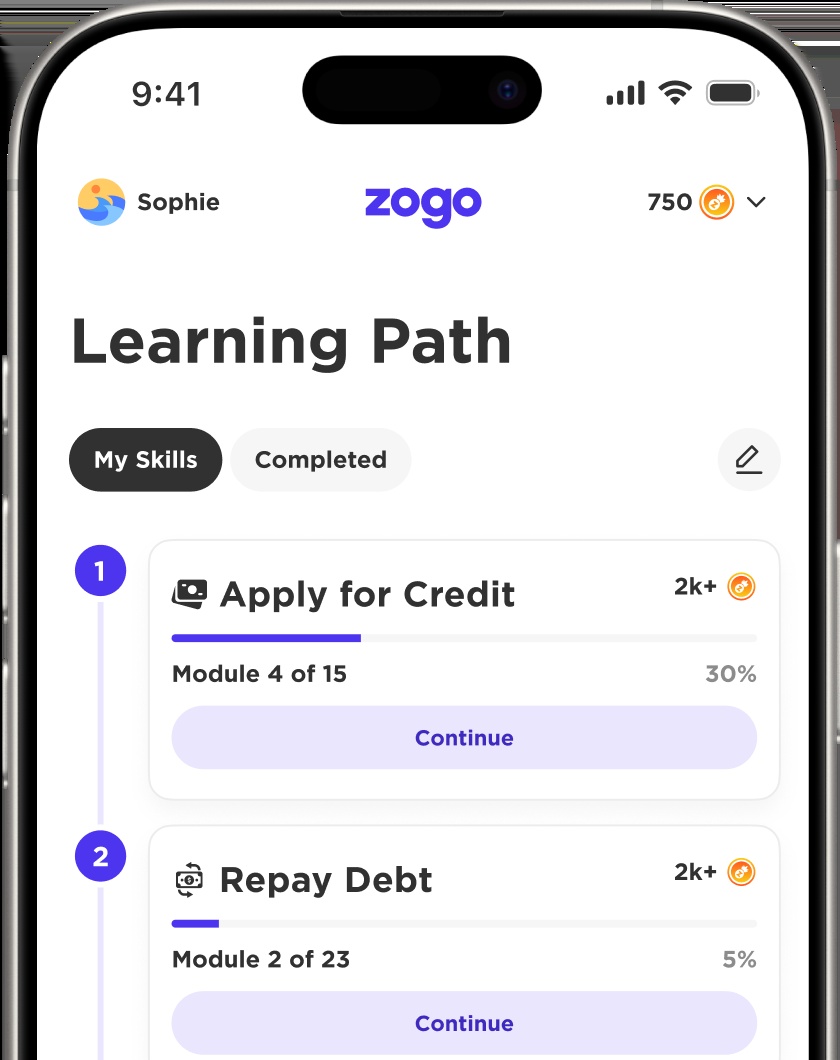
XP supports levels, badges and leaderboards. A learning streak offers another reason to return; daily trivia gives the routine a social appointment. These mechanisms make progress visible. They also make a subject that can feel embarrassingly adult feel manageable. Nobody has to announce that they do not understand credit before opening the next lesson.
On the other side of that screen is an institutional buyer. Zogo licenses financial education to organizations that want to educate customers, build relationships and encourage product use. Its partners include banks, credit unions and fintechs. The learner gets education without buying a course. The sponsor gets a recurring encounter with someone who might otherwise ignore another financial marketing message.
The reward explanation supplies the crucial detail: gift cards come from sponsor budgets. A depleted balance can mean waiting for the sponsor’s reset. Rewards are a funded program, not an unlimited promise. A learner weighing the app should treat the education as the dependable attraction and check the available incentives before counting on them.
Put the lesson where the money is
Zogo now offers several doors into the same basic idea. The branded mobile app supplies points, quizzes, badges and streaks. Zogo Web opens the experience in a browser, making it useful for classrooms, community programs and people who prefer a larger screen. The embedded offering puts lessons into another organization’s app or website.
That last door matters. Installing a separate learning app asks someone to begin a new habit. Encountering a relevant lesson during a banking visit asks for a smaller detour. Zogo’s May 2026 launch announcement for Zogo 360 describes Spanish modules, customized rewards and learning at existing customer touchpoints. It advertises a two-week implementation timeline, a vendor estimate that institutions should assess against their own systems.
Company-reported figures, May 2026. Reach is cumulative; it is not an active-user count.
The dedicated curriculum page lists more than 1,200 lessons, over 85 skills and nine categories. Budgeting sits alongside college, entrepreneurship, insurance and advanced investing. Zogo says Certified Financial Planners review its content; Spanish content and text-to-speech broaden access. Its particular expertise combines curriculum production with the mechanics of getting people to start, answer and return.
It has company in this market. Banzai uses institution sponsorship to make classroom financial education free, with games, worksheets and workbooks. EVERFI offers sponsored school programs as well as consumer and workplace education. Zogo’s distinguishing combination is short lessons, redeemable incentives and partner app integration. Sponsorship itself is already an established idea.
An audience is not an outcome
A useful way to understand Zogo is to look at the subjects its partners bring. College Board’s BigFuture helped develop a scholarships and grants skill in 2024. A question about paying for college becomes a sequence a student can actually work through. Fidelity Alliance Network inclusion in 2023 gave institutional advisory clients discounted access to Zogo. That is a provider-network arrangement; Fidelity is not thereby endorsing every lesson.
Sezzle provides a different setting. Its Money IQ program, launched in January 2025, embeds Zogo education in a buy now, pay later app. The April update reported an average of 11 completed modules per user and more than five million XP earned. Those numbers describe participation. They do not establish that users reduced debt or improved their savings.
- ReachWho encountered the program?
- EngagementWho completed the learning?
- OutcomeWhat changed afterward?
Editorial measurement guide. Each question needs its own evidence.
Zogo’s Partner Portal gives the buyer dashboards, surveys, report exports and customization tools. It can also place account openings, scholarships and loan applications within a learning journey. This is the commercial logic made visible: education can lead toward a transaction. The sensible buyer will define the educational and commercial goals separately, then examine whether each is being met.
Money Minute adds another reason to open the app. Announced in June 2025, it supplies personalized financial news clips twice daily to opting-in partners. At launch, Zogo explicitly excluded custom integrations such as Q2 and Sezzle. Choosing a product therefore means choosing an actual feature set, not assuming that every Zogo experience contains everything.
Borrow the test, then build
Zogo’s history offers a practical experiment for founders: put a specific proposition in front of the person with the budget, and ask for a paid pilot. Ask what they want to accomplish. Revise the offer around that answer. A pleasant conversation is encouraging; a commitment to pay gives the next development decision firmer ground.

That approach needs access to buyers and enough trust to make a pilot credible. The product also needs a sponsor willing to keep funding rewards, an audience that can use the technology, and content suited to its questions. Zogo’s support guidance specifies U.S. identification for reward redemption. Its privacy policy restricts registration below age 13. Broad financial inclusion ambitions still meet particular eligibility rules.
The company describes a working culture of collaboration, curiosity and community, including team dinners, retreats and virtual coffee hours. PEAK6 acquired it in 2021. The business has since continued widening its distribution, while the original lesson survives: a well-intentioned product becomes much more useful when someone wants to pay for the way it works.
The pineapple is memorable. The budget behind it explains the company.
Try a lesson. Watch the pitch.
Explore Zogo, its lesson library and blog. Follow its LinkedIn, X, Instagram or Facebook.
▶ Watch: Sezzle Money IQ case study▶ Watch: Zogo introduction from TrueCore↗ The 2019 Finovate product demonstrationRead the latest company announcements or the early Duke startup story.