Ziv Ofek had a useful piece of advice for an Israeli startup contemplating America: “It’s a lot cheaper to fail in the Negev than in New York.” He delivered it in 2015, at the opening of the Center for Digital Innovation in Beersheba. Two years earlier, Allscripts had acquired dbMotion, the company he helped create, for approximately $235 million. He had earned the right to talk about getting somewhere. His next concern was how other people would get there.
The line has the appeal of a good travel tip and the sting of an accountant’s note. It also offers an entrance into Ofek’s working life. Again and again, he has put his attention on the distance between having something valuable and being able to use it. A promising invention needs a route to market. A collection of information needs a route to the person asking a question. Even a successful founder needs colleagues who understand the next country on the itinerary.
Today, MDClone lists him as co-founder and president. His career has included engineering, research and development, company formation and a nonprofit built to help other founders. The recurring subject is access: who has it, what slows it down, and how much useful work disappears while everyone waits.
A degree in how things fit together
Ofek studied industrial management engineering at Ben-Gurion University of the Negev, specializing in information systems. His LinkedIn profile dates his university education to 1992-1996. It is a revealing combination of subjects for someone whose later work would involve both software and the organizations expected to use it. The machine and the working day have to fit together. An elegant system can still be an awkward colleague.
Before dbMotion, he served as vice president of research and development and business development at Ness-ISI, a Ness Technologies subsidiary. His responsibilities included large projects involving data warehousing, business intelligence and interoperability. These are the less glamorous nouns in the technology vocabulary. They describe the work required before information can travel somewhere useful.
That background matters because it places him inside the practical business of making systems work together, well before the more visible milestones. There is a considerable difference between demonstrating software and getting organizations to rely on it. Ofek’s early roles put development and commercial responsibility in the same job description. The person thinking about the product also had to think about its destination.
One transaction bought a company. The other financed a company’s next stage.
The exit had a long approach
At dbMotion, Ofek was a founder and chief innovation officer. The company’s work involved connecting information held in different systems and making it understandable across them. The technical phrase is semantic interoperability. The ordinary-language ambition is straightforward: a useful message should survive its journey from one system to another.
The acquisition in March 2013 makes an attractive headline. Its quieter prehistory is instructive. Allscripts had begun a strategic partnership with dbMotion in 2009 and made an equity investment in 2011. By the time it acquired the business, the buyer already knew the technology through years of working with it. The deal had an approach road.
The approximately $235 million consideration included cash, stock and a note payable. That detail is a useful antidote to the way startup exits become a single shiny number. A transaction has terms, relationships and a history. For Ofek, it became one point in a career that continued through several kinds of organization. The sale gives the story scale; what followed gives it character.
Putting a startup on the assembly line
In 2015, Ofek helped launch CDI in Beersheba. A university, entrepreneurs and local leadership were part of the undertaking. In the opening photograph, he stands second from the right as the group joins hands. It is a very literal picture of cooperation. For once, the corporate photograph has a point.
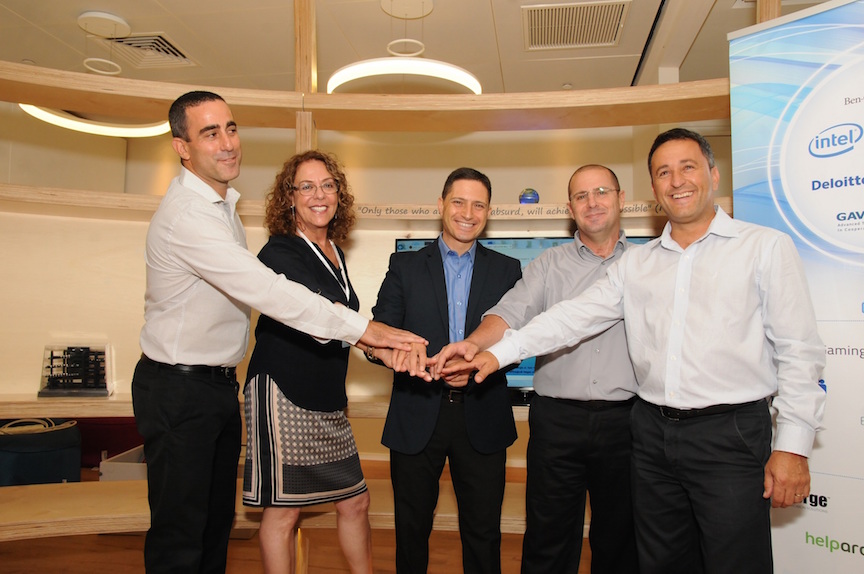
His proposal was to bring more discipline to the journey from idea to market. He reached for Henry Ford’s assembly line as an analogy. Technology, business preparation and market entry belonged in an organized process. The founder would still have to do the work. The surrounding machinery could be designed with rather more care.
CDI’s remit extended across education, social welfare and smart cities. It brought together startups, researchers, investors and industry. A separate partnership with Strategic Interests addressed entry into the United States. In describing that collaboration, Ofek emphasized that young companies had different capabilities and needs. Standardizing support did not require pretending that every business was identical.
“Each of our young companies has unique capabilities and needs.”
Ziv Ofek, on CDI’s U.S. market partnership
There is an appealing tension here: the assembly line on one side, individual attention on the other. It makes better sense when the intended product is a functioning company. A founder needs introductions, technical work and commercial judgment in a sequence that matches the business. A room full of clever people is a promising start. Someone still has to decide what happens on Monday.
Starting again, with familiar company
MDClone was founded in Beersheba in 2016 by Ofek, Luz Erez and Boaz Gur-Lavie. Ofek took the chief executive role, Erez the technology role and Gur-Lavie the finance role. Here was another company, following the exit and the nonprofit, with a founding group divided across the responsibilities needed to build a business.
Its first product arrived in February 2017. In January 2018, it signed its first major U.S. deal, with Washington University in St. Louis. The geography is worth following: a company based in southern Israel, an early product, then a substantial American relationship. Ofek’s interest in helping founders cross that distance was accompanied by another attempt to cross it himself.
The company’s work includes synthetic data and self-service analysis. In general terms, the aim is to let people investigate information with fewer intermediaries while protecting privacy. There is a human question underneath the software: how much specialist help should someone need before they can begin asking something useful? Ofek has spent years returning to that question.
Systems that can work together
Founders ready for market
People able to ask questions
An editorial map of the work, rather than a product comparison.
When explaining synthetic data in 2021, Ofek put the standard in narrative terms: “Synthetic data has to tell the same story as the original data.” The wording is unusually accessible for a subject that can quickly turn mathematical. It asks a reader to think about what an analysis preserves. A representation earns its usefulness through the relationships it retains. For a founder trying to explain a technical product to another organization, that choice of language does some work of its own: it gives the audience a way into the idea before asking them to follow the machinery.
The colleague who could argue back
A useful portrait of Ofek comes from David B. Nash, who worked with him on MDClone’s Global Network. Nash described conversations with Ofek and the leadership team about translating the company’s vision for an American audience. He called them heart-to-heart talks. Enthusiasm needed people who understood the market receiving it.
Nash also described Ofek as a Sabra, using the familiar image of a prickly exterior and a sweet center. His account is affectionate, but it contains a practical observation: Ofek had surrounded himself with American leaders who understood local institutions. The founder’s experience did not remove the need for other people’s experience. Another country can be a vigorous editor of an otherwise excellent plan.
On LinkedIn, David Epstein’s recommendation supplies a different register. He describes Ofek as forward-thinking and generous with colleagues, using the words “modest, self-effacing” in his assessment. Those are colleagues’ judgments, rather than a personality test. Together, they give the public career a little texture: a person with strong ideas, close collaborators and people willing to speak warmly about working with him.
The numbers get bigger; the question stays practical
MDClone was selected as a World Economic Forum Technology Pioneer in 2021. The selection brought Ofek an invitation to participate in the forum’s activities and discussions. By then, the work had moved well beyond a founding team and an early product. Recognition supplied a wider room in which to explain it.
In March 2022, MDClone announced a $63 million Series C led by Warburg Pincus and Viola Growth, with existing investors also participating. The company said revenue had more than doubled over the preceding year and described plans for additional markets and product development. These were company statements about a particular period, rather than a forecast that every following year would behave itself.
By September 2024, Bruno Lempernesse had joined as president, with a primary focus on North America. The current leadership page lists Lempernesse as CEO and Ofek as co-founder and president. The titles have changed. The public record continues to show a founder working alongside an expanding leadership team.
Ofek’s career can be told through transactions, organizations or maps. The more interesting thread is the attention he keeps giving to the work between milestones. Preparing a company for another market. Making information usable. Finding colleagues who know the terrain. An exit is an event; these jobs fill a working life. Back in Beersheba, his advice had already allowed for failure. The sensible thing was to learn somewhere you could afford the lesson.
Follow the work
Company, connections and further reading.