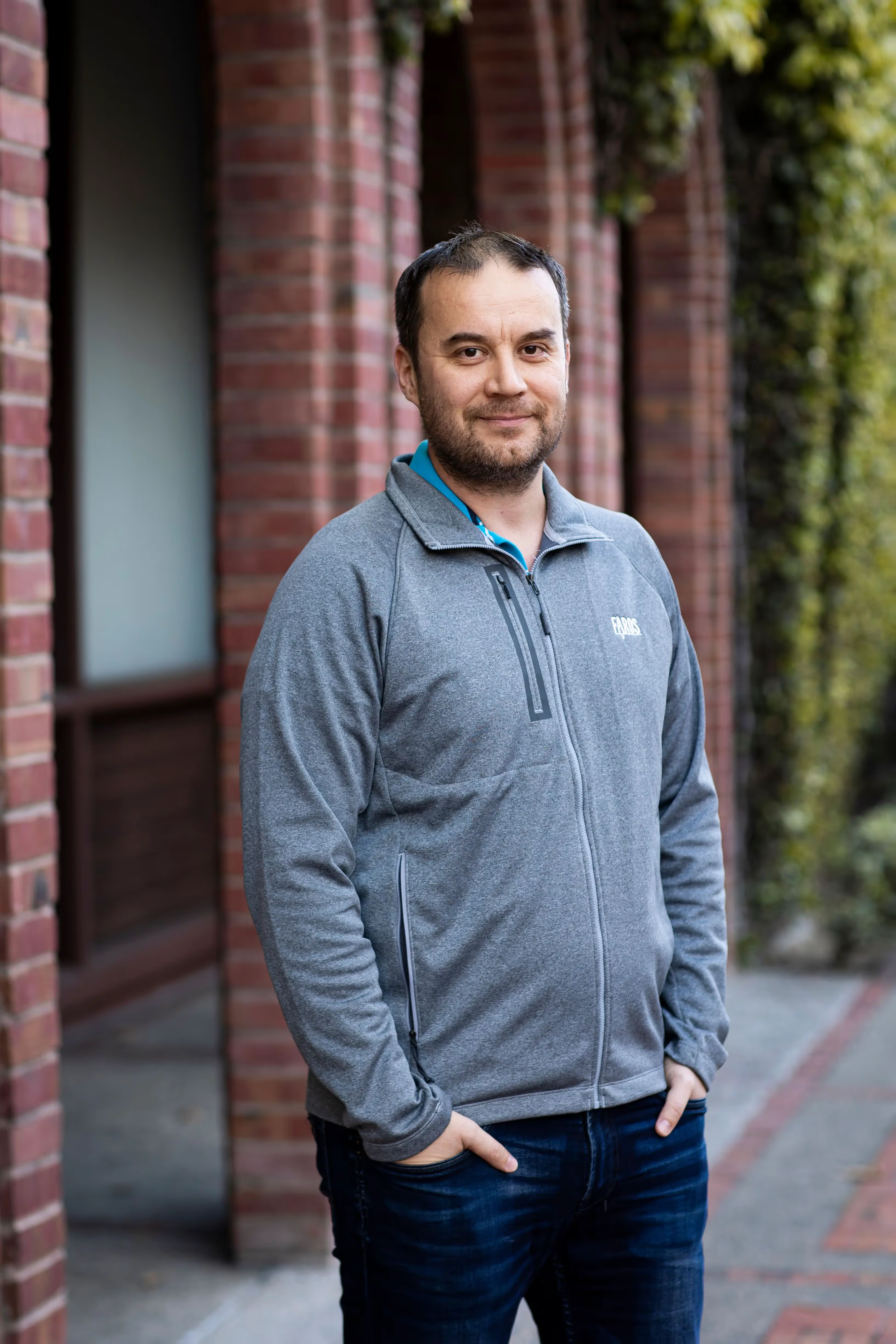
The Data Scientist Who Kept Choosing the Harder Problem
In April 2019, Vitaly Gordon posted a short announcement online. His last day running engineering and data science for the Salesforce Einstein platform had arrived. He called the work "the pinnacle of my career." Then he left to start again.
Most people do not walk away from a pinnacle. Gordon had spent roughly three years building Salesforce Einstein from an idea into what the company described as its comprehensive enterprise AI platform, one that grew from zero to billions of predictions a day. The framework he helped design pushed automated machine learning directly into Salesforce's multi-tenant architecture, so that models were built, cleaned, balanced, and calibrated for every customer without a data scientist touching each one by hand. It was, by any measure, a career made.
He co-founded Faros AI instead. And in a detail that says a lot about how he works, he did not do it alone or with strangers. He brought back people he had already built enterprise AI with - Matthew Tovbin, who became CTO, and Shubha Nabar, both alumni of the Einstein effort. The band that had scaled AI once at Salesforce got back together to try it again, this time pointed at a different target.
April 26th was my last day as head of engineering and data science of the Einstein Platform at Salesforce. Growing it from zero to the world's leading Enterprise AI platform with billions of predictions a day was the pinnacle of my career.
Vitaly Gordon, on leaving Salesforce, 2019From Predictions to People
The target Gordon chose is deceptively unglamorous. Faros AI is an engineering intelligence platform. It gathers signals from the tools engineering teams already use and turns them into a picture of how work actually flows, where it stalls, and whether the money spent on productivity is paying off. In an industry obsessed with AI writing code, Gordon zeroed in on a quieter question that leaders struggle to answer: is any of this making my engineers faster?
That question got sharper when the market cooled. "With the recent market correction that happened, there are more and more companies that are starting to focus on efficiency and productivity," Gordon told VentureBeat around the company's funding. Engineering had spent years as a growth-at-all-costs function. Suddenly leaders wanted evidence, not vibes, and Faros AI sold evidence.
Career arc, illustrative. Each role deepened the same thread: making machine learning genuinely useful.
The Metrics Philosophy
Gordon is wary of the trap that swallows productivity tooling: the vanity metric. Writing for SignalFire on scaling engineering teams, he argued that the right measurements are not universal. "Tailor what you track to your goals, operating model, and company culture," he wrote. A five-person startup and a thousand-engineer enterprise should not be counting the same things. It is a data scientist's answer to a data scientist's temptation, which is to measure everything and understand nothing.
That instinct traces straight back to Einstein, where the entire point was automating the tedious, error-prone middle of machine learning - the feature engineering, the model selection, the score calibration - so humans could focus on outcomes. At Faros, the tedious middle is the sprawl of engineering data across dozens of tools. The job is the same shape. Collect the mess, make it trustworthy, hand people something they can act on.
Betting on the Next Five Years
Gordon's public thesis is direct. "Every aspect of software engineering will be transformed by AI in the next five years, and we are building the platform that will help software organizations make that transition with confidence," he has said. By late 2024 that thesis had turned into partnerships - with Globant, to support agentic AI projects, and with Microsoft, around measuring the impact of tools like GitHub Copilot.
AI is reshaping the software engineering discipline. We bring unique insights to maximize the impact of AI-augmented teams on business outcomes.
Vitaly Gordon, on the Globant partnership, 2024The through-line of Gordon's career is a preference for the problem underneath the problem. Everyone wanted AI predictions; he built the plumbing that made them reliable at scale. Everyone wants AI to make engineers faster; he is building the measurement layer that tells them whether it did. It is less glamorous than the headline and, historically, more valuable.
Roots
The technical grounding runs deep and follows a familiar route from Israel to Silicon Valley. Gordon earned a bachelor's in computer science from Ben-Gurion University of the Negev, then an MBA from the Technion - Israel Institute of Technology, pairing the engineering with the business fluency a founder needs. From there the resume reads like a tour of applied data at consumer and enterprise scale: LinkedIn, LivePerson, Salesforce, and now his own company headquartered in the heart of the Bay Area.
He is candid about the reality of the path, too. In talks aimed at early-stage founders, Gordon has spoken about the hard truths startups face - the survival math, the discipline of focus, the difference between a good idea and a durable company. It is the perspective of someone who has now built at both the safe altitude of a public company and the thin air of a seed-stage startup, and chose the thin air on purpose.
In His WordsSelected Quotes
Every aspect of software engineering will be transformed by AI in the next five years, and we are building the platform to help organizations make that transition with confidence.
Tailor what you track to your goals, operating model, and company culture.
Faros AI provides game-changing guidance to organizations navigating the AI transformation of software engineering, for faster time-to-market and reduced cost of delivery.
With the recent market correction, more and more companies are starting to focus on efficiency and productivity.
Watch: Vitaly Gordon on the hard reality early-stage startups are up against - YouTube.