The word was WAS. Three letters, all doing respectable work in the English language, until Zachary Silverzweig tried to explain them to his young son. Sound them out in the obvious way and something goes wrong. His son’s reply was reasonable: “What is a WASS?” A routine reading lesson had acquired a rather awkward customer review.
Silverzweig began experimenting. There were flashcards, a color-coded approach, and eventually marks that could tell a reader which sound a letter should make. He had spent years building software. Now he was looking at one of the oldest interfaces around: a printed word. The result became TinyIvy, an education company founded in 2019. An adult’s habit had met a beginner’s question, and the beginner had a point.
Today, Silverzweig is back at CipherHealth as co-founder and chief executive, following his return in May 2026. The education chapter is worth lingering over. It gives his career an unusually tangible object to examine. Everyone can look at a word. Everyone who reads English has learned to forgive it a few inconsistencies. He chose to see whether the word could offer its newest reader some help.
A builder with several job descriptions
Before the reading materials came consulting work at Archstone Consulting and Pace Harmon. At CipherHealth, Silverzweig’s responsibilities spread across product, engineering, technical support, configuration, and implementation. These are distinct jobs, and the distance between them matters. A product can make sense to its designer and still be troublesome to configure. It can work in a demonstration and still generate a queue of support requests.
His work crossed those boundaries. He helped take an early prototype into an enterprise software business and participated in fundraising alongside his co-founders. A prototype offers the pleasure of possibility. Implementation supplies the particulars: somebody’s existing process, somebody’s deadline, somebody’s entirely reasonable objection. Spend time in both and the definition of a finished product becomes less forgiving.
There is a practical counterpart in his praise for development partner Xmartlabs. He singled out consistent delivery and considered features. The firm’s account describes a distributed engineering team, paired work, testing, and code reviews. Those details have little theatrical value. They do explain how ideas travel between people without losing every useful part along the way. Silverzweig’s career has involved that machinery as well as the initial invention.
The alphabet gets a set of instructions
At TinyIvy, the central proposal was to add information to letters without changing a word’s underlying spelling. The TinyIvy Phonics System, or TIPS, uses marks to indicate pronunciation. For a designer, the attraction is clear: the instruction sits where the learner is already looking. A separate explanation requires a trip away from the word; a mark aims to bring the explanation closer.
His writing repeatedly returned to differences between writing systems. In one essay, he worked through research on orthographic complexity, the relationship between written symbols and spoken sounds. He was interested in the burden imposed by English spelling and in what more regular systems might suggest. This was the problem he wanted his company to address. The educational ambition was broad; the proposed change was small enough to sit on a letter.
One familiar letter. Different sounds.
TIPS adds pronunciation marks while preserving spelling.
That distinction helps explain the venture. It asked learners to use an additional visual cue rather than asking the rest of the English-speaking world to adopt a spelling reform. A parent could still recognize the word. A child could receive more guidance. The design had to serve both people at once, with very different amounts of experience on either side of the book.
Silverzweig taught an early pilot group in East Harlem. That brought the product into direct contact with the people it was meant to help. A classroom gives an idea plenty of opportunities to become more specific. The learning materials had to fit the student, while the lesson had to fit the time and attention of an adult.
1,250 pages, and the work between lessons
By September 2020, Silverzweig was writing about a problem that rarely makes it into a founder’s origin story. TinyIvy had more than 1,250 pages of curriculum, spread across roughly 500 files. Books, worksheets, lesson plans, and reference materials had to fit together. Feedback would arrive. Changes would follow. The correct version still needed to reach the correct person.
He described choosing Contentful to organize that material and connect it to a teacher portal. The attraction included a free startup offering and a relatively quick path to a working system. This is a useful glimpse of his decision-making: buy back time where a tool already exists, and preserve the team’s effort for the work that makes the product its own.
The numbers describe the curriculum as he reported it in 2020. They also make the point better than an abstract discussion of execution. One misplaced revision is an annoyance. Hundreds of files with no reliable sequence become a second job for the teacher. A teaching idea needs a distribution system, and distribution needs care even when nobody is applauding it.
Silverzweig also worked with Molly Ness, then an associate professor at Fordham, on an article about spelling instruction. It considered how spelling and reading reinforce one another and how teachers might organize practice. The collaboration matters to this portrait because it places an outside educational voice inside his work. He was building a product while also publishing explanations that asked readers to think through the instructional choices.
A game, then a classroom, then a booth
In October 2020, he announced TIPS Reading World for iOS and Android. The game offered more than twenty learning activities across five islands. Behind the adventure setting were exercises in letter sounds and blending. It was another route into the same pronunciation system, with characters and places doing some of the work that printed materials had done elsewhere.
A game introduces its own design demands. It must tell a child what to do next, respond to an attempt, and provide a reason to return. The educational purpose cannot depend on the child reading a product explanation first. That makes an early reading app a fairly exacting assignment for someone interested in usable software: the instructions themselves are part of the challenge.
By November 2021, his conversation with education podcast host Mike Palmer had moved into classroom use. The discussion covered an app, materials, and work across early grade levels. In 2021, TinyIvy joined the WISE accelerator cohort, reporting partnerships with eleven schools across India and the United States. That is a useful measure of reach at that point in the venture, with actual places attached to the ambition.
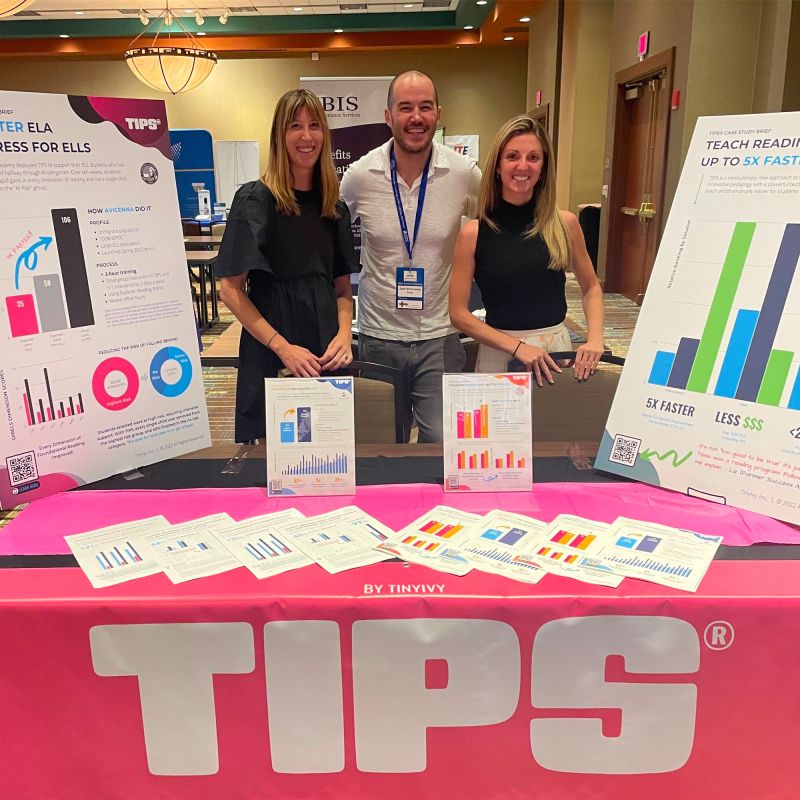
At TinyIvy’s first education conference in 2022, the team brought a booth full of numbers. Silverzweig’s post about the event dwelled on how vendors presented their work. His own team’s charts were a deliberate choice. A conference aisle is a place where an argument has to become visible from several feet away. The photograph catches that translation: years of work converted into posters, a table, and a conversation starter.
The question after the promising result
There was a recurring demand underneath the venture’s promotional language: test the idea. In September 2020, Silverzweig announced research plans covering seven schools and forty-five students, with support from the Johns Hopkins Center for Research and Reading Evaluation. He also acknowledged that the earlier small pilot offered limited evidence and required validation. Those qualifications belong beside the ambition.
The useful questions went beyond whether a score might improve. His proposed research also asked about teachers’ perceptions, instructional changes, and the difficulty children experienced. Those are product questions as well as educational ones. A method has to fit a lesson, a teacher’s time, and a learner’s attention. A promising early result creates more work for a founder who wants a tool to travel.
“A CMS is a system that allows you to gracefully manage your content, whatever that may be.”Jason Singh, TinyIvy developer
The modest language of the content system sits comfortably alongside that work. Whatever the idea promises, somebody must manage its materials, hear objections, and make the next version available. Silverzweig’s literacy venture is interesting in those ordinary dimensions. There is room for invention, but also for the person who needs tomorrow’s worksheet and would prefer not to become a software administrator to obtain it.
Leave something that can carry on
TinyIvy was also a family undertaking. Its early team description included Silverzweig relatives, and the company’s 2024 farewell to its founder made that closeness plain. It remembered daily meetings, work sessions, and late messages. Rebecca Kate Silverzweig would continue into the next phase, with technical and curriculum teams still in place. The work had acquired people and routines of its own.
That is a revealing point in a founder’s story. The initial question can belong to one person. The company eventually needs a shared understanding of what to make, how to change it, and who carries it forward. TinyIvy’s farewell recorded affection alongside continuity. Its inventor could take another role while colleagues continued the business. Building an organization introduces that possibility, and asks a founder to make room for it.
Back to the builder’s desk
Silverzweig’s May 2026 return to CipherHealth put him back in the chief executive role at a company he had helped build. His more recent public writing has considered how organizations can give more employees the means to develop useful tools. He has argued for flexibility among AI vendors and for connecting systems so teams can build around their own needs. The attention remains on how work gets done.
That makes the alphabet chapter more than a curious line in a résumé. It offers a concrete way to read his career: identify an obstacle, put something in front of users, and deal with what follows. His son had encountered a word whose instructions were unreliable. Silverzweig’s response became materials, software, classrooms, and a team. Three little letters had proved quite capable of assigning a grown-up homework.