Before there was a trading platform, there was an office with an unfortunate heating arrangement. Yuriy Sorokin had heard about Bitcoin, bought graphics cards and brought mining rigs to work. His colleagues acquired a front-row seat to his curiosity. The machines made their small office hot and cramped. Entrepreneurship occasionally arrives wearing a turtleneck; on this occasion, it could have used an open window.
Sorokin would later describe himself and his colleagues as “builders and tinkerers at heart.” It is an appealing description for a founder whose business began with a practical annoyance. Managing cryptocurrency holdings across exchanges required attention and repetition. His team wanted software to do some of that work. Then other people wanted the software, too.
That small migration, from something useful to its makers to something useful to their friends, produced 3Commas in 2017. The company would attract venture investment, develop tools for professional money managers and endure a damaging security crisis. In 2026, its original platform would close while an AI product opened to the public. Sorokin’s career has become an extended examination of what happens after people agree to let software act for them.
Keep responsibility for the result.
The registration form came later
The team predated the crypto business. A small IT company working on data visualization and mobile applications had assembled in 2013. By the middle of 2017, the team had switched its attention to 3Commas. This was an existing group of software makers redirecting its work toward a problem its founders experienced themselves.
The early product included a portfolio balancer. Its job was to keep cryptocurrency holdings aligned with a chosen allocation, drawing on Modern Portfolio Theory. When acquaintances asked to participate, the team added registration. A private convenience was acquiring the obligations of a public service.
The company established its base in Tallinn. Sorokin’s public LinkedIn profile now places him in Barcelona, a distinction that matters in a business routinely described through its headquarters. His working world extends beyond either city: exchanges, developers, customers and counterparties occupy different jurisdictions and keep different hours. A cryptocurrency market has little interest in a founder’s local bedtime.
The product expanded into trading bots and tools for placing and managing orders across exchanges. The attraction was straightforward: users could set rules without writing every part of the machinery themselves. Sorokin was building a business around the distance between having a trading idea and being able to execute it repeatedly.
The token they chose to leave unmade
In the initial coin offering boom, a crypto company could raise money by issuing a token. Sorokin considered it. He and his customers reached a less fashionable conclusion: a 3Commas utility token would add little to the experience. The company passed on an ICO.
That decision supplies a useful detail about his stated approach to product development. Listening to customers could mean declining to build something. A feature might be technically possible, commercially tempting and still fail to make the software more useful. For a team paid to make things, leaving something unmade can require unusual restraint.
Outside investors eventually arrived through a more conventional door. Alameda Research invested $3 million in 2020. A $37 million Series B followed in September 2022, with Target Global, Alameda Research, Jump Crypto and Copper founder Dmitry Tokarev among the participants. The funding supported development of the trading ecosystem and developer tools; DeCommas extended the effort into decentralized finance.
Those rounds are company financing, rather than a measure of Sorokin’s personal fortune. They mark a change in the scale of his responsibilities. Software first shared with friends now carried expectations from institutional backers as well as traders. More resources brought more people to answer to.
Investment received by 3Commas. Bars share a common scale.
When the market moved, the servers felt it
Growth exposed a less glamorous side of automation. In May 2021, Sorokin published an apology about capacity limits. During volatile markets, the service could be pushed beyond what its systems could process. Customers wanted automation most urgently at moments when the infrastructure faced its hardest test.
His explanation was unusually mechanical. He discussed storage, processing ceilings, background jobs, statistics calculations and monitoring. The response included optimizing heavily used components, changing how calculations were built and improving incident escalation. These are the details that disappear from a product demonstration and reappear when customers need an answer.
The episode put Sorokin in a familiar founder’s predicament. Demand validated the product while making its weaknesses harder to excuse. A bot’s usefulness depends on its ability to follow instructions at the required moment. An elegant screen offers limited consolation when the machinery behind it cannot keep pace.
The keys became the story
The more serious reckoning came in late 2022. Users reported unauthorized trading. The company initially pointed toward phishing and other explanations outside a confirmed breach of its own systems. Then API data appeared publicly, and Sorokin acknowledged that the disclosed information was authentic.
On December 29, 3Commas confirmed that some users’ API keys, secrets and passphrases had been disclosed by a third party. It asked supported exchanges to revoke connected keys and urged customers to replace theirs. The notice also acknowledged its earlier explanations and said its internal investigations had failed to establish a compromise.
The distinction between holding funds and having permission to trade them became painfully concrete. Customers kept assets at exchanges, but the connections used by automation could authorize transactions. A service did not need to be a wallet to occupy a consequential position between a trader and the trader’s money.
In October 2023, 3Commas disclosed a separate incident involving unauthorized access to customer account data and reports of trades after password resets. It said the accessed data did not include API secrets or account passwords. The company changed its reset process so that resetting a password also disabled API connections.
For Sorokin, these incidents made trust an operational responsibility with specific failure points. The appeal of automation rests on being able to step away. That makes the permissions behind the convenience central to the product. The founder asking customers to delegate work also has to answer for how that delegation is protected.
The appeal of automation rests on being able to step away.THE RESPONSIBILITY BEHIND THE INTERFACE
The customers behind the volume
By 2024, Sorokin was discussing tools for fund managers and family offices alongside the familiar retail products. At the European Blockchain Convention in Barcelona, he joined a discussion on asset management and tokenization with participants including Barnali Biswal of Hilbert Capital and Fabian Dori of Sygnum Bank, moderated by Madeleine Boys.
The company’s Asset Management product addressed people running strategies across multiple client accounts. The work involved coordination: applying instructions across accounts, keeping execution organized and making activity visible. For Sorokin, serving these customers meant thinking beyond the individual trader adjusting a bot.
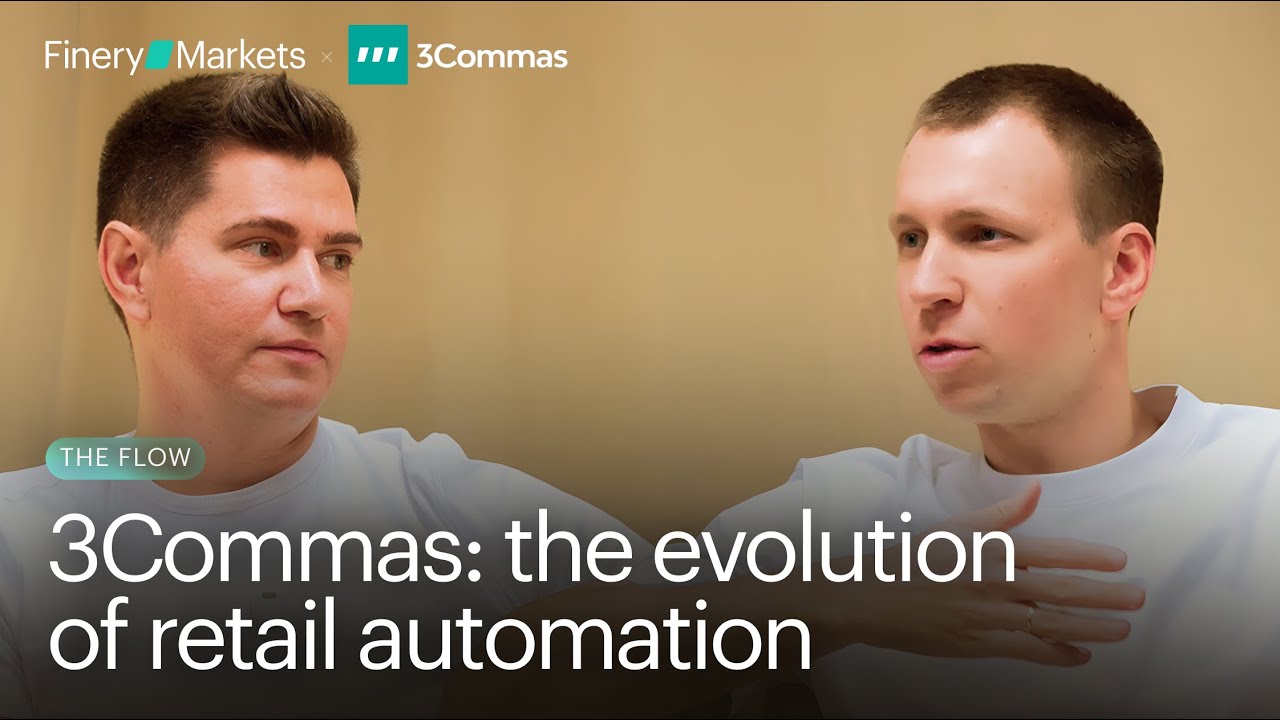
His November 2025 conversation with Finery Markets CEO Konstantin Shulga offered a numerical explanation. He described a customer base in which roughly 5-7% of users generated 90% of trading volume. A small group of intensive users was responsible for much of the platform’s activity. That concentration helped explain the attention paid to managed accounts.
There is a product lesson in that imbalance. Registered users, active traders and trading volume describe different things. A business can have a broad audience while a narrow segment shapes its most demanding workflows. Sorokin’s expanding toolkit reflected the practical requirements of people using the service repeatedly and at scale.
Now the instruction can be a sentence
By 2025, the interface itself was becoming part of Sorokin’s next project. He discussed AI-assisted ways to describe and refine strategies without navigating complicated parameter screens. In November, 3Commas introduced an AI assistant initially focused on DCA bots. The longstanding effort to simplify trading software was moving toward conversation.
QuantPilot followed in 2026. An April announcement introduced an agent-based product for research, strategy development, backtesting and optimization. The ambition was to let a trader describe an idea in ordinary language and have software help turn it into something testable. The technical work would become less visible to the person giving the instructions.
Public access opened on June 17 after more than 5,000 early-access traders had helped shape the platform. The launch included market research and strategy testing, with live execution on Hyperliquid described at that stage as forthcoming. The sequence matters: an announced destination and an available capability are different milestones.
The attraction for Sorokin is consistent with the original portfolio tool. Reduce the work between intention and execution. Yet each reduction changes what a customer must judge. Selecting parameters, describing a strategy and evaluating an agent’s output require different kinds of attention. Simpler instructions still need careful interpretation.
- 01DescribeA strategy in ordinary language
- 02TestBacktest against historical data
- 03RefineReview and optimize the strategy
Product workflow illustration. No performance results are implied.
A successor, and a set of instructions
Then came a definite ending. On September 11, 2026, 3Commas v1 was deactivated. Its successor, v2, was built in partnership with WunderTrading. Existing strategies did not transfer automatically; customers had to record settings and rebuild them. Orders already placed at exchanges remained live after v1 stopped managing them.
It is a revealing final scene for this chapter of Sorokin’s work. A platform designed to save people from repetitive tasks needed customers to undertake a careful migration. Even the departure instructions concerned the relationship between an intention, an order and the system responsible for carrying it out.
The mining rigs, the portfolio balancer, the bots and the new agents belong to the same practical curiosity: how much useful work can software take over? Sorokin has spent years enlarging the answer. His record includes funding, product changes, apologies and closures. Every new interface makes the question easier to ask. The difficult part remains making the answer dependable.