Profile • The Agent Economy
Manny Medina
He built a $4.4 billion company out of two months of runway. Now he is building the cash register for AI agents.
PHOTO: Slush / Manny Medina program portrait, 2025
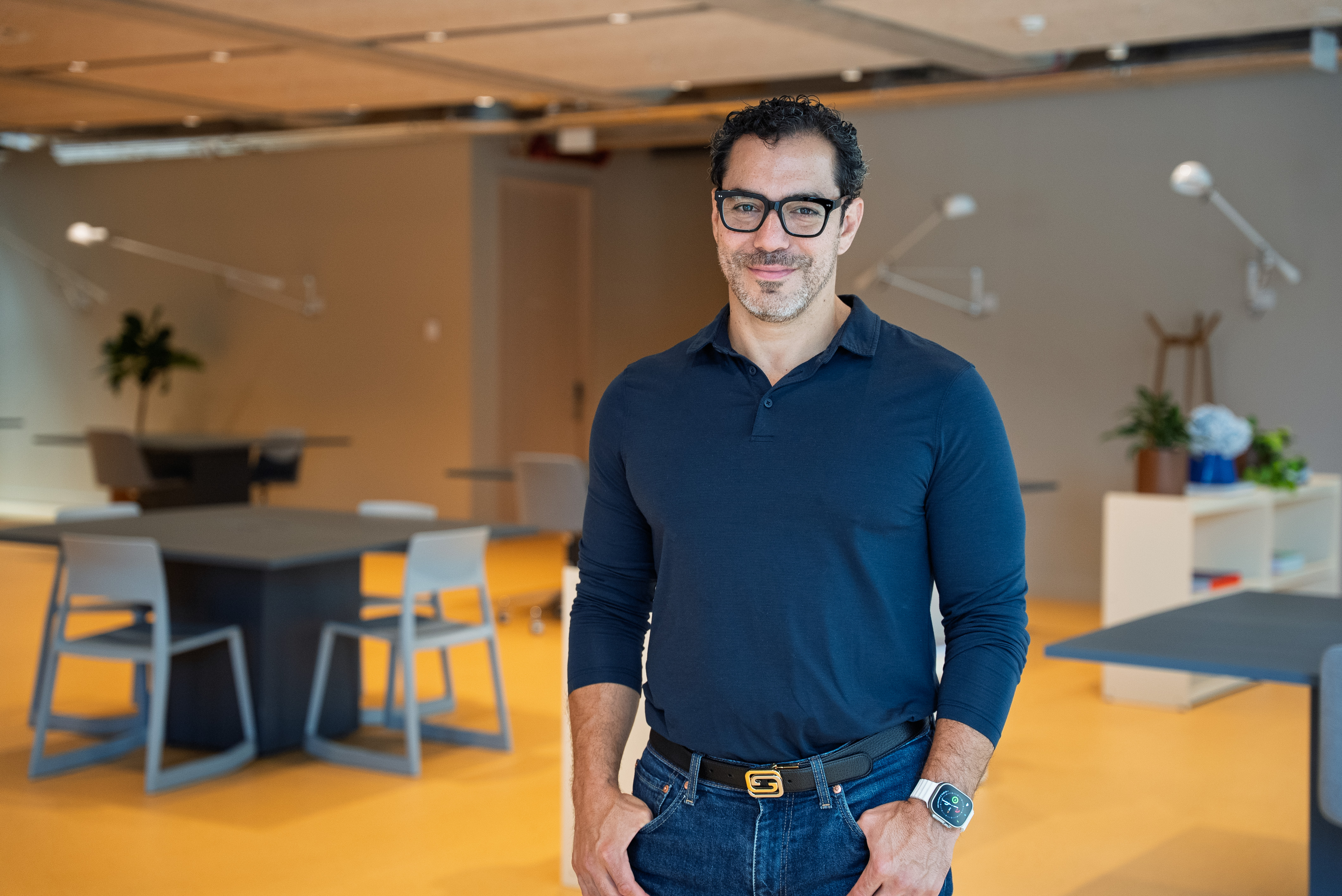
He built a $4.4 billion company out of two months of runway. Now he is building the cash register for AI agents.
PHOTO: Slush / Manny Medina program portrait, 2025
Manny Medina has a habit of showing up where the money is about to change shape. He was an early hand on the team that became Amazon Web Services, back when "the cloud" was a punchline. He turned a dying recruiting marketplace into Outreach, one of the defining sales tools of the SaaS decade. And in 2025 he left Seattle for London with a single, deceptively small question: when an AI agent does the work of a person, who sends the invoice - and for how much?
The name is the whole pitch. Paid does not build AI agents. It builds the layer that lets the people who do build them charge for what those agents actually accomplish. The model has a name - "results-based billing" - and a target it is aimed squarely at: the per-seat subscription, the meter that SaaS has run on for twenty years.
Medina's logic is blunt. If an agent replaces a chunk of work that used to require a human, charging for a "seat" makes no sense - there is no person in the seat. You charge for the outcome. In his framing, agent makers should "start charging for points of margin saved by their customers." Pay the software the way you would pay an employee: by the value it returns.
He arrived at the idea the unglamorous way - by asking. Over several months he interviewed dozens of agentic startups, and the same confession kept surfacing: they did not know what to charge. That gap, between a powerful product and a coherent price, became the company.
If you're a quiet agent, you don't get paid. You need an infrastructure that allows the agent to charge for the additional work.Manny Medina, on why invisible software needs a way to prove its worth
It is a sharp observation. Agents do their work in the background, silently, with no dashboard hours and no desk to walk past. An employee who saves the company a fortune gets a raise. An agent that does the same can vanish into a flat monthly fee. Paid's job is to make that value legible - to track the cost, measure the margin, and turn it into a bill a customer is happy to pay.
Conceptual illustration of Medina's stated thesis, not a market measurement.
The market agreed, fast. Paid raised a roughly $11 million (€10 million) pre-seed in March 2025 from EQT Ventures, Sequoia and GTMFund. By September it had closed an oversubscribed $21.6 million seed led by Lightspeed, with FUSE joining. That is $33.3 million banked before the company has reached a Series A, at a valuation reported north of $100 million. Early customers run from buzzy AI-native names - Artisan, 11x, HappyRobot, VidLab7 - to the enterprise ERP vendor IFS.
Start with the shrimp. Medina grew up in Ecuador - his father Ecuadorian, his mother an immigrant who had come to Ecuador from Russia - and spent his summers on his stepmother's shrimp farm, working the harvest. It is not the usual prologue for a Seattle software founder, and that is rather the point.
He left for New Jersey and a computer engineering degree from the Stevens Institute of Technology, then a master's in computer science from the University of Pennsylvania, and later an MBA from Harvard. The credentials opened doors at the two companies then rewiring how the world bought software. At Amazon he was an early employee on the team that became AWS and built the compensation system for Amazon associates. At Microsoft he spent six years in business development, rising to director for Canada and Latin America.
Then came the part of the story he tells most often, because it nearly ended everything. In 2011 he and three co-founders started GroupTalent, a marketplace for hiring engineers. By late 2013 the marketplace had too few buyers and sellers, and the bank account had about two months left in it.
We were literally two months from going out of business.Manny Medina, on the winter that nearly killed the company before Outreach existed
None of the founders had sold anything in their lives. So, out of pure desperation, they reverse-engineered the problem: to survive, they needed roughly ten times their usual number of sales meetings. They built a tool to automate the prospecting and force-multiply their outreach. It worked well enough to keep the lights on - and then something stranger happened. Recruiters started buying the tool not for recruiting, but to learn how it was pulling a 40% email reply rate when they were stuck at 5%.
That was the signal. Medina asked the question that turned a survival hack into a company: what if they sold the tool to the people whose entire job was selling? In 2014 GroupTalent became Outreach. The thing built to save the company became the company.
From there the arc bends up and to the right. Outreach hit unicorn status in 2019 with a $1.1 billion valuation after a $114 million round, and by 2021 was valued around $4.4 billion, serving roughly 6,000 customers at about $250 million in annual recurring revenue. In 2024, a decade after the pivot, Medina stepped down as CEO and moved to executive chairman - the rare founder who hands off a company he built from the brink.
If there is a through-line, it is the lesson he repeats to founders now: obsess over customers, not code. Outreach was not born from a brilliant architecture diagram. It was born from watching what customers actually did with a tool and following them there. Paid is the same instinct, aimed at a new economy: he listened to agent makers describe their pain, and built the answer.
Founders must obsess over customers, not code.Manny Medina, on the rule he learned the hard way - and applied twice
There is a tidy symmetry to Medina's career. He helped build the infrastructure that made cloud software cheap to ship (AWS). He built one of the tools that made it efficient to sell (Outreach). Now he is building the meter that decides what the next generation of software - the kind that works on its own - is worth. Each act sits one layer closer to the money.
The wager underneath Paid is that AI agents will only become a real economy once they can be paid like participants in one. A vendor that cannot prove its value gets commoditized into a flat fee and squeezed. A vendor that can show, in real time, the margin it saved a customer can charge for it - and keep charging. Medina is not selling the agents. He is selling the confidence to put a price on them.
Whether results-based billing becomes the default or stays a clever niche is unsettled. What is not in doubt is the pattern: Medina has spent his career arriving early at the place where software changes how it gets paid for, and betting the next company on it. He has been wrong-footed before, down to his last two months of cash. He has also, more than once, been exactly right.
Notice what he chose not to do. The obvious play for a founder with an Outreach-sized exit and an AI tailwind would be to build an agent - to ship the shiny thing everyone is racing to ship. Medina went one rung down the stack instead, to the plumbing nobody tweets about: metering, margin tracking, invoices. It is the least glamorous corner of the agent gold rush, which is precisely why it may be the durable one. Pickaxes outlast prospectors.
The geography of the bet is its own tell. Outreach was a Seattle company, born in the Pacific Northwest's enterprise-software bloodstream. For Paid, Medina relocated to London - closer to the European investors who anchored his first checks, and a deliberate distance from the Bay Area echo chamber where every founder is already chasing the same agent. He is not building where the agents are loudest. He is building where they will eventually need to settle their accounts.
There is a reason Medina talks about charging the way he does, and it traces straight back to that GroupTalent winter. When you have been two months from zero, you stop romanticizing the product and start respecting the invoice. The thing that saved his first company was not its elegance - it was that someone, a recruiter, looked at a result and decided it was worth paying for. Value first, cleverness second. That hierarchy is now stamped into the company literally named for getting paid.
It also explains his impatience with the seat. To Medina, the per-user license is a relic of an era when software's value scaled with how many humans touched it. Agents break that assumption - one agent can do the work of ten people or none, and a head-count meter measures the wrong thing entirely. He is not arguing that subscriptions are evil. He is arguing they have stopped describing reality, and that pricing which has stopped describing reality eventually gets replaced by pricing that does.
The unglamorous truth of his career is that he keeps winning by listening longer than is comfortable. Months of customer interviews before Paid existed. A 40% reply rate noticed because he paid attention to who was buying his tool and why. It is not a flashy superpower. It is closer to patience - the discipline to keep asking customers what they actually want until the answer becomes a company.
Early Paid customers cited in 2025 coverage. Funding, valuation and biographical figures drawn from TechCrunch, GeekWire, Sequoia, SaaStock and Paid's own announcements. Figures reflect reporting at time of publication and may change.