On September 11, 2026, a peculiar separation occurred inside the world of 3Commas. Its original trading platform stopped operating. Its bots stopped too. But orders already sitting on customers’ exchanges remained live. The instructions had left the building; the transactions had not. For a company built to relieve traders of constant supervision, the shutdown exposed exactly where supervision still mattered.
- 3Commas connects exchange accounts to trading rules, bots, and analytics.
- Customer funds stay on the exchange; API access still carries trading authority.
- The 2026 successor, built with WunderTrading, requires users to rebuild their strategies.
That distinction is the thread running through the company’s history. Crypto trades around the clock. People have jobs, dinners, and the occasional ambition to sleep. 3Commas emerged in 2017 with a practical proposition: let software perform the repetitive parts of a plan. By October 2026, the proposition survives in a successor platform and an AI strategy product. The machinery has changed; the human problem remains.
The company says the original tool was made for personal use and spread among friends before reaching the public. Its about page lists Yuriy Sorokin, Mikhail Goryunov, and Andres Susi as co-founders. The origin is pleasantly ordinary: a recurring inconvenience became something other people wanted to buy.
The order outlives the bot
The handover is easy to misunderstand as a routine upgrade. The transition instructions describe something more involved: a new v2 account, fresh exchange connections, and strategies rebuilt manually. Funds remain at the exchange. Familiarity with the old interface does not make the new setup automatic.
The successor was built with WunderTrading. Its service terms identify Latvia’s Wunderbit SIA as the provider, operating under a licence from the Estonian owner of the 3Commas brand. This is a useful detail for anyone buying software that acts on money: the familiar name and the company delivering the service can be different entities.
The migration guide supplies the small print that makes the change intelligible. Indicator-driven DCA setups remain DCA Bots. Those triggered by TradingView or an API become Signal Bots. SmartTrade becomes Terminal, with controls spanning multiple accounts, exchanges, and trading pairs. A trader must translate a working habit into a different set of controls.
Closing the automation service does not cancel every order already sent.
A machine for the tedious bits
Consider a hypothetical trader who wants to enter gradually, take some profit at one price, and close the remaining position at another. Doing this manually means remembering the plan while watching the market tempt them to abandon it. 3Commas makes the plan executable. Its expertise lies in order management, exchange integrations, and strategy controls: the plumbing between an intention and a trade.
The tools divide that work. A DCA Bot can add configured averaging orders as a position moves against the trader, changing the average entry price. That also commits more capital. A Grid Bot places orders across price levels, seeking repeated trades within a range. A Signal Bot turns external alerts into instructions. SmartTrade historically gave manual traders coordinated entry and exit controls.
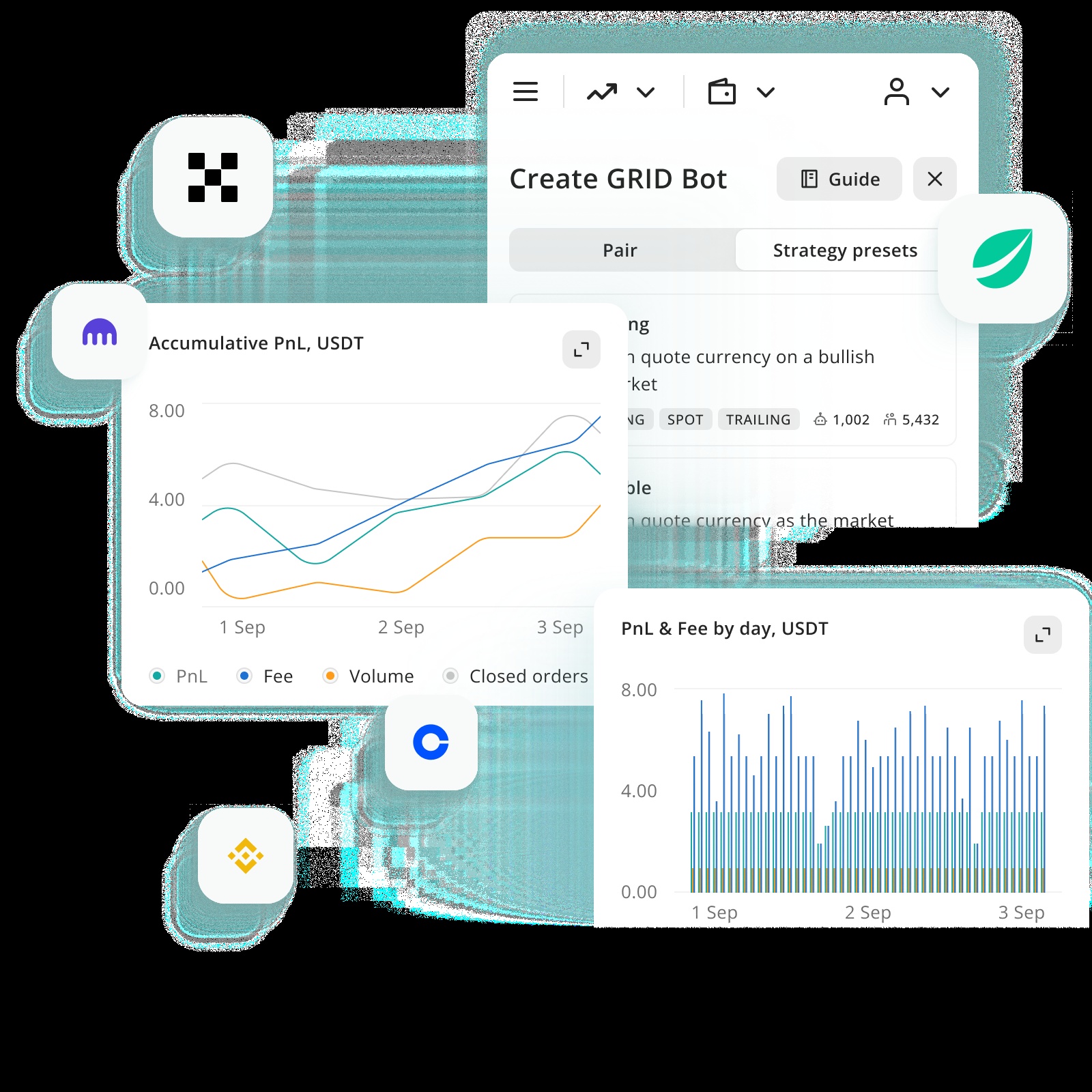
The customer is someone whose desired workflow has outgrown a basic exchange screen. That includes active retail traders, people managing several exchange accounts, and TradingView users with custom signals. The appeal is operational convenience. Exchange-native bots offer a shorter route within one venue; a cross-exchange dashboard offers a common working surface.
Bitsgap and Cryptohopper occupy nearby territory. 3Commas’s combination of configurable averaging, grid execution, signal handling, and manual trade management gives users several ways to express a strategy. Those features are not exclusive inventions. The distinction is how they fit together, and whether that arrangement suits the trader’s existing habits.
The bill behind the button
The business model is subscription software. At the research date, the public pricing page displayed monthly plans of $20, $50, and $140, with lower equivalents for annual billing. The tiers ration active API accounts and bot capacity. The published pricing should be read alongside the transition terms, rather than assumed to describe every migrated customer’s agreement.
Then come exchange fees and the money committed to positions. A grid can produce numerous completed trades without making the entire portfolio profitable. A falling asset can overwhelm the small gains collected inside the range. Averaging into a decline can improve the entry price while increasing the amount exposed. A strategy earns its keep only after those costs and risks are counted.
The same accounting applies to time. Automation reduces repeated clicking; it leaves configuration, monitoring, and exit decisions with someone. A useful practice to copy is to define what happens when the price leaves the intended range before launching the bot. Backtests help examine the rules against history. They cannot oblige tomorrow to resemble yesterday.
The keys changed the conversation
Investors financed the proposition: a $3 million Series A announced in November 2020, followed by a $37 million Series B in September 2022. The latter included Target Global, Alameda Research, Jump Capital, and Copper founder Dmitry Tokarev. Those announcements establish $40 million raised across the two rounds. They establish neither customer profits nor present-day revenue.
Later in 2022, the company’s security explanation failed a public test. In November, 3Commas denied that its API systems had been breached and pointed toward phishing. After credentials appeared publicly on December 28, it acknowledged disclosed API data and asked exchanges to revoke connected keys. Published evidence changed the conclusion.
“Our previous assumptions were wrong.”
3Commas incident FAQ, January 2023
The FAQ described at least 100,000 exposed Binance and KuCoin API keys and secrets. The company introduced isolated signing infrastructure and expanded IP-whitelisting controls. Its own account explains why non-custodial software deserves close scrutiny: keeping funds elsewhere does not make the permission to trade them harmless.
From a form to a conversation
A different obstacle surfaced in the November 2025 AI Assistant announcement. Customers wanted bots but struggled to turn ideas into settings. The assistant aimed to configure DCA strategies, run backtests, and suggest adjustments through chat. Here, the company’s reported customer feedback supplies the reason for changing the interface.
In June 2026, 3Commas opened QuantPilot publicly after reporting more than 5,000 early access traders. The product extends that approach to AI-assisted research, strategy generation, testing, and optimization. Its launch announcement still marked Hyperliquid execution as coming soon. Easier strategy creation is a concrete benefit; successful future trades remain a separate question.
3Commas’s enduring idea is modest enough to be useful: a repeatable decision can become software. Its history adds a condition. Someone must understand the permissions, the exposure, and the handover. The night off is real only when the trader knows what is still working in their absence.