Yuki Kaneko’s route to the chief executive’s chair began with an empty year. After high school, he paused to read and decide what to study. Languages, business and information technology caught his attention. He made a plan: two years learning languages and business, followed by two years of IT. Before there was a company to run, there was a timetable to arrange.
The timing is the interesting part. Someone who would later run a startup first gave himself permission to consider his direction. The ambition to start a business emerged during that interval, alongside the choice of what to learn. A year spent reading does not produce a company on its own. It can produce a better account of what a person wants to attempt. In Kaneko’s case, the next steps were specific enough to put on a calendar. A gap year can look like a blank on a résumé. Here, it supplies the beginning of the plot.
Kaneko is now CEO and co-founder of Tokyo’s ecoeats. The company’s description has widened from food-industry software to AI-powered brand optimization. His own story offers a way into that changing brief: a founder moving between commercial questions and technical possibilities, with education and work sharing the same calendar.
A timetable with more than one classroom
Kaneko studied at Japan College of Foreign Languages from 2020 to 2022, followed by Cyber University from 2022 to 2024. Computing studies at 42Tokyo added another learning environment. An analyst role at Jakore, beginning in October 2020, overlapped with that education. The sequence gives the usual phrase “student entrepreneur” some useful detail: several kinds of work were happening together.
There is an obvious appeal to studying business before building a business. It gives a person words for markets, customers and costs. Computing adds another kind of precision. A proposed feature eventually needs instructions; an attractive commercial idea eventually needs someone willing to use it. Put the subjects beside one another and each can make the other harder to bluff.
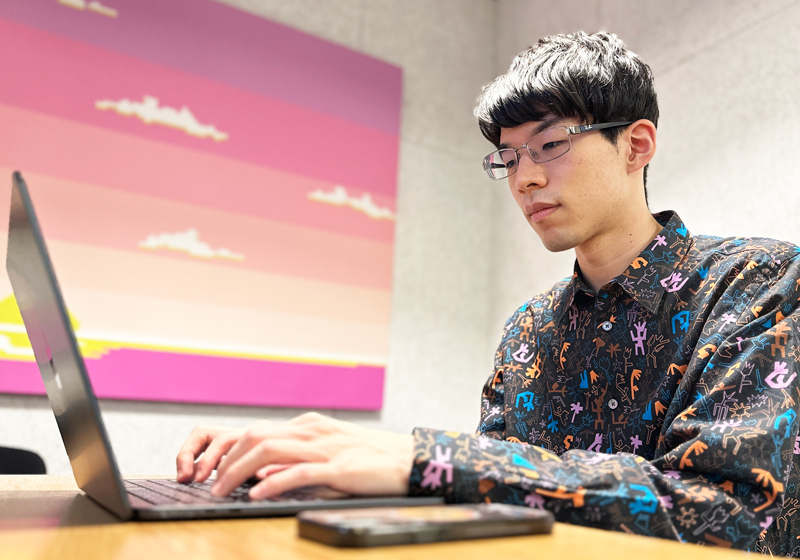
His listed skills and interests add a more informal inventory: front-end development, databases, market research, presentation preparation and English, alongside reading, music and soccer. It is an assortment that brings the technical and commercial parts of an early venture into the same frame. A database and a sales presentation have very different audiences. Someone still has to make them describe the same product.
He also lists Excellence Awards from a SPAJAM hackathon qualifier and Promptson. Those are self-reported entries, belonging to his early practice rather than a later corporate victory lap. His LinkedIn introduction is shorter than most startup pitches: “i love ai.” The capitalization budget appears to have gone elsewhere.
A company gets a date
On October 13, 2023, ecoeats was incorporated. Kaneko took the CEO role; Masaru Tagaya is identified as CTO and co-founder. Kaneko had achieved the goal of starting a food-tech business while still a student. A plan for learning had acquired a second set of obligations: a company, a colleague and a proposition that other people would need to understand.
The date matters because it gives the ambition an edge. Before incorporation, a business can live comfortably in the future tense. Once it exists, even ordinary questions become harder to postpone. Who is the customer? What is being offered? Which piece of work comes next? None requires a dramatic answer. Each requires an answer that colleagues can act on.
- 2020Business studies
Jakore analyst role begins - 2022Cyber University
Computing studies - 2023Antler Japan
ecoeats incorporated - 2024LEAPS
Public demo-day pitch
Selected dated milestones. Study and work overlapped; this is not a measure of business growth.
Antler Japan also appears in his career, with an entrepreneur role listed for 2023. Later came LEAPS, the accelerator run by Quantum Leap Ventures, or QXLV. Those environments make an idea answerable to people beyond its authors. A founder has to carry the explanation out of a notebook and into a conversation where somebody may ask an inconveniently sensible question.
Ten pitches, one food-industry proposition
On July 31, 2024, Kaneko presented ecoeats at the inaugural LEAPS demo day at Google for Startups Campus. Ten entrepreneurs pitched to three judges. The ecoeats entry described software for food manufacturers, using the term food renewability management. That wording places the early business among companies deciding what to make, rather than people deciding what to order for lunch.
It is a useful distinction for understanding the founder’s job. Selling software to a manufacturer means entering an existing working process. There are people responsible for the decision, people supplying information and people expected to carry out what follows. A pitch has to make sense across those responsibilities. The product’s category is only the beginning of the explanation.
Kaneko presents ecoeats at the first LEAPS demo day.
Google for Startups Campus · 10 entrepreneurs · 3 judges
The occasion also preserves an early version of the argument. Companies tend to introduce themselves in the present tense, which can make their histories seem tidier than they were. Keep a dated pitch in view and the development becomes easier to examine. Here was a named founder, addressing a particular industry, at a particular moment. The nouns would later grow broader.
The brief grows wider
Today, ecoeats calls its offering an “AI-powered brand optimization platform.” Its stated aims include helping teams interpret data, taking on recurring reporting tasks and retaining knowledge that otherwise depends on individual experience. Human intuition remains part of the proposition. In the company’s account, AI joins the process of asking questions and considering what to do next.
The shift in language puts a wider explanatory task in front of Kaneko. Food manufacturers name a recognizable audience. Brand optimization can cover several different needs. To become useful in a customer conversation, the broad phrase has to arrive at a specific piece of work. A report? A recurring decision? A question a team keeps circling without resolving?
2024 PITCHFood manufacturersFood renewability management software
CURRENT POSITIONINGBrand teamsAI-powered brand optimization
That is where his combination of business and computing becomes relevant to the story. The commercial explanation and the technical implementation must stay within speaking distance. A demonstration may produce an answer while leaving the buyer unsure how to use it. A persuasive pitch may describe a result the product still needs to deliver. The work lies in bringing the two closer together.
Read this way, the company’s development poses a question rather than supplying a triumphant ending. Can the broader description make the offer clearer for the people it hopes to serve? The answer belongs in the customer’s working day. Founders can choose the language on a website; usefulness has to survive a less accommodating audience.
The people behind the next attempt
Kaneko’s learning extended through people as well as institutions. He used Cyber University’s career support center to discuss plans for starting a company and to meet people with different backgrounds. He also undertook contracted work for an Israeli company. These were opportunities to put technical knowledge and business skills into a setting that could answer back.
His account of those experiences emphasizes learning quickly, applying what he had learned and making corrections. It is a less glamorous description of entrepreneurship than the finished founder photograph suggests. Corrections imply that an earlier attempt needed changing. They also give learning somewhere to happen. A plan can become more useful when somebody else is allowed to question it.
His stated ambitions extend beyond the immediate company pitch. He has spoken of working across industries, developing new technologies and creating environmentally friendly products, with a sustainable future as the larger aim. Those are aspirations, with the long horizon that word allows. The company’s present work offers a nearer place to examine how an intention becomes a practical task.
That difference in timescale gives the story its tension. A founder can describe the future generously; the next piece of work needs narrower boundaries. For Kaneko, his career already contains both: the wish to contribute to a sustainable world and the dated task of presenting food-industry software to a room of listeners.
Food remains on the calendar
The wider AI pitch still has food-sector company beside it. ecoeats announced participation in Japan’s Food-Tech Public-Private Council in January 2026, followed by the Oishii Nippon, Todoketai initiative in February and Shibusawa MIX in March. These are dated organizational steps, keeping the business connected to settings beyond its own product description.
For Kaneko, they extend the pattern already visible in his education and accelerator appearances: taking work into places where other people bring different questions. The company also records his November 2025 appearance at an event co-hosted by SoftBank and Cyber University. The institution that formed part of his student years remained part of his public professional life.
“とりあえずやってみる”
Yuki Kaneko’s advice to prospective students
“Give it a try.” Translated from Japanese.
The phrase is a compact ending for a story that began with time deliberately left open. It permits a first attempt without demanding that the whole route be settled in advance. Kaneko’s route now has a company, a co-founder, a public pitch and an evolving brief. The next version will need the same thing the first one did: something concrete to put to use.