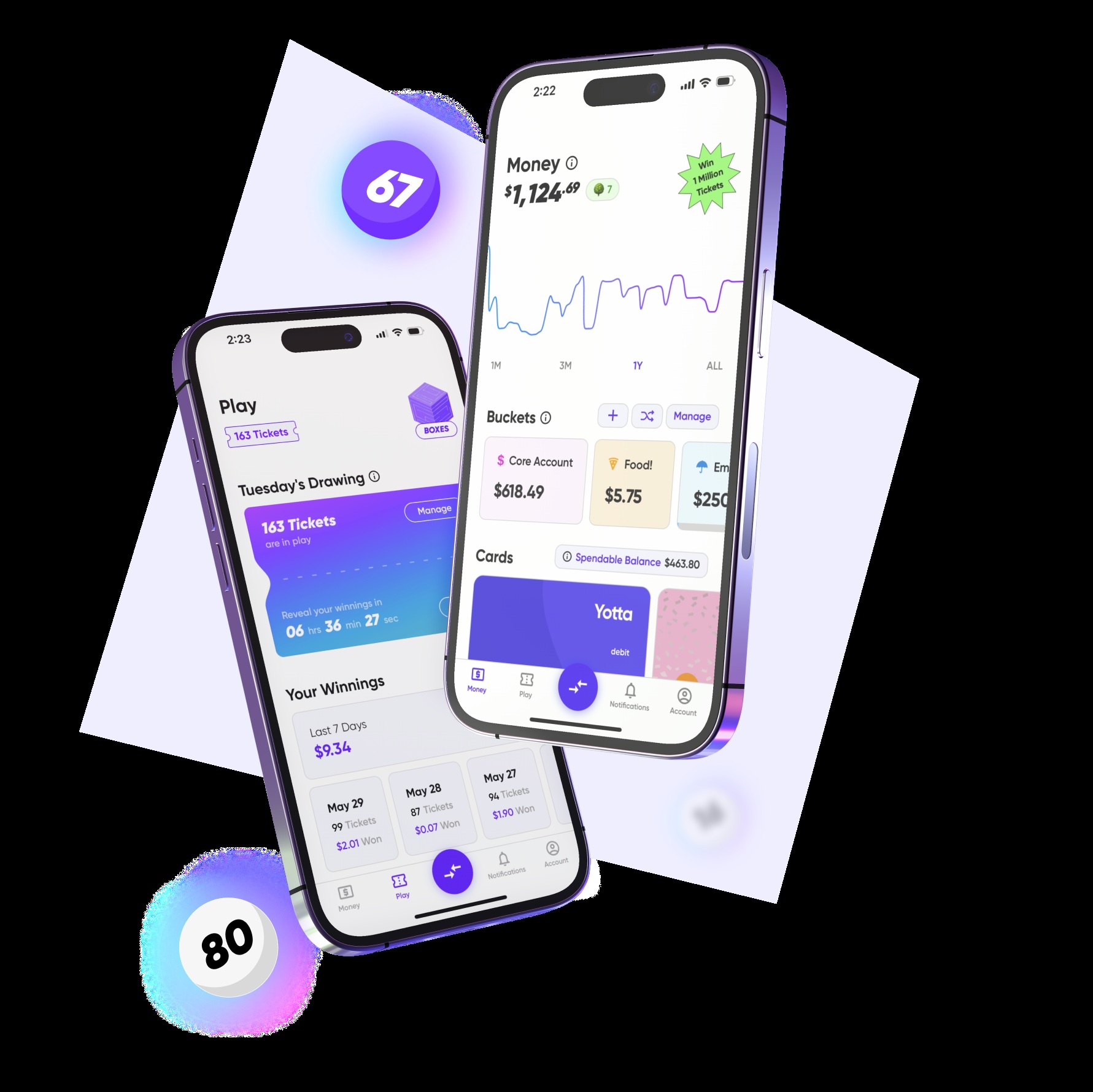
Put $250 into the original Yotta savings account and something curious happened. You still had $250. But you also had ten recurring tickets in a prize drawing. A dull act of restraint acquired a little suspense. The money could sit quietly while its owner imagined a more extravagant future.
That was the elegance of Yotta’s opening proposition: borrow the lottery’s anticipation and attach it to saving. By 2024, however, customers encountered a suspense nobody had signed up for. Their money stopped moving. The app was only the visible end of a banking arrangement whose participants could not agree on the balances underneath.
- Started in 2019 by Adam Moelis and Ben Doyle, Yotta made savings deposits earn drawing tickets.
- Its current business markets recreational games and sweepstakes, with optional Token purchases.
- Former savers’ access broke after Synapse failed in 2024; a California penalty followed in 2026.
A ticket for doing the sensible thing
Moelis had worked at Goldman Sachs and YipitData. With co-founder Ben Doyle, he pursued a problem familiar to anyone who has postponed opening a savings account: prudence offers very little entertainment. Their company, founded in 2019 and launched in 2020, joined Y Combinator’s Summer 2020 batch.
In founder interviews, Moelis cited Britain’s Premium Bonds as an inspiration. The original Yotta mechanic was simple enough to explain to a friend: every $25 deposited earned a recurring ticket. A small savings bonus supplied a predictable component; drawings supplied the possibility of something much larger. The early advertised jackpot was $10 million.
“Playing the lottery is fun.”Adam Moelis, in a Plaid interview
That observation supplied the marketing plan as well as the product. Referrals rewarded both participants with tickets. YouTube personalities could demonstrate the proposition without a lecture about compound interest. In a December 2020 interview, Moelis said referrals had driven almost all growth so far, with influencers becoming another promising channel.
The business behind the suspense
Yotta’s early customers were consumers who wanted a reason to save beyond being told they ought to. The company occupied a peculiar space between the conventional savings account and the lottery. A bank offered predictable interest. A lottery sold a vanishing ticket. Yotta offered recurring anticipation attached to a retained balance.
In January 2021, it announced a $13.2 million Series A led by Base10 Partners, with Y Combinator, Core Innovation Capital and Slow Ventures participating. Its historical business model included deposit-related yield and card interchange. The banking product expanded to include cards, savings buckets and an I-Bonds service. More activity could mean more revenue, but also more operational work.
Some of that work was ordinary payment friction. In a Plaid interview, Moelis described replacing uniform ACH waiting periods with transaction-level risk decisions. He reported that the share of transfers moving through in one business day rose from 10% to 60%. The integration took one or two days, followed by several weeks of observing a small sample.
Here was a practical experiment another operator could copy: start narrowly, measure outcomes and vary the waiting period with the risk. These were Yotta’s reported results, rather than an independent audit. They also addressed a particular payment problem. Faster transfers could not settle a later dispute over whose money was held where.
The company between the company and the bank
To customers, the relationship looked like an app and an account. Behind it sat Synapse, a banking-as-a-service intermediary, and banking partners including Evolve Bank & Trust. Synapse supplied the bridge between financial apps and banks. When that bridge became unusable, an attractive interface had very little to offer.
The warning signs preceded the freeze. California’s 2026 consent order says Yotta moved accounts to Synapse Brokerage around October 11, 2023, despite management’s serious concerns about Synapse’s ability to execute the migration. This complicates the comforting account of a startup simply blindsided by an outside failure. The regulator documented doubts before the decision.
sees the balanceYotta
provides the appSynapse
connects recordsBanks
hold funds
Synapse filed for bankruptcy on April 22, 2024. Payment access unraveled in May. The CFPB later alleged inadequate records and failures to match them with partner-bank records. It described an ecosystem-wide shortfall of $60 million to $90 million. That range covers Synapse’s broader network, rather than Yotta alone.
California’s order recorded at least 18,155 affected Yotta customers in the state, losing access to at least $28 million. In May 2026, the regulator imposed a $1 million penalty for deceptive practices involving safety claims. FDIC protection against a bank failure did not resolve an intermediary’s collapse and disputed records. The distinction was much clearer after customers needed their money.
The game survives; the bargain changes
Today, Yotta’s homepage invites visitors to play games and win prizes. It claims more than one million people, a marketing figure rather than a verified count of active players. Its published terms describe Tokens, which can be purchased but cannot be redeemed for money, and YottaCash, used in sweepstakes games.
Optional Token sales provide a commercial mechanism. Bonus YottaCash and free entry methods sit alongside them. Players can lose YottaCash committed to a game; prize redemption depends on the rules and verification. This is a different proposition from leaving a savings balance untouched while recurring tickets do the entertaining. Current terms describe participation as recreational.
There is also unfinished business. The CFPB allocated $46,248,291 in November 2025 and another $8,965,767 in May 2026 for eligible Synapse victims. Those allocations are not completed repayments, nor are they reserved exclusively for Yotta users. Yotta’s August 31, 2026 update said individual payment timing and amounts remained undetermined.
The detail worth copying
Yotta’s original insight travels well: give an unglamorous habit immediate feedback. It can apply wherever effort arrives long before the reward. Its financial version requires reliable custody, reconciled records and accurate promises. Without those conditions, a reason to check the app can become a reason to fear opening it. The little ticket was clever. The balance required considerably more care.
Follow the two histories
Explore the games, revisit the original idea, or follow the recovery process.