Yoni Tserruya did not set out to become a salesman. This is mildly inconvenient, because the company he built spends its days helping salespeople decide whom to call. His trade was software engineering; his native habitat was the mobile app. Lusha began there, as a side project and a coding exercise, before it became a job, a company and, eventually, a lesson in how thoroughly a useful thing can rearrange the life of its maker.
The problem arrived before the business plan. Tserruya and Assaf Eisenstein saw recruiters struggling to reach people through noisy social networks. They built a tool that made business contact details easier to find. Then salespeople began using it. The founders paid attention to that unscripted vote. What had looked like a recruiting convenience was also a sales product, and perhaps a rather large one.
“I never set out to lead a big company,” Tserruya would later say. “But I kept building, and people kept joining.” It is the sort of origin line that makes ambition sound like weather: one minute there is code, the next a forecast of meetings.
A consumer instinct wanders into B2B
Tserruya brought a mobile developer's assumptions to business software. A product should be simple enough to try immediately. The customer should encounter value before a sales representative appears with a calendar link. If more value is needed, the customer can pay for it. He did not initially know that this self-service habit was unusual in business-to-business software. In mobile apps, it was simply how products behaved.
That accidental innocence became Lusha's growth engine. The browser extension could prove itself in a moment, and free users could become paying customers without a ritual of demos, procurement courtship and polished promises. Tserruya has described the beginning with disarming honesty: the founders did not know that their approach had acquired the respectable name “product-led growth.” They merely built in the grammar they already spoke.
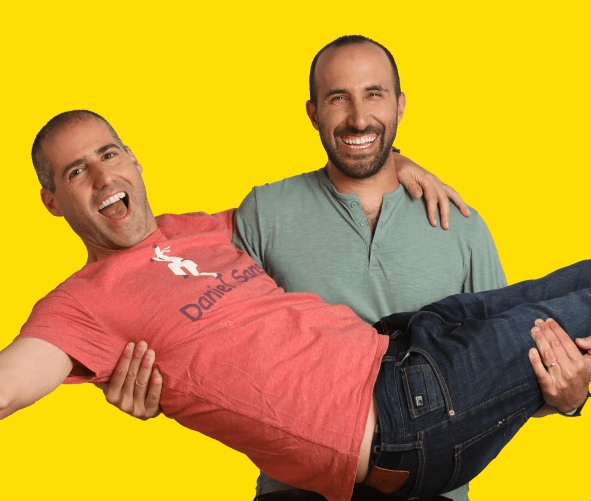
For nearly five years, the company grew without institutional funding. Bootstrapping supplied a strict editor. Features needed to help many customers, not flatter one important prospect. Releases came in small steps. Revenue, not applause, decided what survived. Tserruya once described the experience in physical terms: “When you bootstrap, the laws of physics apply and you immediately feel the weight of gravity.”
“When you bootstrap, the laws of physics apply and you immediately feel the weight of gravity.”Yoni Tserruya
Gravity was profitable. By early 2021, Lusha reported more than 460,000 users and 120,000 customer companies. That February it accepted its first large outside round, a $40 million Series A led by PSG. Nine months later, PSG and ION Crossover Partners backed a $205 million Series B at a reported $1.5 billion valuation. Total funding reached $245 million. The side project had acquired a boardroom.
The founder becomes the bottleneck
Capital enlarged the possibility. Headcount enlarged the problem. In a small company, a founder's attention can behave like a central processor: every choice passes through it, every exception is noticed, every weak signal gets a human interpretation. Tserruya calls it the star model. At Lusha, he found that it stopped working somewhere in the climb from roughly 70 people toward 150.
The company tried the grown-up equipment, including objectives and key results. Some of it helped. Some of it taught people to optimize for the stated goal instead of the reason behind it. Experiments began to feel dangerous. A system designed to align the organization risked sanding away the curiosity that had created it.
Tserruya's correction was neither anarchy nor another dashboard. He became more interested in context. If everyone could see the same destination, he reasoned, teams could make local choices without waiting for the founder to bless each turn. He compared a clear vision to a magnet: the organization moves toward it without being pushed through every inch.
Here sits his most useful paradox. Instinct matters because a founder can feel distinctions that an operating manual misses. Yet instinct cannot be delegated. A company organized around one person's intuition has confused a gift with an infrastructure plan. “Instinct is critical for a founder,” Tserruya says. “But instinct doesn't scale.”
He remains suspicious of the corporate playbook for a related reason. Follow every best practice and a company may become a tidy average of its peers. His alternative is selective disobedience: let ordinary work benefit from established methods, but protect one, two or three consequential choices that the company makes in its own way. Character, in business as in people, is usually found in the exceptions.
The five percent and the human remainder
Lusha's product has also been learning to let go of an old form. Contact data once sat like a telephone directory with better filters. Tserruya now describes the useful product as a stream: hiring changes, funding events, web activity, job moves and other signals that suggest when a company may be ready to buy. His recurring figure is 5 percent. At any moment, he says, only a small share of a market is prepared to act.
Sending more messages to the other 95 percent is a poor substitute for timing. Tserruya calls manual prospecting a tax, work that consumes a seller's day before the selling starts. In his preferred future, software digests signals, scores possibilities and prepares the short list. The human begins closer to the conversation.
The market, according to Tserruya's rule of thumb
The strategic question is not how loudly to pursue everyone. It is how accurately to recognize the moment.
At EvoLusha 2026, the company presented two layers for that future. A search layer supplies verified business data and live signals to the tools where teams already work. A deeper layer learns from a customer's own market, CRM and history to rank accounts and explain why they matter. The database is becoming less a destination than a current running through other software.
The change also alters where Lusha expects to meet its users. Tserruya has been pushing the company's data into APIs, automation platforms and AI assistants rather than asking every customer to begin inside a Lusha screen. In August 2026, he said the system was processing more than 1.2 billion B2B data points each day across more than 300 million verified profiles, with seven predictive models and 24 buying signals. These are company-reported figures, but the direction is plain: the product wants to travel, and to arrive before the seller asks for it.
That same month, Lusha published 17 go-to-market workflow “skills” that had previously been kept internal, covering such jobs as account intelligence, pipeline risk and customer health. Tserruya framed the release as a change of mind. The company had treated its workflows as a private advantage; now it wanted verified data to become the base material from which other teams built. For a business that once won by pulling information into a browser extension, giving away the method while distributing the data everywhere is a revealing inversion.
Tserruya's embrace of AI comes with a boundary. Lusha reported in 2026 that 96 percent of its roughly 330-person team used AI daily. He wants some tasks automated end to end, but argues that a human in the loop preserves judgment and original thinking. His public writing about sales makes the same distinction. Machines can remove research and clerical drag. A complicated enterprise deal still asks someone to read a room, answer the objection nobody predicted and earn trust over time.
The distinction is not sentimental. Simple deals with short cycles can absorb more automation; complex purchases gather committees, procurement rules and anxieties that refuse to fit neatly inside a score. Tserruya's position is that AI can narrow the field and improve the timing, while people handle the unstable territory after contact begins. The machine finds the door. It does not know, by itself, how the room feels.
“If you follow best practices across the board, you end up with average practices.”Yoni Tserruya
A company and four children grow up
The decade has a domestic clock too. Tserruya, 41 when he discussed the story in spring 2026, is a father of four. His children and the company, he said, have basically grown up together. It is a compact description of founder time: product releases and school years, hiring plans and family calendars, each making the other look impossibly fast.
His career has moved from writing the instructions himself to explaining why the instructions exist. The engineer is still visible in the way he talks: find the friction, isolate the waste, improve the system. But the CEO's hardest system contains people, ambiguity and the troublesome fact that tomorrow's correct answer may contradict yesterday's best practice.
Lusha began by helping strangers find one another. Tserruya's later work is concerned with deciding when that connection is worth making, and with building a company capable of that decision without routing it through him. This is the quieter second act of entrepreneurship. The product grows up. The founder has to do the same.