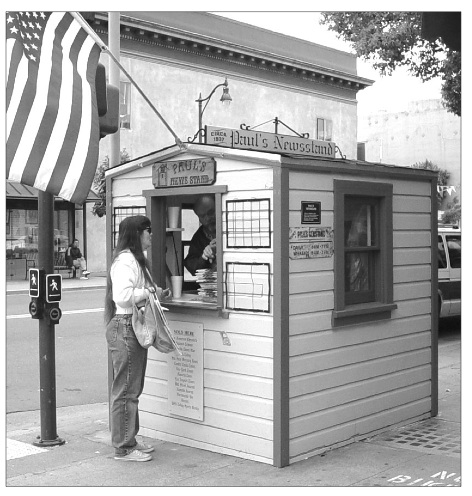
A newsstand is a wonderfully literal answer to an advertising question. Where do people look? Here, at this corner, beside the crosswalk, on their way somewhere else. In Alameda, Paul’s Newsstand offered precisely that kind of answer. When volunteers restored it in 2006, West Advertising contributed preliminary computer designs showing what the little structure could become.
The agency’s principal, Pete Halberstadt, was involved in the physical work too. Pete, Carol Halberstadt and a friend helped remove the later vertical siding. Beneath it was the original horizontal siding. The project brought together preservationists, volunteers and the city; the restored stand was dedicated that August.
It is a useful opening scene for a company whose work depended on a particular place. Advertising can look disembodied: a slogan, a picture, a passing interruption. A newsstand insists on geography. Somebody has to walk past.
A business measured in nearby people
West began in 1988 and worked from Alameda’s downtown Park Street district. Its stated focus was Northern California businesses selling to consumers. The service menu stretched from television and radio advertisements to direct mail, email, websites, search marketing and reputation management. That breadth puts it in the regional full-service agency market: a place where a client can bring several connected problems to one firm.
Consider a hypothetical retailer. A promotion needs an idea, artwork, a place to run and a page that explains the offer. Each component can be purchased separately. The retailer then becomes the person responsible for making the components agree. An integrated agency offers to take on that coordination.
West’s automotive and retail expertise fits that practical world. A local business wants people within reach to recognize an offer and do something with it. A television spot can introduce the message; a search result can help someone find the business later. Those are different moments in the same person’s day.
This is the clearest way to understand West’s positioning. Its offering combined regional familiarity with several kinds of execution. The attraction was a shorter chain between deciding what to say and getting it into circulation. Whether that arrangement is worth paying for depends on how much coordination the customer actually needs.
The $200,000 question
One assignment makes the economics visible. In June 2008, Alameda County approved a $200,000 agreement with West for public awareness of changed citizenship-documentation requirements affecting Medi-Cal applicants and recipients. The agreement ran from June 17, 2008, through January 31, 2009.
The planned split was $25,000 for production and translation, and $175,000 for media. West would retain 15% of that media budget. The plan called for a 30-second commercial and targeted five languages: Spanish, Farsi, Cambodian, Vietnamese and Chinese. These were the terms of one historical commission.
Total contract ceiling
The arithmetic is revealing. Seven dollars went into the media allocation for every dollar assigned to production and translation. That is a useful corrective to the temptation to treat the finished advertisement as the whole purchase. A polished message still needs repeated opportunities to meet its audience.
For a buyer, the distinction matters before the creative meeting starts. If the production bill consumes the money needed to distribute the result, the campaign has acquired an expensive bottleneck. The sensible brief asks how much to spend making the message, how much to spend carrying it, and what the agency earns within those amounts.
The unglamorous part was in the agreement
The county’s requirements extended to expenditure tracking, verification of placements and credits for media that did not deliver. West was selected after two vendors responded, with DuDell and Associates also in the process; the county cited West’s ability to satisfy the criteria within budget.
That account gives “expertise” a more useful meaning than an adjective in a sales pitch. Someone needs to know how to commission creative work. Someone also needs to know what a media seller promised, what ran, and what to do when the two differ.
The finished ad is one deliverable. Knowing what happened to it is another.
An editorial reading of the campaign brief
For anyone copying the approach, begin with an observable action. Should the audience call, visit, read instructions or recognize a name? Then choose the places where those people can reasonably encounter the message. Finally, decide what evidence will show that the purchased exposure arrived. The sequence is simple enough to write on one page. Keeping all three parts connected is the work.
Two logos, a small office, many hats
Public information work continued to appear in West’s record. An April 2019 City of Alameda Health Care District board packet presented two logo options developed by the agency, under an update on branding and website development. It is a modest, specific example of what clients bought: proposed identities they could review and choose between.
A logo assignment asks a different question from a media buy. An institution needs to be recognizable before it can become familiar. Presenting alternatives turns an abstract discussion about identity into a decision about something people will actually see. West’s range allowed it to participate in that earlier part of the communication process as well.
Historical employee accounts give a glimpse of how such a range might be managed. A 2016 anonymous Glassdoor review described a family-owned business where employees learned across roles and followed shared procedures. A 2018 review emphasized independence and opportunities to take on new assignments. These are individual recollections, but their overlap is interesting: variety required organization.
That relationship is easy to underestimate. An agency offering many services needs people who can move between tasks without losing track of approvals, schedules or versions. The glamorous artifact may be the advertisement. The enabling artifact may be the procedure everyone agrees to use.
Thirty-five years, then a short message
West’s connection to its surroundings also had an operational expression. Downtown Alameda included it among eleven certified green businesses in a 2018 article. The agency’s own profile described a commitment to conserving energy and resources. Alongside the newsstand contribution, that places West inside the ordinary civic life of its business district.
The company’s website now carries an exceptionally brief retrospective: “35 years in the field,” beneath the dates 1988-2023. The surviving page invites a historical reading of the business. Its long service list describes what it offered during that span.
There is a useful limit to the lesson. Coordinating several channels makes sense when the audience and assignment require them. A business with one narrow task may be better served by a specialist. A campaign without a clear action can multiply its confusion across every medium it buys. More services on a proposal do not automatically make the proposal more appropriate.
What remains useful in West’s record is the habit of specificity: a named audience, an actual budget, a reviewable design, a check on delivery. And, occasionally, a computer rendering of a tiny wooden building at a familiar intersection. Before there is an advertisement, there is a person somewhere who might look up.