A truck can be young and already have a succession problem. The paint is fresh. The battery is charged. The company that built it has a persuasive founder and an international itinerary. A fleet owner still has a question: what happens when a part breaks twelve years from now?
Wen Han has started putting his answer online. In September 2026, Windrose, the electric truck company he founded in 2022, made engineering models for 1,023 components of its E700 base vehicle publicly available. Customers could inspect a machine that would ordinarily arrive with rather more of its workings kept behind the curtain. A bracket, it turns out, can carry quite a philosophical burden.
For Han, the decision reaches beyond a library of files. It touches the basic bargain between a young manufacturer and someone buying an expensive working vehicle. He wants customers and independent workshops to have enough information to repair trucks without depending entirely on the manufacturer's continued attention. Selling a vehicle commits a business to a future much longer than its next fundraising round.
“Our trucks should outlive our ability to support them,” he wrote. It is an unusual ambition for a founder to state so plainly. Most company stories invite the audience to picture the organisation growing forever. Han has invited his customers to consider how the product might carry on without it. That is a useful place to begin understanding him.
“Our trucks should outlive our ability to support them.”
Wen Han · on opening the engineering files
A route through other people’s worlds
His route into manufacturing passed through institutions better known for moving money. At Williams College in Massachusetts, he studied mathematics and economics; a 2012 college announcement lists him among the students elected to Phi Beta Kappa at the end of their junior year. His hometown appears as Taiyuan, China. The future truck founder was acquiring a rather different set of tools.
He grew up in Shanxi, a Chinese province associated with coal. School took him to the United States, where he lived with a Mexican host family and learned Spanish. Later study abroad included Spain and France. These are concrete details behind the international biography: different households, different languages, and repeated practice in being the person who has arrived from somewhere else.
Bridgewater Associates came next, from 2013 to 2016, followed by an MBA at Stanford. He worked at GSR Ventures in 2018 and 2019. The sequence put him on several sides of the table: studying companies, investing in them, and eventually taking responsibility for one. A founder who has watched capital being allocated has at least had an opportunity to study the questions he will later have to answer.
The decisive introduction to trucking came at Plus, where he served as chief strategy and financial officer from 2019 to 2022. The company worked on autonomous driving. His biography credits him with raising more than $380 million there, with investors including Amazon and Full Truck Alliance. Trucks had become a business he knew from the inside, before he set out to build one himself.
Finance meets the loading bay
Han founded Windrose in March 2022. His co-founder, Haoli Chen, brought experience from the truck industry, including a senior technology role at Chinese manufacturer Dayun. That combination matters. A financing background does not confer the ability to engineer a chassis. The venture paired Han's experience with capital and strategy with a colleague's experience making heavy vehicles.
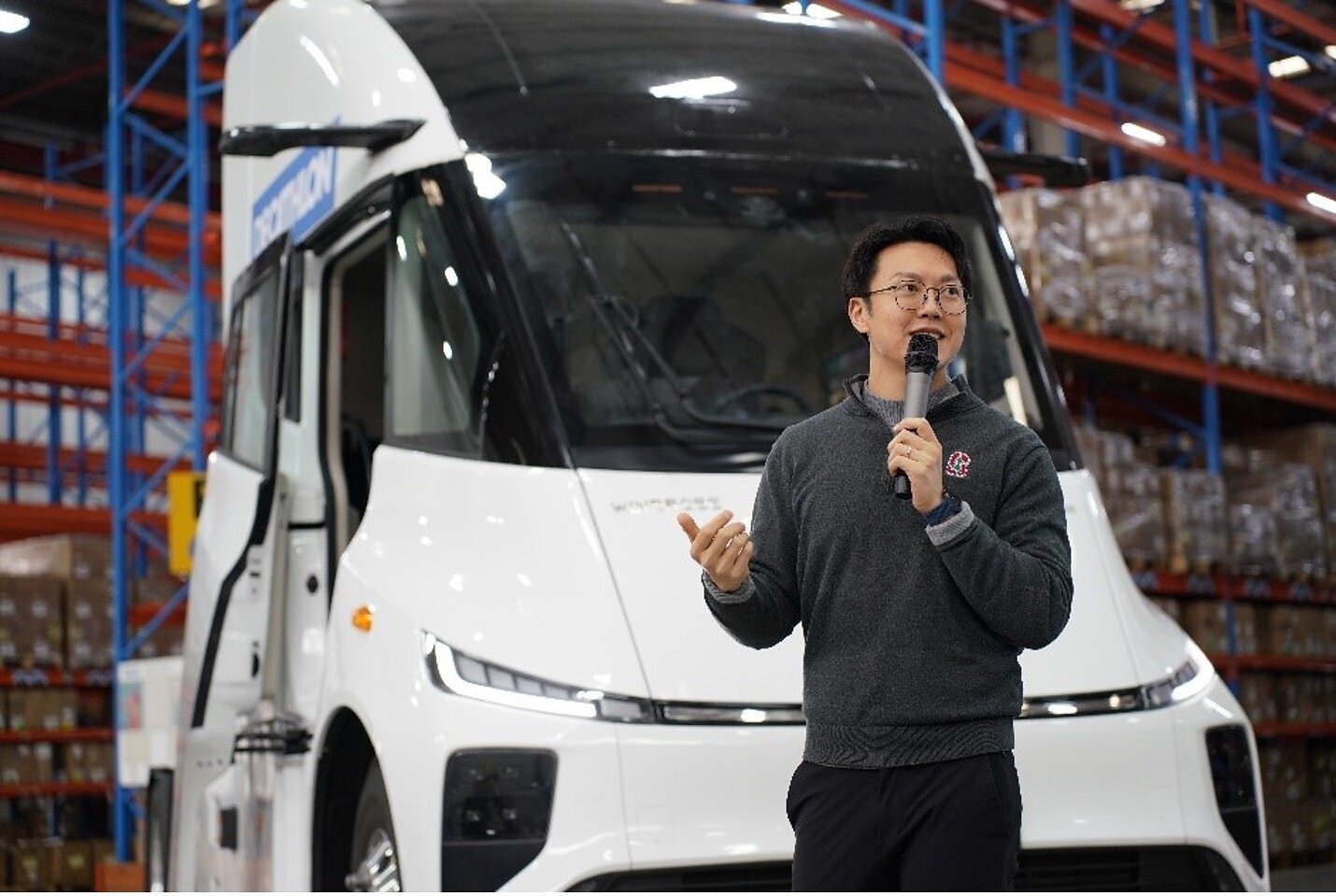
The early work was physical and unglamorous in the way useful industrial work often is. In 2023, Windrose announced that its truck had completed forty days and more than 10,000 kilometres of high-temperature and high-altitude testing with Decathlon and Rokin Logistics. The programme included loaded operation, climbing, braking and charging. A warehouse schedule is an exacting audience for a new idea.
Decathlon supplied a particularly practical connection between the ambition and its intended use. Sports equipment needs to travel whether or not the delivery vehicle has an interesting founder. Rokin supplied logistics experience. These relationships placed the truck close to customers who would judge it by whether it could do the work, rather than by how pleasingly it photographed beside a charging cable.
By April 2024, Windrose announced a $110 million Series B round. Participants included HSBC, HITE Hedge Asset Management and Goodman. Part of the financing was bank debt. The money was intended for testing, deployment, production capacity, supply-chain work and charging infrastructure. Even the list of spending priorities shows how many businesses a truck startup must learn to coordinate.
Han's job, increasingly, was to connect those businesses. A vehicle needs components. Components need suppliers. A fleet needs somewhere to charge and someone to call when the vehicle stops working. The founder's pitch has to survive all of these meetings. A handsome cab may open a conversation; the workshop and the electricity bill tend to keep it going.
The border is part of the design
Windrose's headquarters are in Antwerp, Belgium, while its manufacturing approach draws on China's electric vehicle supply chain. Han has spent years discussing how to connect those strengths with customers elsewhere. His own biography crosses China, the United States and Europe. The company's operating problem follows much the same map, with considerably more paperwork.
In a January 2025 interview, he described a staged European approach: import trucks first, assemble imported components locally next, and eventually manufacture additional components in Europe. The order is revealing. International expansion consists of distinct industrial steps, each requiring more local capability. Announcing a destination and having a functioning production line there are different milestones.
That distinction remains relevant in the United States. In May 2026, Windrose described plans to use Aertssen Logistics facilities near Savannah, Georgia, and Tacoma, Washington, for final technical assembly, battery integration and quality checks by the end of the year. The arrangement was a plan with a timetable, rather than evidence that those assembly operations were already running.
The company has also had to explain how its ambitions fit a less welcoming political climate. Han's life was shaped by movement between China and America; his business now encounters arguments about how much of that movement governments should permit. Batteries and components can be specified on a drawing. National identity is harder to put in a bill of materials.
The immediate commercial question is more local. Who supplies the truck? Who services it? What happens to the route when a charger is unavailable? In June 2025, Windrose and Terawatt announced charging tests in California using two 350 kW chargers together, delivering more than 650 kW. The collaboration also included software integration. Getting electricity into the vehicle was becoming a joint operating task.
A vehicle reaches the customer through several organisations. Keeping it useful requires them to cooperate.
A basketball club, and a different scoreboard
Antwerp has given Han another public role: director of Windrose Giants Antwerp, a basketball club with men's, women's and youth programmes. In a 2025 interview, he talked about discovering basketball in China and becoming more absorbed in it while attending school in California. He followed the Lakers in the Shaquille O'Neal and Kobe Bryant years.
His favourite player, he said, was Stephen Curry. He admired the evidence that a relatively small player could dominate in the NBA. There is a ready-made business metaphor available here, but basketball deserves a little time off from being recruited into management theory. Sometimes a founder simply has a favourite player.
He did bring an executive's targets to the club. He wanted the Giants to become the best team in the Benelux and to matter in European competition. The ambitions were explicit, as they are in his truck business. Sport adds a welcome complication: the opposition also gets to participate in the plan. The scoreboard is refreshingly unwilling to read a strategy deck.
Paying for the next set of questions
Education is another recurring commitment. Han and his wife, Jessie Jia, pledged $15 million to establish a fellowship at Stanford supporting students in a joint programme involving its business and sustainability schools. For someone whose career moved between investing and industrial technology, the pairing has a particular logic: students working across disciplines that his own business asks to cooperate.
Kettering University announced a $1 million gift in February 2025 from Han and Jia on behalf of Windrose. It supported scholarships and an endowment connected to sustainability, manufacturing and mobility. Jason Roycht, a Kettering alumnus then working with Windrose, helped develop the relationship. The connection grew through a person who knew the institution, rather than through a university name on a presentation slide.
“Sustainability is the key mission of my career,” Han said in the university's announcement. The gift put money behind that statement and extended the work beyond his own employees. Scholarships operate on a different clock from product launches. A student may take years to reach the problem a donor hopes they will help solve.
Han and Jessie Jia · 2024
Han and Jessie Jia / Windrose · 2025
Leave the drawings on the table
The public engineering files bring the story back to the customer who is thinking ahead. Han's stated terms allow service, repair, replacement parts and modification without a fee or individual permission; manufacturing complete vehicles from the designs requires an agreement. The distinction preserves a commercial business while offering independent repairers more of the information needed to do their work.
Publishing drawings cannot by itself create a dependable service network. Workshops still need skills, equipment and parts. A design file does not answer the telephone or recover a stranded vehicle. Its practical value will emerge when people use it, including people outside Windrose. That makes the initiative an invitation to scrutiny as much as a statement of confidence.
There is a recognisable thread through Han's career: a willingness to enter a field through one doorway and keep walking into the next room. Mathematics led toward markets; finance led toward autonomous trucks; trucking led toward manufacturing, charging and repair. The rooms have become larger, and the obligations have become heavier.
For a founder, the opening sale is an occasion worth celebrating. For the owner, it begins years of maintenance, invoices and deliveries. Han's most interesting recent proposition gives that owner a longer view. Somewhere in the future, a workshop may need a drawing for an ordinary part. He is trying to make sure someone has left it on the table.