A business card has a small job: say who you are, make an impression, and survive long enough for someone to contact you. Give that card a browser window and the assignment expands. Now it must explain the offer, answer questions and point a stranger toward a useful next step. Website Designer, the business linked to Web Design Carnival, builds its public pitch around that familiar object. The metaphor is modest. The work it implies is substantial.
The company describes its offering as web and graphic design, with WordPress at the center of its website proposition. Its language connects appearance to business purpose: a site should look considered, function sensibly and support the customer’s ambitions. Read that as a design brief, and a useful question emerges. When a visitor has finished admiring the page, what exactly should happen next?
A business card with somewhere to go
“Your website is your online business card,” says the company’s public description. That tells us more about the intended buyer than a parade of technical terms would. The pitch addresses a business that needs to introduce itself professionally and give prospective customers a reason to continue the conversation. It puts the commercial introduction ahead of the machinery.
Consider a hypothetical consultant with a service to explain, or a small firm with work to show. The visitor needs an intelligible offer, enough evidence to judge it, and a way to ask for help. Those are editorial and design problems as much as programming problems. The right photograph cannot rescue an incomprehensible service description; a clear description still needs somewhere sensible to live.
Website Designer’s combination of web and graphic design suits that kind of brief. The appeal is the possibility of discussing the appearance of the business and the structure of its website together. A customer can start with what they want to communicate, then work toward the pages and visual materials that communicate it.
“Your website is your online business card”
Web Design Carnival’s public company description
The work hiding behind the homepage
The company’s WordPress description emphasizes functional design and code that is clean, secure and optimized. These are stated priorities. For a buyer, their value comes from translating each word into an observable result. “Functional” might mean a contact form that reaches the right inbox. “Optimized” needs a defined test, a defined page and an agreed expectation.
Graphic design belongs in the same conversation because a website contains a collection of visual decisions: image treatment, typography, spacing, color and the relative importance of competing messages. A business owner may arrive asking for a homepage and discover that the harder question is which part of the business deserves the most attention.
Antspath also lists marketing strategy, content marketing and social media marketing among the business’s services. That broadens the advertised conversation beyond page construction. A practical buyer should treat each activity as a deliverable with its own boundaries. Writing a service page, planning a campaign and maintaining a website involve different work, even when one provider discusses all three.
A designer’s trail through Dhaka
There is a human connection behind the business’s generic listing name. Tanmoy Biswas’s Behance profile identifies him as a web designer and WordPress expert, lists Web Design Carnival, and gives his location as Dhaka, Bangladesh. His visible projects include a business WordPress website and a foreign-exchange trading blog website. Those project types suggest an interest in both business presentation and publishing.
Biswas’s own description offers a more personal account of the work: “I also consider the websites of clients as if they were mine.” It is a statement of attitude, and an understandable one in commissioned design. The designer must spend enough time with another person’s business to decide what deserves a headline, an image or a prominent button.
Sky Dream IT’s public material supplies another connection: its portfolio has listed Web Design Carnival, and its media library contains a presentation of the Carnival website. Sky Dream IT identifies Biswas as its founder. The portfolio connection gives readers a concrete visual artifact to examine, alongside his account of the craft.
Four screens, one invitation
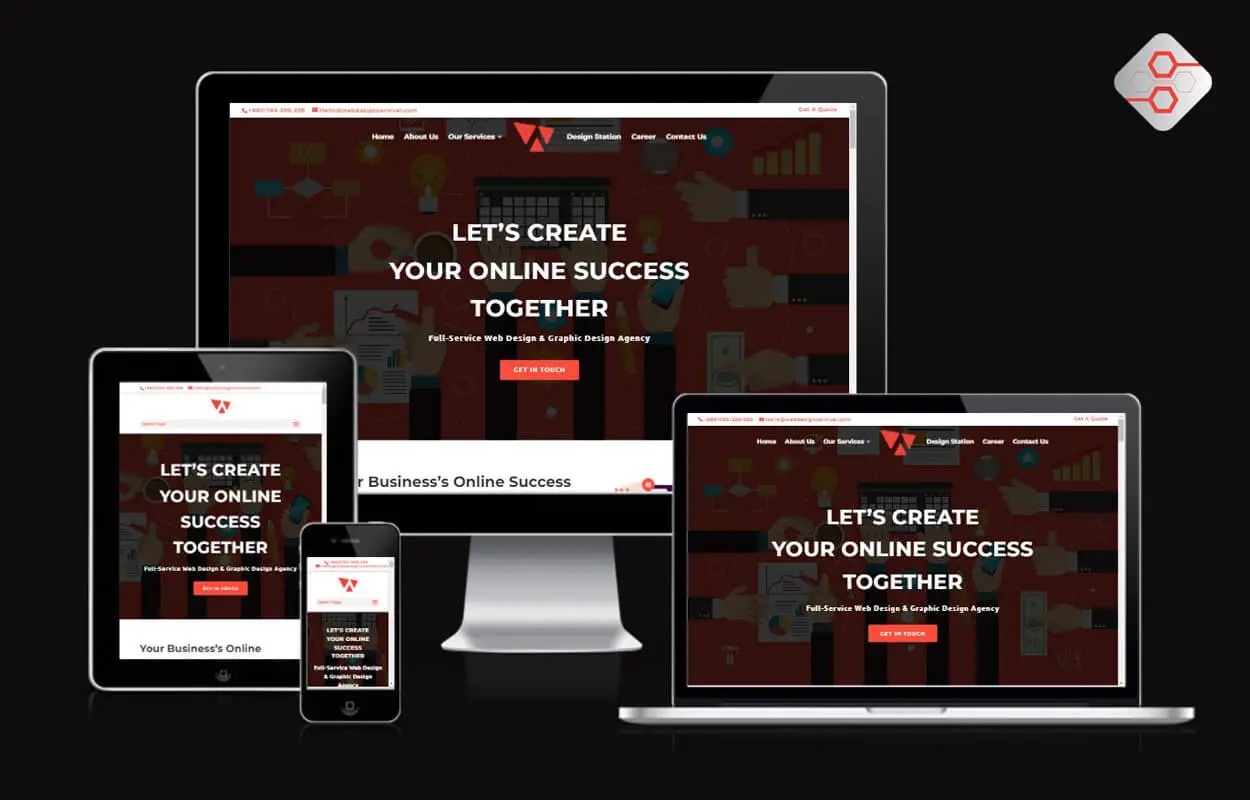
The mockup is a small device family portrait: desktop monitor at the back, laptop to one side, tablet and phone out front. Across the screens, the site repeats a red visual identity, a large invitation to create online success together, and a contact button. The arrangement makes consistency the subject of the picture.
It also demonstrates the difference between a visual presentation and a working-site review. The picture lets a reader inspect hierarchy and message. To evaluate an actual website, a customer would still need to open the pages, follow the navigation and try the contact route. That is a useful distinction whenever a design purchase begins with attractive screenshots.
The strongest visible choice is the invitation. The visitor is being asked to begin a conversation. In an agency website, that button has a clear commercial role: it connects the introduction to a potential project. For another business, the equivalent action might be requesting an estimate or viewing a service. The principle is easy to borrow; the wording should fit the customer.
Free software, paid decisions
WordPress is open-source software that businesses can use and modify, including for commercial projects. Its publishing features include pages and posts, media management, revision tools and different user roles. Themes shape presentation, while plugins can add capabilities. For a business website, that provides an existing foundation on which design work can be built.
Website Designer’s commercial position is therefore best understood as a service business. A customer is paying for the work of turning a brief into an appropriate site and visual presentation. The software’s availability does not decide the page structure, select the right images or resolve a disagreement about what the homepage should say.
The meaningful alternatives are other agencies, an independent WordPress designer or a business undertaking the build itself. The choice depends on how much work the buyer can specify, produce and maintain. Someone comfortable making design decisions may want help with implementation. Someone still sorting out the offer may need a more involved creative conversation.
For budgeting, separate the initial design and build from hosting, a domain, optional paid software and future work. These are categories to clarify in a quotation, rather than a price promise from Website Designer. A useful quote makes the first deliverable legible and gives the owner a way to understand the cost of keeping it useful.
Editorial buying framework. Items depend on the agreed scope.
The website after the screenshot
The next test arrives when somebody needs to change a sentence. WordPress supports routine publishing, but the experience of editing a particular site depends on how that site has been assembled. A sensible handover exercise is wonderfully ordinary: ask the future editor to update a service description and replace an image while the designer is available.
Ownership also has an operational side. WordPress’s backup guidance explains that a typical site needs both its files and its database to be fully restored. A folder of pictures alone is not the whole website. Asking who keeps the backups, where they are stored and who can restore them turns an abstract maintenance discussion into named responsibilities.
Security is ongoing work too. The WordPress project issues fixes for vulnerabilities and distinguishes between its core software and the wider plugin and theme ecosystem. A business commissioning a site should establish who handles updates and how changes are checked. The agency’s stated interest in secure code belongs in that longer conversation about operating the finished site.
A brief the customer can actually use
The lesson a reader can copy from Website Designer’s positioning is to begin with the introduction. Write one sentence explaining the business, one identifying the visitor, and one naming the action the website should encourage. Then assemble the evidence that makes the offer believable. This is an editorial exercise a buyer can do before selecting colors or arguing about a slideshow.
Keep the scope proportionate to the job. A straightforward business presentation can begin with a small set of well-considered pages. A service involving complex permissions, transactions or unusual integrations needs a more detailed technical brief. The business-card metaphor earns its keep at the introduction; the requirements of the actual service should determine what gets built behind it.
The useful outcome is easy to describe. A visitor understands the offer. The next step makes sense. The owner can keep the information current. Website Designer’s public pitch points toward those ordinary, consequential tasks. For the business buying the website, they are also a much better basis for the final review than whether everybody likes the shade of red.