The Dog Door That Doesn't Cut a Hole in Your House
Two brothers-in-law on a ski trip did the math on dog boarding and decided the sliding door most homes already have could do the job of a pet door - if only it could open itself.
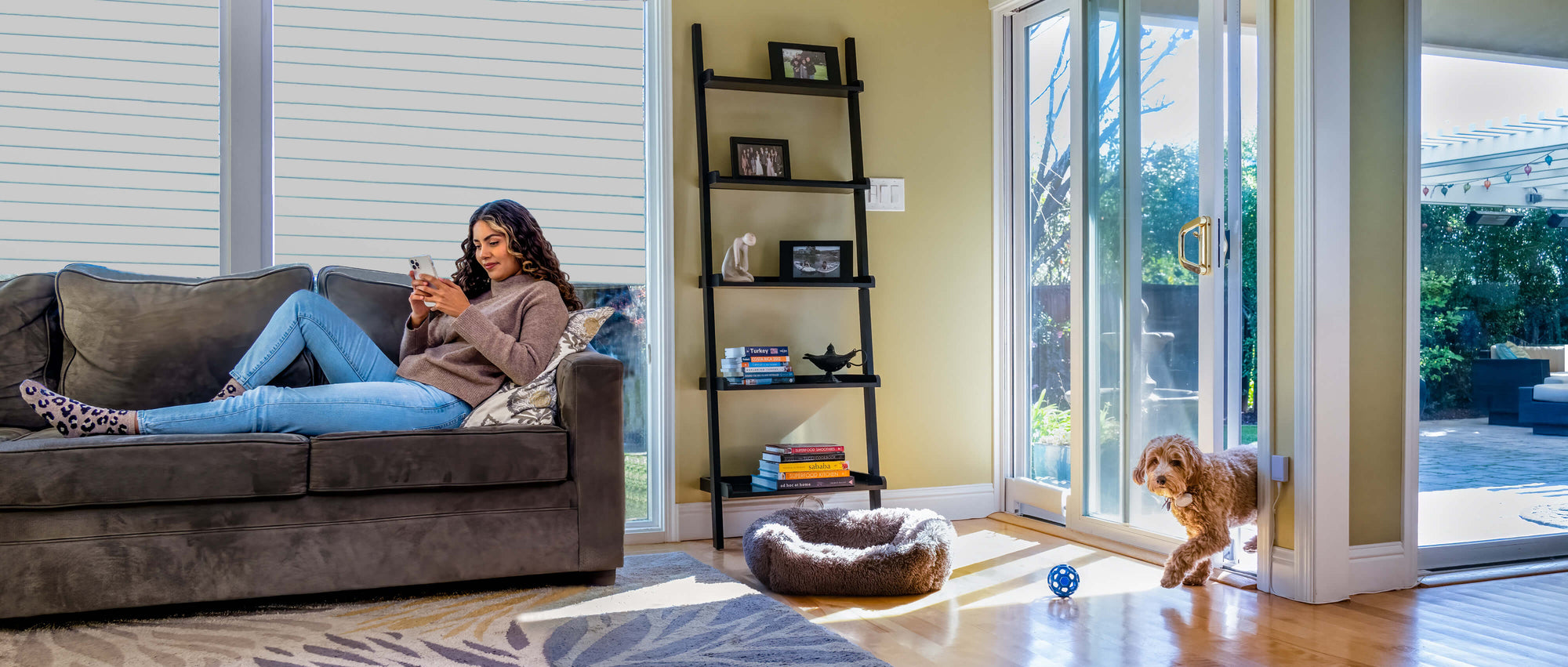
Most companies solving the pet-door problem begin with a saw. They cut a hole in a wall, a door, or a pane of glass, and then they sell you a flap to fill it. Wayzn started somewhere stranger: with the observation that the sliding glass door already in your living room is, functionally, a very large dog-sized opening that happens to be closed. It does not need a hole. It needs a motor and a brain.
That reframe is the whole business. Wayzn, based in Los Altos, California, makes a device that clamps onto an existing two-panel sliding patio door and opens or closes it on command - by app, by motion sensor, by Alexa, or by a wearable tag clipped to the dog's collar. Installation takes minutes and a screwdriver. Nothing gets drilled, cut, or permanently altered. When you move out, it peels off.
01 / The NapkinA ski lift, a boarding bill, and a bad idea that wasn't
The origin is almost too tidy. Co-founders Adam Smithline and Mike Demele - brothers-in-law with, between them, roughly 65 years in enterprise and mobile software - were on a Lake Tahoe ski trip in 2018, grumbling about what it costs to board dogs every time life gets in the way. Somewhere on the chairlift, Demele floated the thought: what if a smartphone could just open the patio door for the dog?
The pair had built SaaS analytics and data-warehousing companies before. They approached a physical door the way software people do - as something with inputs and outputs. A pet approaches (input). The door opens (output). An obstacle appears (input). The door retracts (output). Framed that way, a patio slider is less a piece of carpentry and more an interface waiting for an API.
- Adam Smithline, CEO and Co-Founder
02 / The ProductWhat it actually does, and how it stays off your dog
The Wayzn Smart Pet Door attaches to a standard two-panel sliding glass door using strong, removable adhesive and a frame adapter, held in place with a screwdriver. Once calibrated - the device uses onboard AI to learn the door's size and weight - it can slide the panel open and shut on its own. It ships in three sizes keyed to the door's exposed track length: Small (27-30.5"), Medium (30.75-37.5"), and Large (37.75-49.75"). It accommodates pets of every size, from cats to large dogs.
The part that turns a slightly alarming premise - a motorized door that could, in theory, close on a Labrador - into something people trust is the safety system. Wayzn's obstacle sensors detect resistance and retract the door, the same principle that keeps an elevator from clamping shut on an arm. The original door stays fully intact and lockable, the device doubles as a security bar against forced entry, and communications run on 256-bit encryption.
There are four ways to open it, and the story of the company is really the story of removing the human from that list one step at a time:
Open from anywhere by phone. Set it to motion-activated automatic mode. Say "Alexa, let the dog out" and mean it literally. Or skip yourself entirely with the Pet Tag.
03 / The TagWhen the dog opens the door and you're not in the room
The newest piece, the wearable Pet Tag, is where the idea completes itself. A waterproof tag clips to the collar; a receiver plugs in near the door. When the tagged pet approaches - from inside or outside - the door opens, and closes behind them. No phone. No person. The set ships with a receiver, two tags with batteries, and collar straps in blue and gray.

04 / The CustomersFirefighters, nurses, and a pandemic full of Zoom calls
Wayzn's early buyers were people whose jobs make a predictable dog schedule impossible: first responders, nurses, firefighters - anyone gone for long, irregular stretches who would otherwise pay a dog walker or feel guilty about it. The device sells to homeowners and, notably, to renters, who almost never get to have a pet door because they cannot modify the property.
Then 2020 handed the company a market it did not plan for. Millions of people were suddenly working from home, wall-to-wall on video calls, with a dog scratching at the patio glass. Wayzn let the dog out without leaving the meeting. In one figure the company has cited from that period, one in five owners said the door enabled a job opportunity they otherwise could not have taken.
The complaint it answers is older than the pandemic, though. Traditional dog doors are, by most owners' accounts, unattractive; they demand construction, they weaken security, they leak weather, and the opening is usually too small for a big dog anyway. Wayzn's pitch reframes all of that as a single question: why buy a worse, permanent hole when the door beside it can be taught to open? For a household with a large breed and a nice patio slider, the math is not close.
05 / The DifferenceWhy not just cut the hole?
The pet-door aisle is crowded with flaps, in-glass inserts, and microchip-reading doors from names like PetSafe and SureFlap. Almost all of them share one requirement Wayzn refuses: a permanent opening. That single design choice is what separates the products, and it is worth laying side by side.
The trade-off is honest: Wayzn needs a two-panel sliding glass door with the fixed panel outermost, so homes without one are out, and at roughly $549 to $599 it costs more than a basic flap. What buyers are really paying for is the thing that never appears on the invoice - the construction that does not happen, and a door they can take with them.
06 / The BusinessSmall team, two patents, sold direct
Wayzn is a lean, direct-to-consumer operation. It sells through its own Shopify storefront, ships to all 50 states, and makes money the straightforward way - a one-time hardware purchase plus accessories like the Pet Tag and warranty upgrades, with no subscription attached. The core team is small; the company leaned on outside specialists to punch above its weight, including product-design firm StudioRed and digital manufacturer Protolabs, whose rapid prototyping earned Wayzn a Cool Idea Award.

The expertise on hand is worth noting, because it explains why a hardware product from a two-person shop feels considered rather than improvised. Smithline spent roughly three decades in technology, marketing, and data warehousing and previously co-founded two SaaS analytics companies; Demele brought about 35 years of enterprise and mobile software development. Neither is a lifelong mechanical engineer, and that shows in the best way - the product treats mechanics as a means to a software experience, with AI calibration, encrypted communications, scheduling, presence detection, and voice integration doing the heavy lifting.
The funding matches the scale: the company got going with crowdfunding rather than a big venture round, beating its Indiegogo goal roughly fourfold in 2018 and later closing an equity crowdfunding raise on Republic in late 2020. Public records put total capital raised in the neighborhood of half a million dollars, including a $280,000 convertible note. This is not a company trying to blitz-scale; it is one trying to nail a specific product for a specific door.
07 / The VerdictWhere it fits
Wayzn sits at the intersection of two things people already spend on without blinking: their pets and their smart homes. Its bet is narrow and defensible - most American homes with a yard have exactly the sliding door it needs, and none of the flap-and-hole competitors can offer a reversible, whole-door, app-controlled version of the same job. The awards (a CES 2020 Innovation honoree, GearBrain's Best of CES, a Smart Home Mark of Excellence) suggest the industry noticed. The two patents suggest the founders expect company.
Whether a two-person shop can hold a category it more or less invented is the open question. But the core insight is the kind that looks obvious only after someone says it out loud on a chairlift: the smartest pet door might be the door you already have.