Before Food Rocket had a network of small warehouses, it had a friend in a car near a Whole Foods in San Francisco. Vitaly Alexandrov had put grocery pictures on a Shopify website. When somebody ordered, the friend could collect the goods and drive them over. The promise was delivery in roughly 10 to 15 minutes. The machinery behind it was pleasingly modest. A parking space can be an inexpensive place to discover whether anybody wants your business.
Alexandrov described that early test as the beginning of a service that would eventually attract a $25 million Series A. It is an appealing opening scene for a founder’s career: the improvised arrangement before the expensive one. But his story also has a closing date. Food Rocket ceased operations in March 2023. By 2026, he was working on AI tools for sales teams at AvangardAI. The groceries had disappeared from the transaction; the customer was still there.
The book that came to the meeting
Long before the American grocery experiment, Alexandrov had tried selling graffiti paint. In a 2021 interview, he recalled starting that business at fourteen. At university, seeing classmates launch their own ventures helped him imagine an alternative to waiting for graduation and applying for a job. Business was already happening around him. There seemed little reason to stand politely outside it.
He studied public administration at the Higher School of Economics, graduating in 2013. His academic work included research on corruption, and he had experience as a government intern. Yet in 2011, while still studying, he founded the CRM marketing agency Out of Cloud. Initial capital was 15,000 rubles. By 2015, the agency’s revenue had reached 20 million rubles. The distance between those figures covered years of selling a service, finding clients and persuading them to stay.
CRM marketing supplied a practical education in second purchases. Out of Cloud helped businesses communicate with people who already knew them, using channels such as email and messages. Its clients included Panasonic and Puma. The work concerned a familiar commercial problem: a business can spend considerable effort winning a customer, then lose touch immediately afterward. Alexandrov built a company around keeping that relationship alive.
He also wrote Email Marketing Strategy, a guide drawing on his agency experience. He had a particular use for the finished volume. Prospective clients would receive a copy when they met him. A book could introduce the agency’s thinking before a contract had been signed. It was a calling card that required rather more shelf space than usual.
“I wrote the book so I could gift it to clients when we met.”
Vitaly Alexandrov, 2021
He described the book as a business undertaking with its own positioning and marketing. He also wanted to share what he had learned. Both purposes could coexist in the same binding. The useful detail is the sequence: experience became a book, the book created confidence, and confidence could become work for the agency. His authorship belonged inside the business rather than on a decorative shelf beside it.
A supermarket with a stopwatch
From 2019, Alexandrov began developing food technology ventures in the United States. Foodcast worked on forecasting demand; Foody addressed restaurant purchasing. These projects moved him closer to the physical complications behind an order: suppliers, inventory and products that could not wait indefinitely to be sold. His later delivery business grew from that period of experimentation.
Food Rocket launched in 2021. The early Shopify test let him try the customer proposition before constructing its eventual operating system. He wanted to know whether people would order ordinary groceries when delivery was measured in minutes. A few products on a page and an available driver could answer an initial question. They could not answer every question a delivery company would eventually face.
The products mattered. In explaining the model, Alexandrov emphasized everyday purchases, including fresh food, rather than relying entirely on occasional snacks. He also described working with local producers that struggled to find shelf space at larger retailers. Food Rocket could offer another route to customers. For the shopper, the appeal was immediate availability. For the supplier, it was an additional place to be discovered.
In April 2022, Food Rocket announced a $25 million Series A led by Alimentation Couche-Tard, Circle K’s parent. It had expanded from California into Chicago. The company reported that 60 percent of its California customers made a second order, with an average order value of $30. Those figures were company-reported, a snapshot from the expansion period. They give a useful glimpse of what Alexandrov was watching: whether the first convenient purchase became a habit.
April 2022
rate in California
order value
His earlier work makes that emphasis understandable. A marketing agency asks how to bring a buyer back through a message. A rapid delivery company can ask the same question through a bag of groceries. The delivery adds warehouses, riders and inventory to an already difficult problem. Convenience must be paid for every time it is provided.
The employee who made the stamp
Alexandrov’s published management ideas include an unusually small piece of company equipment. One Food Rocket employee handmade its bag stamp. Another started awards and bonus programs to recognize colleagues. He offered these examples while arguing that people close to everyday work should be able to influence it. Even a company concerned with algorithms still needed somebody to think about the bag.
He wrote about hiring people from varied backgrounds, including an opera singer. His argument for giving employees access to leadership was practical: they encounter the daily problems first. He favored training and internal advancement, and asked managers to listen to suggestions from the people carrying out the work. These were his stated principles, illustrated with things colleagues had actually done.
In a separate essay about mistakes, he used the example of a late courier or an incorrect order. A manager should examine the surrounding process before deciding that the employee alone caused the problem. He recommended pausing before reacting, discussing what happened privately and agreeing on steps to prevent a recurrence. He also argued that leaders should acknowledge their own errors so employees could speak openly about theirs.
That is a revealing subject for somebody selling speed. A fifteen-minute promise puts the whole operation under pressure, while a missed deadline arrives at the customer’s door in the form of one person. Alexandrov’s writing placed some responsibility farther back in the system. The customer sees the courier; the founder should also see the decisions that sent the courier there.
Borrowing the corner store
Circle K offered Food Rocket something more tangible than an investor’s name. It had existing stores, supplier relationships and purchasing power. By late November 2022, Food Rocket had launched delivery from two Circle K stores in Charlotte, North Carolina. Working inside an established retailer’s footprint meant the startup could use infrastructure that somebody else had already built.
Alexandrov’s ambition extended beyond groceries to delivery for other kinds of merchants. Yet his December 2022 explanation also stressed efficiency and a slower expansion pace than some competitors. The change in emphasis was telling. A network can look impressive on a map while remaining expensive on the ground. Each additional location must eventually justify its place there.
- 2021California launch
- 2022Chicago expansion
Circle K partnership
Charlotte delivery launch - 2023Operations cease
in March
The existing stores did not settle the financing problem. In February 2023, Food Rocket withdrew from San Francisco to concentrate on North Carolina. In March, it ceased operations. The company said it had exhausted its capital and could not raise more, including bridge financing from Couche-Tard. It also claimed overall profitability, a statement that did not change the immediate outcome. Money required to continue operating was unavailable.
The closure belongs in any account of Alexandrov’s career, alongside the funding announcement. A customer deciding to order again and an investor deciding to commit again are different decisions. Food Rocket needed both. Its service could promise fifteen minutes; its financing depended on a much longer and less controllable calendar.
Back to the customer conversation
By October 2025, Alexandrov was discussing business applications of AI on a Russian-language podcast, identified with AvangardAI and Most AI as well as Out of Cloud. AvangardAI develops tools for sales teams, including analysis of customer conversations, training and assistance during sales work. The setting had changed from the delivery route to the dialogue that might produce an order.
A 2025 RetailCRM case study provides a concrete example. Lighting retailer Don Plafon used an AvangardAI integration to examine its sales calls. The case reported coverage of all calls, fewer manager errors and a nine percent increase in conversion from calls to sales. These were results reported for one deployment. They describe the particular commercial task: helping a business understand conversations that managers previously had time to review only in small samples.
In September 2026, AvangardAI announced a planned plugin integration with Yandex’s Alice AI Pro business assistant. Proposed uses included assistance for salespeople and sales training. Alexandrov, identified as a co-founder, described an ambition to connect training with tools informed by analysis of customer communications. The announcement concerned a planned integration, giving his next chapter a specific direction rather than a finished verdict.
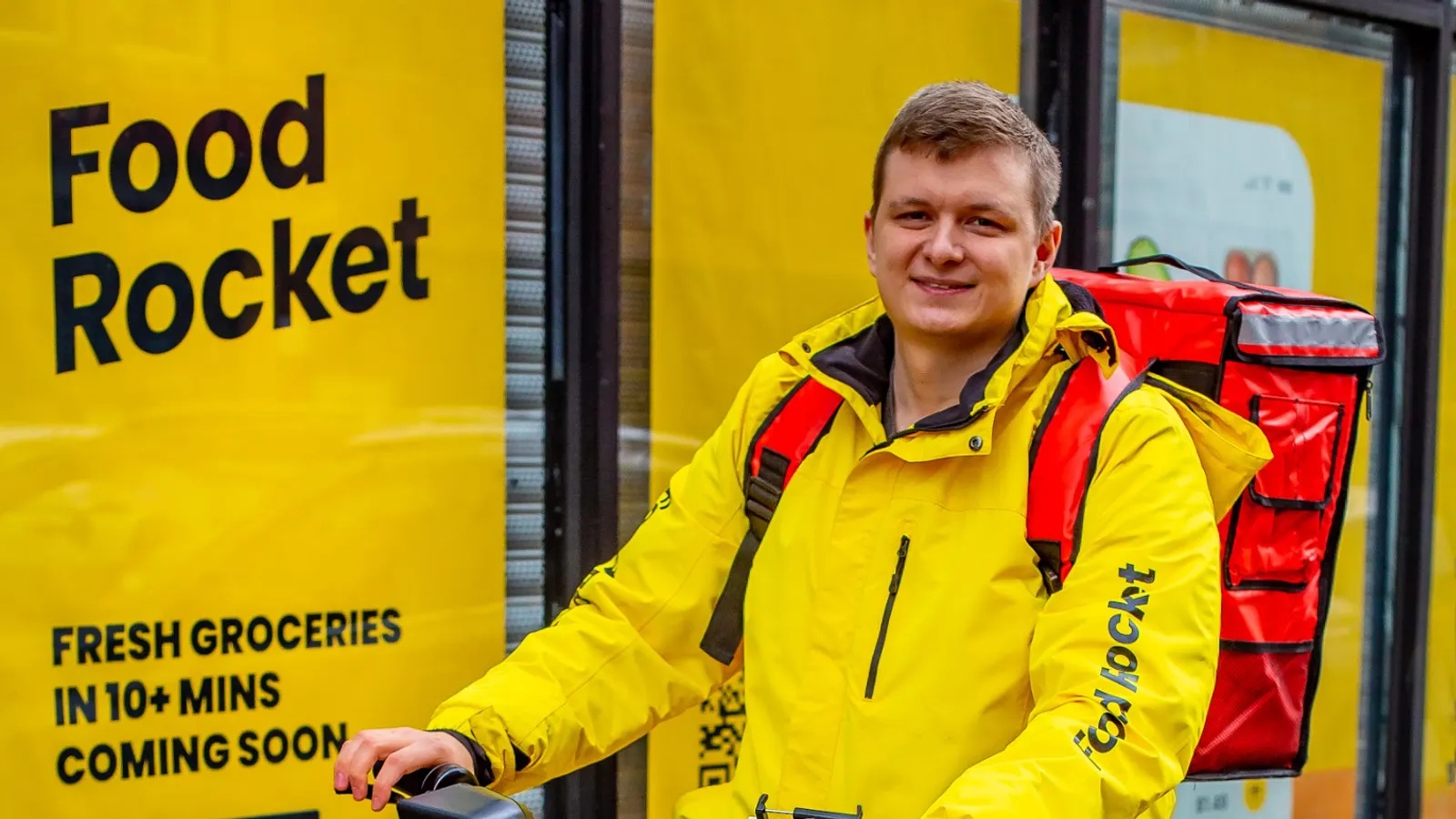
Across these businesses, a recurring interest becomes visible. Alexandrov has worked on the message that earns another purchase, the grocery order that becomes routine and the conversation that might end in a sale. Food Rocket put that interest into a yellow jacket and sent it down the street. His newer work brings it back to words. There is still a buyer to understand, and still another decision to earn.
Keep reading & listening
- AvangardAI - current company website ↗
- Vitaly Alexandrov on LinkedIn ↗ · X ↗
- The early Food Rocket interview - Mixergy ↗
- Alexandrov’s essays on teams, mistakes and growth ↗
- Listen: his 2025 conversation about AI (Russian) ↗
- The March 2023 closure report ↗
- The Don Plafon customer case (Russian) ↗
- The September 2026 integration announcement (Russian) ↗
- His 2021 Forbes Russia nominee profile (Russian) ↗
- The book and agency interview ↗
- Inside the Circle K partnership ↗
- His essay on giving employees a voice ↗
- His essay on handling mistakes ↗