Chris Hulls built a business around knowing where people are. Then, after eighteen years as Life360’s chief executive, he had to decide where he belonged. On August 11, 2025, he handed the CEO job to Lauren Antonoff and became executive chairman. His explanation came with a photograph of the two of them at his house, testing pet trackers with their dogs. Corporate succession usually involves fewer paws.
The scene suited the company. Life360 lives in the space between an ambitious technological promise and an ordinary household chore: finding someone, arranging a pickup, checking whether everybody has arrived. Hulls had spent much of his adult life persuading people that this was a business worth building. By June 2026, its app had approximately 102.4 million monthly active users. The question facing him had changed. How much of the organization still needed its founder in the middle of everything?
The school assignment that kept going
Before the maps and membership plans, there was Hurricane Katrina. Hulls was at the University of California, Berkeley when the storm exposed how difficult it could be for separated families to reconnect. He made a school business plan around using SMS to help them find one another after emergencies. This was 2005. The smartphone habits that would eventually support his company had yet to become habits at all.
He had already taken a circuitous route to the classroom. He grew up in West Marin, attended West Marin School and Tomales High School, joined the Air Force at seventeen, and later studied at College of Marin. He earned his Berkeley business administration degree with Highest Honors in 2006. An offer from Goldman Sachs gave him a conventional destination. He also had an offer to wash dishes in Antarctica, which is a reasonably emphatic way of avoiding a desk.
Life360 became the project that lasted. Hulls and Alex Haro co-founded the company in 2007. In 2008, it won $275,000 in Google’s Android Developer Challenge. Prize money offered something more useful than applause: room to keep building. A system imagined for extraordinary emergencies began moving toward the ordinary rhythms of families. People might rarely need to reunite after a disaster. They could need to coordinate the school run every afternoon.
The customer wasn’t in the room
There was an awkward feature of this plan for a young technology founder: he was building for people whose lives differed from his own. Mothers, rather than his immediate peer group, became central to his thinking. The usual instruction to build something you personally wanted offered limited guidance. Understanding why a parent would keep opening the app mattered more than whether a fellow founder admired the idea.
In 2019, Hulls described penetration in the American South as ten times that on the coasts. It was a useful rebuke to any assumption that the people discussing a product in Silicon Valley represented everyone who might use it. The customer could be a long way from the investor meeting, both geographically and in what she considered a pressing problem.
Hulls paid for that conviction in unglamorous ways. He described living in a closet during two separate years in his twenties, deliberately making home less inviting so he would spend more time working. His mother lent him $10,000. These details make a startup sound less like a carefully designed career move and more like a household rearrangement that got considerably out of hand. The eventual scale can obscure just how provisional the beginning was.
A free map, with a constitution
The commercial idea depended on frequency. An emergency service can be useful and still be forgotten between emergencies. Location sharing gives a family reasons to return during an entirely uneventful week. Paid safety features could then sit alongside that everyday utility. In Hulls’s account, free access had a job to do: establish a product that people actually kept using.
He later worried about what a larger company might do to that arrangement. A succession of small restrictions could each look commercially sensible while gradually making the free version less appealing. In a 2025 conversation about subscription businesses, he described an internal member bill of rights intended to protect meaningful free functionality and discourage deceptive tactics. His concern was cumulative: a test could miss the damage done by many individually modest changes.
“We don’t trick our customers.”
Chris Hulls, on Life360’s product principles
That position also gave the founder a continuing occupation. Somebody had to argue for the member who did not pay. Today, Life360 explicitly includes championing the free member experience in Hulls’s executive chairman remit. It connects his new title to an old argument: the company’s future depends partly on keeping a promise to people who are easy to overlook in a subscription spreadsheet.
When the family disagrees
A family app has a complication that a neat business model cannot remove. The person paying and the person appearing on the map may have different preferences. Parents can value reassurance. Teenagers can value space. A location marker is a small graphic carrying a surprisingly large domestic argument.
In 2020, criticism from teenagers on TikTok drew Hulls into conversation with them. Life360 announced Bubbles, a feature allowing users to show a general area temporarily instead of an exact location. The announcement described it as a response to months of dialogue. It preserved safety and communication tools, and parents retained the ability to burst a Bubble. The compromise therefore had limits, but the complaint had produced a change in the product.
It is an instructive episode in Hulls’s career because persistence alone would have been an inadequate response. A founder can hold his ground against a skeptical investor. People inside the family need a way to negotiate with one another. The software was entering a relationship that already existed, complete with rules, grievances and competing definitions of a reasonable amount of information. Listening became part of the engineering brief.
The bell rang twice
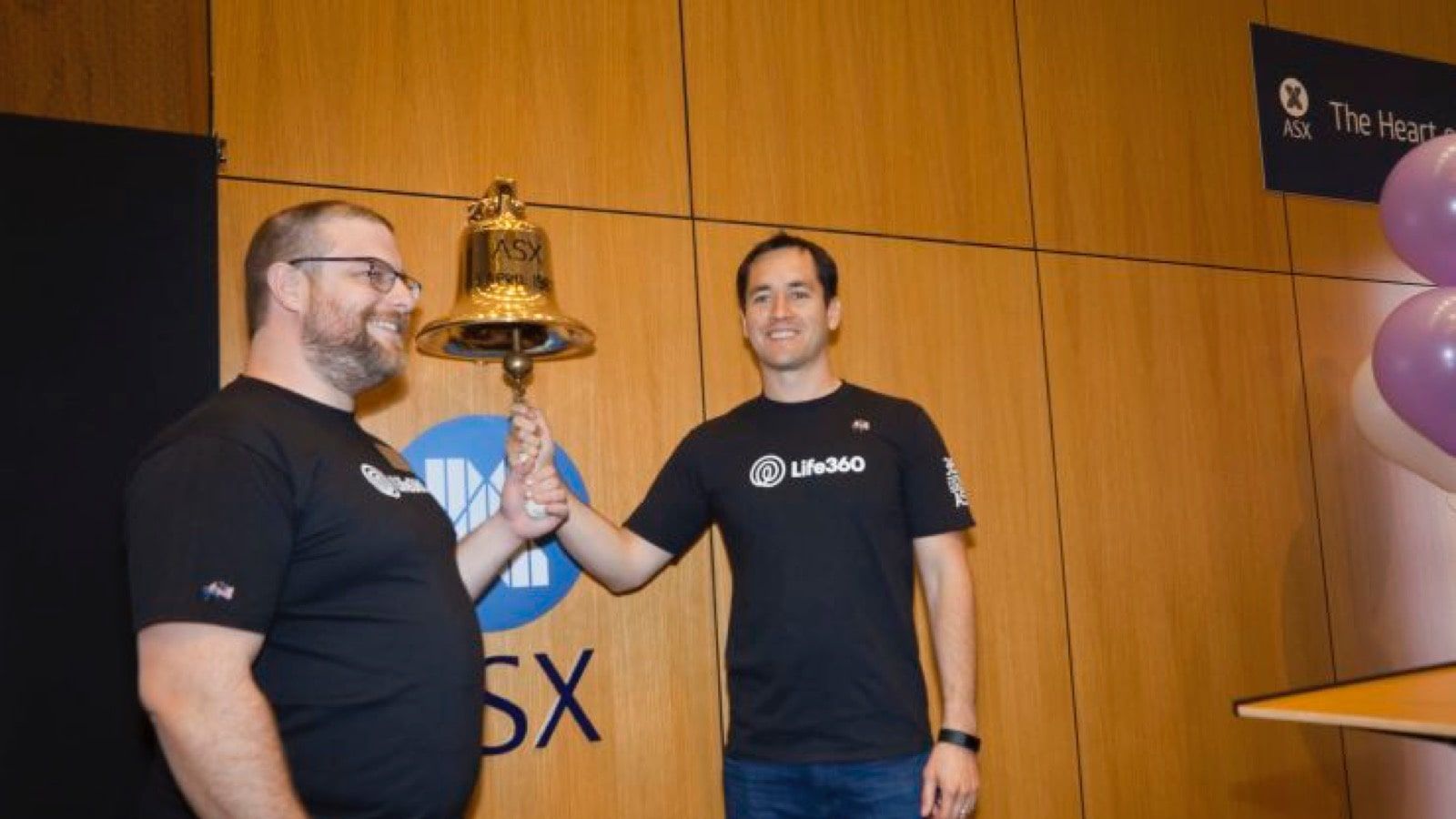
Life360 listed on the Australian Securities Exchange in 2019. For a California company, that was an unusual route to public capital. Hulls had looked beyond the familiar sequence of venture rounds and found another market willing to back the business. Five years later, on June 6, 2024, Life360 began trading on Nasdaq as well. The American offering added a second public-market milestone to a company already listed overseas.
At the end of June 2024, Life360 reported roughly 71 million monthly active users and more than two million Paying Circles. Two years later, those figures were approximately 102.4 million and 3.2 million. A Paying Circle is a subscription covering a group, so the two measures count different things. They should not be read as individual customers moving through a simple conversion funnel.
Monthly active users
Global monthly active users. Company-reported period-end figures; includes paying and non-paying members.
The growth continued after the CEO handover. Second-quarter 2026 revenue reached $159 million, up 38 percent from a year earlier, under Antonoff. That matters to the personal story: the institution Hulls spent years willing into existence was operating with someone else in the chief executive’s chair. Succession had become observable behavior, with quarterly results attached.
A smaller team inside the bigger company
By May 2026, Hulls had described another way to stay close to invention. He was personally leading a Family AI team inside Life360, looking for builders who wanted a small-team environment with access to a large existing audience. His examples were domestic rather than theatrical: events appearing on the family map, bills remembered, information organized without repeated requests between spouses.
He wanted the intelligence to work in the background. The product was still being explored, and his invitation acknowledged that uncertainty. The attraction for him is easy to see in the arrangement itself: a founder could work on rough ideas with a handful of colleagues while a larger organization handled the demands of an established platform. The new title had created room for a familiar activity.
There is a tension here, too. Life360’s usefulness comes from information about real families, and each additional use makes trust more consequential. Hulls’s earlier defense of free members and his willingness to hear teenagers become relevant to the next experiment. A family may welcome help with its calendar while still wanting a say in what the helper knows. Convenience will have to earn its invitation.
Some places should stay on the map
Hulls’s other project brings the story back to West Marin. Through the Point Reyes Good Luck Fund, he has been working to preserve buildings and keep important spaces in local hands. In June 2025, he explained the effort as protecting the places that define Point Reyes from becoming uses residents neither need nor want. The intended beneficiaries live close enough to walk past the results.
His connection is more specific than a wealthy newcomer’s affection for a picturesque town. Growing up, he worked at Palace Market, Cafe Reyes, Rancho Nicasio, St. Columba’s Church and the Bovine Bakery. He is now a co-proprietor of the Old Western Saloon. These are places where he had jobs and neighbors before he had a public company. Preservation gives that history a practical outlet.
There is something pleasingly unruly about this second map. One project asks how technology can anticipate a family’s next errand. Another asks how a town can retain the buildings in which people have been running errands for years. Both involve arrangements that are easy to take for granted while they work. Hulls has spent eighteen years making family life visible on a screen. He is now also putting money and attention into the places people still have to turn up in person.