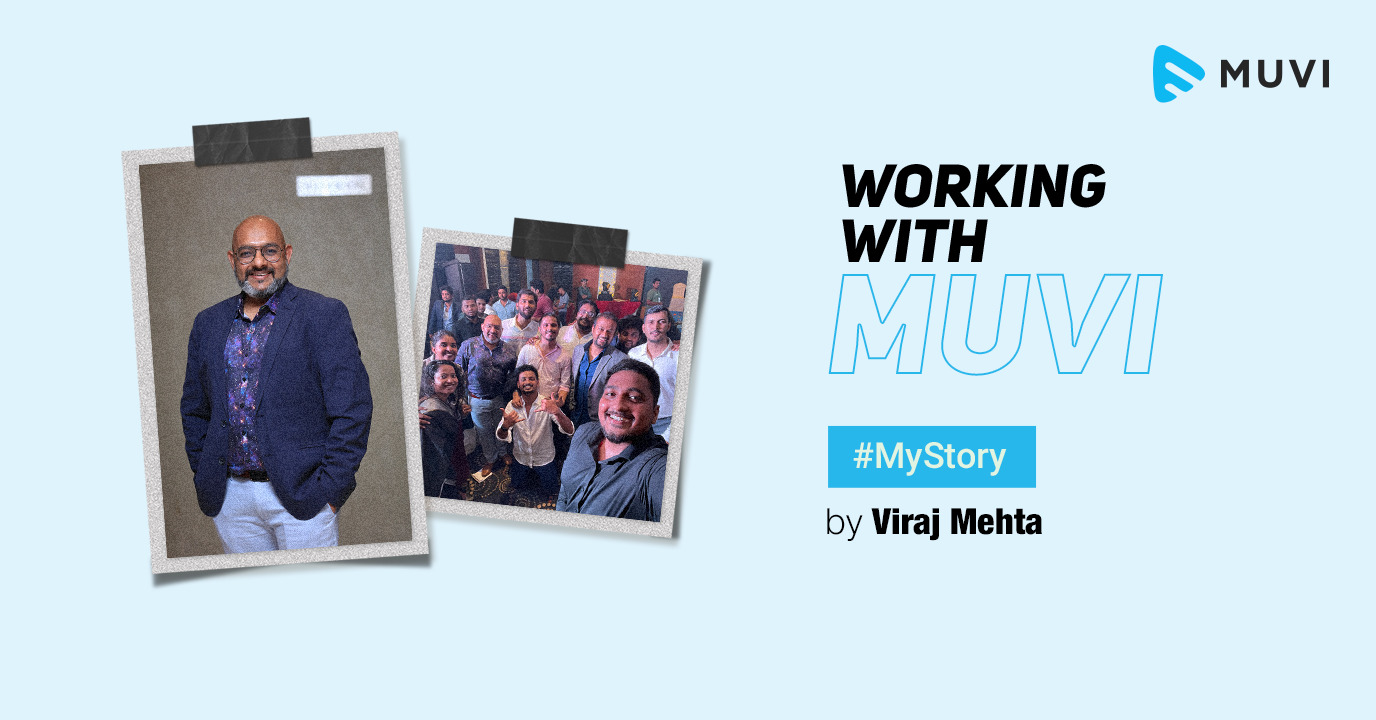
Viraj Mehta found Muvi by looking for a company audacious enough to take streaming seriously. It was 2014, a time when watching video online could still feel like a negotiation with the progress bar. Infrastructure was improving, audiences were forming new habits and the business vocabulary around OTT had not yet settled into its present confidence. Mehta saw the awkwardness and the direction at once. Streaming was early, but it was moving.
Muvi was young too - only a small team, in his recollection, and trying to turn the complicated machinery of video delivery into a product. That combination appealed to him. A finished company might have offered a polished job description. Muvi offered blank pages: positioning, product-market fit, performance marketing, communications and a global brand still waiting to be articulated.
He joined as Head of Marketing. The choice would place him close to a technical shift that altered television, music, education and events. It also gave him a role in the less glamorous half of streaming: explaining the infrastructure behind the screen. The viewer sees a play button. A platform vendor sees hosting, encoding, rights, payments, apps, analytics and a small orchestra of devices that do not always agree with one another.
The internet before the play button
Mehta did not arrive in streaming as a film obsessive looking for a technology problem. His route was through the commercial internet. The public chronology begins with marketing and sales at Weightronix Controls, then moves into online and affiliate marketing at People Interactive in 2007. Affiliate work offers a brisk education: attention can be measured, incentives can be tuned and a click is only useful if it eventually leads somewhere.
At UBM India, beginning in 2009, his responsibilities expanded into online product development and marketing. The work sat at the intersection of publishing and software. He helped manage the launch of the InformationWeek India website, including design, development, server work and data migration. He later worked on bringing Light Reading to India and on virtual events for enterprise technology audiences.
That last detail now sounds ordinary. It was not. In the early 2010s, an online exposition needed explaining. Mehta's project record describes digital spaces that brought technology vendors, speakers, chief information officers and channel partners under one virtual roof. The format anticipated a future in which an event could be a venue, a media product and a lead-generation engine at the same time.
A career assembled in layers
Read as job titles, the route can look varied. Read as a collection of questions, it is remarkably consistent. What makes someone arrive? What earns attention? How does a digital product turn interest into revenue? What must work behind the interface before any of that is possible? Streaming bundled those questions together and added the exhilarating nuisance of many screens.
Four reasons to say yes
When Mehta later explained why he joined Muvi, he organized the decision into four parts. First came the size of the company. A young organization offered room to create processes and structures instead of merely inheriting them. Second was direct access to founder and chief executive Anshuman Das. Mehta wanted to understand where the product and company were heading, and he considered a working equation with the chief executive essential to that clarity.
A young company
Small enough to explore multiple roles and build systems from the ground up.
Founder proximity
A direct line to the person setting the product and company direction.
A product bet
An Indian software company building a repeatable product rather than selling only services.
Streaming timing
An emerging market whose infrastructure was beginning to catch up with demand.
The third reason was the product model itself. Many Indian technology companies he saw were focused on services; he wanted to work inside a business creating its own software. The fourth was streaming. Demand was becoming visible before the supporting infrastructure was fully comfortable. For a marketer, that gap is either a headache or a canvas. Mehta treated it as the latter.
“It was quite a challenge to not say Yes to Muvi!”Viraj Mehta, reflecting on the 2014 decision
The sentence is cheerful, but the logic beneath it is methodical. He was not simply betting on video. He was choosing a setting where the category, company and marketing function were all unfinished. That meant the marketing playbook could not be copied neatly from an established rival. It had to be assembled near the product, while the product and market were still learning each other's names.
Selling machinery nobody sees
During his first Muvi chapter, Mehta's public work ranged across the economics and politics of online video. He wrote about whether India was ready for video on demand, compared revenue models and argued for net neutrality when differential pricing proposals threatened to make some services more expensive to access than others. He also spoke for Muvi as it launched tools for physical merchandise, linear channel scheduling and multi-device streaming.
The breadth makes sense. A streaming platform sits underneath other people's brands. Its customers may be broadcasters, educators, faith organizations or entrepreneurs. Each wants an audience-facing service, but few want to stitch together the infrastructure by hand. The marketing task is therefore an act of translation: turn encoding, billing, deployment and rights management into a credible promise that a customer can launch, operate and monetize a service.
Mehta's phrasing in product announcements favored speed and reduced complexity. Upload, click, go live. Migrate without downtime. Add another revenue stream. The details changed, but the message kept returning to agency. The customer should be able to concentrate on content and business while the platform handles the wiring.
His later webinar on technical video SEO reveals the other half of the problem. Launching a video website is not enough if search engines cannot understand it. Structured data, video sitemaps and rich results become part of distribution. The marketer has to care about the website's technical readiness because discoverability begins before the campaign.
The useful art of returning
Mehta left Muvi after his first stretch and moved into the Head of Internet role at The Indian Express. The period placed him inside a media group managing its own transition across print, web, specialist titles and digital audiences. Yet the relationship with Muvi did not close when the job did.
He stayed in touch with his former marketing colleagues, other teams, the founder and the product. This was more than networking in the thin, transactional sense. He watched. During his time away, Muvi grew from a single-product company into a multi-product SaaS organization. By 2021, the opportunity was no longer the one he had accepted in 2014.
Moved into digital and affiliate marketing at People Interactive.
Built online publications, products and virtual events at UBM India.
Joined Muvi to develop its marketing playbook and global brand.
Worked as Head of Internet at The Indian Express.
Rejoined Muvi; now serves as Chief Marketing Officer.
He returned for the product growth, but not only for the product. He also pointed to professional satisfaction, work-life balance and a culture that had matured with the company. A return can look sentimental from the outside. Mehta's explanation is closer to due diligence. He had years of observation, durable relationships and direct knowledge of how the place behaved. He did not return to a memory. He made a new decision about a changed organization.
There is a compact career lesson here. Leaving well preserves information. Staying connected allows a former employee to evaluate progress without relying on a recruitment pitch. The door remains useful from both sides: a company retains someone who understands its early logic, while the returning executive brings experience gathered elsewhere.
Culture as an information system
Mehta talks about culture with the specificity of an operator. Freedom, in his description, means a developer can offer a marketing idea and a support colleague can suggest an improvement to sales. Flatness is useful because information can cross the borders drawn by an org chart. People closest to customers, technical constraints or recurring questions can improve work outside their formal function.
That freedom comes with a condition: maturity. In remote work without tracking tools, he argued, a team has to understand the difference between autonomy and neglect. People need to know their daily responsibilities, the product and the company's goals. Trust can replace surveillance only when ownership travels with it.
Colleagues have described him as calm and composed when solving problems, hardworking and helpful across teams. Those qualities fit the operating system he prefers. Cross-functional candor is easier when disagreement does not arrive wrapped in theatre. A calm leader can make room for more voices without letting the room become noise.
“The challenges are unique and fun to work on.”Viraj Mehta on the range inside marketing
His recruiting answer is equally revealing. Asked what he would tell someone considering Muvi, he declined the easy declaration that it was the best place to work. Instead, he offered questions. What does the candidate want from a new job? Why are they leaving the last company? Which boxes should the next one tick? The approach treats employment as a fit to investigate, not a prize to advertise.
A marketer close to the machinery
Today Mehta sits on Muvi's executive team as Chief Marketing Officer. The title crowns a career that began with sales and acquisition, passed through publishing and digital events, and arrived at software used to create other media businesses. His work still occupies the seam between a product and the story a market can understand.
Streaming has changed since his first Muvi chapter. The question is no longer whether audiences will watch on demand. It is how a service can reach many devices, protect content, support multiple business models, travel across regions and still feel simple to the person pressing play. Marketing inherits that complexity, then has to make it legible without making it sound magical.
Mehta's answer has been to stay near the product and near the people building it. The same instinct explains both the first decision and the return. In 2014 he followed curiosity toward a small company in an unfinished category. In 2021 he followed the evidence back. Careers are usually narrated as a straight ascent. His has a loop in it - and the loop may be the most instructive part.