Vince Koehler has a useful test for supposedly personal marketing. The message arrives polished. It knows his title. It knows his company. Then it addresses that company with the legal suffix attached, the little “LLC” a database has dutifully dragged into the conversation. The disguise slips. What looked like attention turns out to be automation wearing a name tag.
Koehler described the tell in a 2018 interview about content marketing. What gets his attention, he said, is a message that is clearly not one-to-many, something tailored “but not in a fake way.” It is a small complaint with a large philosophy tucked inside it. Relevance cannot be manufactured by inserting a field. A buyer can tell when somebody has done the work.
That distinction has followed him across a career that began near the commercial web’s opening act and now runs through healthcare software. He co-founded the digital agency Propeller Interactive, worked on e-commerce accounts at VML, advised companies at SBI, led marketing at Netsmart, and in 2024 became Chief Marketing Officer at MedTrainer. The tools changed. The expectation did not: marketing has to be useful enough for a buyer to care and accountable enough for sales to trust.
“What gets my attention is when it’s obvious it’s not a one-to-many message.”Vince Koehler, on earning attention in B2B
The internet before the playbook
In a 2012 presentation, Koehler summarized the early years with the compression of a résumé slide. Propeller built initial digital presences for companies including CITGO Petroleum and Koch. At VML, where he worked from 1999 through 2006, he was part of a team helping turn a traditional agency into a digital one. His accounts included large companies such as Colgate, GE, and American Express. In 2006, his name appeared among the account managers on VML’s WebAward-winning Yellow Racing site.
The dates matter because the job was still being invented. A corporate website could be a first. E-commerce needed an explanation. The distance between an advertising idea and a working digital experience was full of unmarked road. Koehler learned in a period when “digital” could not merely mean buying a newer tool. It meant building the capability, explaining it to clients, and then making it perform.
His later writing at SBI reveals the operating habits formed around that work. In one article, he argued that marketers should treat sales as an audience rather than assume automatic interest. Test an early version of sales material with a small group of trusted representatives, gather the field’s reaction, and improve it before the full release. The point was not perfection. It was adoption.
This is less glamorous than announcing alignment. It is also more useful. A prototype creates an actual exchange. A salesperson can object while the work is still pliable. Marketing can watch where the material breaks in a real conversation. The handoff becomes a loop.
The right to make a patient bet
Koehler’s version of accountability leaves room for experimentation. On the B2B Revenue Executive Experience podcast, he recalled that podcasts were once an uncertain format for SBI. They required more effort than they seemed to return. The team stayed with them, and the format became one of the firm’s stronger marketing tools. He saw high-quality long-form video as a similar wager.
His condition was telling: the broader marketing engine had to produce a strong return before the team could put down bets that might pay off later. Creative patience, in this view, is not funded by vibes. Reliable work buys the organization enough confidence to wait for an unfamiliar format to find its audience.
“You have to have enough of the marketing engine producing a strong ROI to put down some bets that are going to pay off later.”Vince Koehler, on experimentation
The measurement went deeper than counting leads. Koehler described one view that tracked marketing-sourced and marketing-influenced demand, then another that traced dollars back far enough to explain why an investment worked and where to put more money. He also pushed sales and marketing to think in shared opportunities, especially within important existing accounts, rather than protect separate definitions of success.
A mission, a team, a measurable chapter
Koehler joined Netsmart in 2018. When he left six years later, he described the chapter through the company’s growth and the teams he had been trusted to lead: Marcom, Proposals, and BDR and Revenue Marketing. He wrote that Netsmart had grown from 800 to 2,800 employees during his tenure and that his teams helped contribute to accelerated pipeline growth.
Netsmart’s reported employee growth, 2018-2024
The farewell was notably communal. Koehler thanked colleagues, named the groups he led, and framed the work around equipping clients. Former teammates answered in kind, recalling his investment in their growth, the space he made for ideas, and the regular conversations in which those ideas became processes. The picture is of an operator who treats performance as a team property.
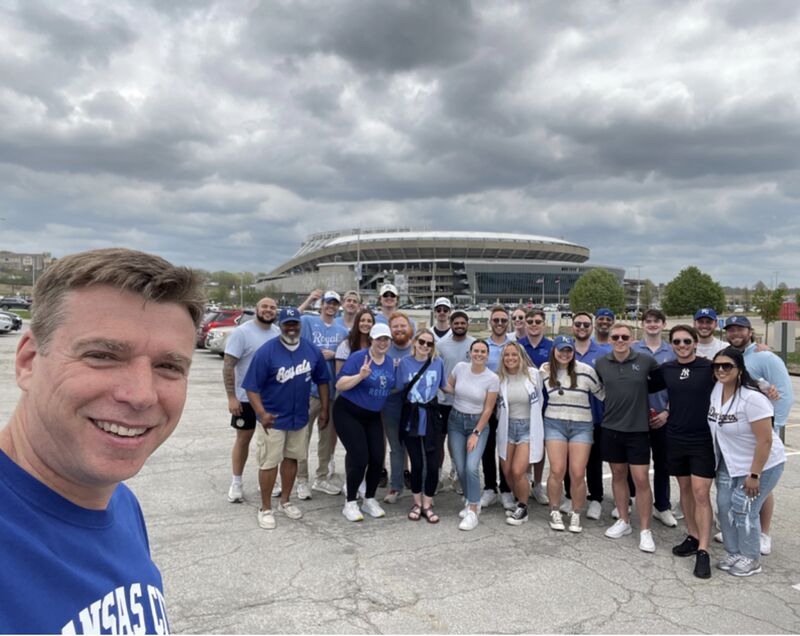
That emphasis also appears in his public description of MedTrainer’s BDR program. He has written about training and mentoring new representatives, getting them into real industry events, and building a ramp that helps them understand the problems customers bring to the booth. His LinkedIn profile also lists decades of coaching youth baseball and soccer. Different field, familiar instinct: practice should prepare people for the moment when the situation becomes live.
Making complicated work legible
At MedTrainer, Koehler leads marketing for software that brings learning, credentialing, and compliance workflows into one platform. These are consequential systems, but they rarely arrive with the immediate theater of a consumer launch. Their value sits in reduced back-and-forth, cleaner documentation, clearer status, and fewer administrative surprises. The marketing job begins by making that quiet relief visible.
In 2024, MedTrainer received eHealthcare Leadership recognition for email content and short-form video. Koehler’s explanation returned to the customer. Effective communication, he said, was essential to simplifying compliance. The company combined its subject knowledge with customer stories and their day-to-day experience. “It’s all about storytelling,” he said, “and showing the promise of what our customers are already experiencing.”
The phrase “already experiencing” does important work. It keeps the promise attached to observed reality. A marketer does not have to inflate the product into a revolution. The customer’s improved Tuesday afternoon may be persuasive enough.
His current public work follows that approach. MedTrainer’s author archive places his name across announcements about credentialing workflows, AI-assisted onboarding, workforce compliance, and company leadership. He is also identified as a regular webinar host, podcast guest, client collaborator, and primary media contact. The role stretches from demand generation to translation: take a dense operating problem and make the next step understandable.
The Mustang and the clock
Then there is the car. Koehler owns a 1966 Ford Mustang GT Fastback that he has had since he was 16. He races it in autocross, the discipline in which drivers navigate a cone-marked course against the clock. It is almost too tidy as a career metaphor: learn the route, make the run, read the time, adjust.
But the more interesting detail is continuity. Digital marketing has moved from first corporate websites to social feeds, automated outreach, and AI-assisted software. The Mustang stayed. So did a handful of professional convictions: understand the person on the other side, build something useful, listen to the field, and measure what happens next.
A thirty-year career collects fashionable language whether it wants to or not. Demand generation becomes growth. Revenue collective becomes go-to-market community. Personalization gets faster, then risks becoming less personal. Koehler’s work offers a stable translation beneath the labels. Marketing earns its place by helping the buyer see clearly and helping sales move honestly.
The clock matters. So does keeping the car worth driving.
Continue exploring