BREAKING   Vijil raises $17M, named a Gartner Cool Vendor in Agentic AI TRiSM PROFILE   Vin Sharma - Co-founder & CEO, Vijil TRACK RECORD   11 AWS AI services · 10 patents · 5 papers · 30 products CUSTOMERS   SmartRecruiters · DigitalOcean · DuploCloud BREAKING   Vijil raises $17M, named a Gartner Cool Vendor in Agentic AI TRiSM PROFILE   Vin Sharma - Co-founder & CEO, Vijil TRACK RECORD   11 AWS AI services · 10 patents · 5 papers · 30 products CUSTOMERS   SmartRecruiters · DigitalOcean · DuploCloud
Founder · Engineer · Menlo Park, CA

Vin Sharma

Thirty years building AI at AWS, Intel, and HP. Now he is building the one thing the machines still lack: trust.

Co-founder & CEO, Vijil ex-AWS AI ex-Intel Gartner Cool Vendor 2025
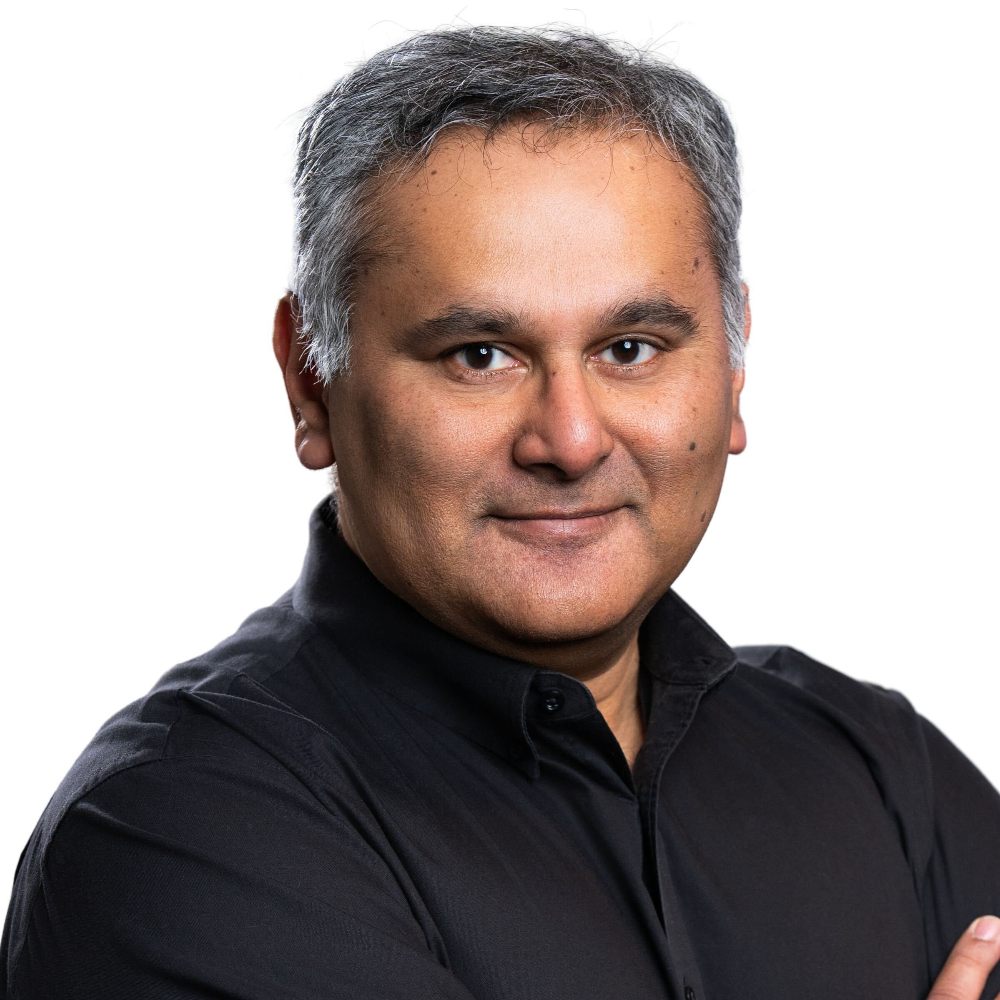
Vin Sharma, co-founder and CEO of Vijil
VIN SHARMA // CO-FOUNDER & CEO, VIJIL
The Story

Trust is the missing layer in AI

Ask most founders in the AI boom what they are building and you will hear about capability. Faster models. Smarter agents. Longer context windows. Vin Sharma spent three decades inside that machine, and he came away convinced the industry was measuring the wrong thing. The problem was not that AI agents were not smart enough. It was that nobody could bring themselves to trust them.

Roughly 95 percent of enterprise AI projects never reach production. Sharma likes to cite that figure because it reframes the whole conversation. A model that dazzles in a demo and then stalls before deployment is not a technical failure - it is a trust failure. The people who would have to answer for a hallucination, a leaked record, or a prompt-injection attack simply cannot sign off. So the project dies quietly, somewhere between the proof of concept and the pager rotation.

Vijil, the company he co-founded in 2023 with fellow AWS AI leaders, exists to close that gap. Its pitch is deceptively plain: treat trust as infrastructure, the same way you treat storage or networking. Give developers hardened components to build agents with, tools to test reliability and security during development, ways to mitigate risk before deployment, governance at runtime, and a feedback loop that keeps learning from what happens in production. Do that, the argument goes, and the 95 percent starts to move.

Sharma frames the whole thing in human terms. "We cannot trust autonomous agents today, no matter how intelligent they may seem, the way we trust the people we employ," he has said. His point is that human trust was never a feeling - it was a system, built up over millennia through reputation, verification, and consequences. Agents, he argues, need their own version of that machinery before anyone should hand them the keys.

It is a thesis that only makes sense coming from someone who has watched the field from the inside for a very long time.

"We cannot trust autonomous agents the way we trust the people we employ. Trust has to be earned through measurable systems."
By the Numbers
30
Years in AI, cloud & security
11
AWS AI services shipped
10
Patents
$23M
Raised at Vijil
The Long Arc

From red-teaming UNIX to red-teaming agents

Sharma's career has a strange symmetry to it. In 1995, fresh into the field, he was writing automated red-team tests for trusted UNIX systems - probing secure operating systems for the ways they could be broken. Thirty years later, at Vijil, he is building red-team and defense tooling for AI agents. The technology changed completely. The question never did: can you actually rely on this thing when it matters?

In between, he moved through some of the defining infrastructure of the modern computing era. At Hewlett-Packard he held product and engineering roles across open source, big data, cloud, and Linux. At Intel he started a division that built a bespoke datacenter for BMW's autonomous-driving research - the kind of unglamorous, high-stakes plumbing that self-driving cars quietly depend on. Then came Amazon.

As GM and Director of Engineering at AWS AI, Sharma worked on the deep-learning engines behind Amazon SageMaker and Amazon Bedrock, two of the services that put large-scale machine learning within reach of ordinary enterprises. It was, by most measures, a summit. He was helping build the tools the entire industry was standardizing on.

He helped build the engines behind SageMaker and Bedrock. Then he walked away to build the part everyone kept skipping.

What he kept seeing, though, was the same wall. Companies could build impressive agents and still could not deploy them, because the trust question had no good answer. Point solutions - a guardrail here, a filter there - could not carry the weight. Vijay Reddy of Mayfield, an early backer, put it bluntly: the biggest barrier is trust, and point solutions cannot overcome it. So Sharma and a group of AWS colleagues left to build the missing layer themselves.

The founding team is small and deep. His co-founder Zdravko Pantic, Vijil's head of engineering, led the SageMaker Training, PyTorch, and TensorFlow teams at AWS. The advisor bench reads like a who's who of applied AI: former AWS AI VP Bratin Saha, Meta's generative-AI product director Joe Spisak, and NVIDIA principal research scientist Leon Derczynski. Stephen Ward of BrightMind Partners, which led the company's larger round, summed up the bet in one line: "Vijil has assembled a seasoned team with deep experience of having built AI infrastructure at AWS."

Career Timeline

Three decades, one question

1995
Writes automated red-team tests for trusted UNIX systems - the start of a career in security
2000s
Product and engineering roles at Hewlett-Packard across open source, big data, cloud, and Linux
2010s
Starts an Intel division that builds a bespoke datacenter for BMW's autonomous-driving R&D
to 2023
GM & Director of Engineering at AWS AI, working on deep learning in SageMaker and Bedrock
2023
Co-founds Vijil with fellow AWS AI leaders to build trust infrastructure for AI agents
2024
Vijil emerges from stealth with $6M seed funding from Mayfield and Gradient Ventures
2025
Raises $17M led by BrightMind Partners; named a Gartner Cool Vendor in Agentic AI TRiSM
2026
Vijil launches a platform enabling AI agents to adapt to attacks and failures

Vijil delivers the essential infrastructure layer that enterprises need now to trust AI agents in production.

Vin Sharma · Co-founder & CEO, Vijil
Under the Hood

What trust infrastructure actually looks like

Vijil's platform is less a single product than a lifecycle. It follows an agent from the first line of code to the thousandth production incident, and treats every stage as a place where trust can be measured and defended.

Runtime Defense

Vijil Dome

Guards live agents against prompt-injection attacks and unsafe outputs while they are running in production.

Testing & Monitoring

Vijil Evaluate

Synthesizes test suites that measure performance, reliability, privacy, security, and safety - continuously, not just at launch.

Compliance

Automated Governance

Generates documentation mapped to frameworks like the EU AI Act and NIST, plus a trust score based on the defenses in place.

Custom

Enterprise-specific

Trust requirements are tailored to each business, not bolted on from a generic template.

Continuous

Whole lifecycle

Trust is maintained from development through operations and continuous improvement.

Inside-Out

By design

Resilience is built into agents from the start, learned from real operational telemetry.

The Money

$23 million, and a Cool Vendor nod

$6M
Seed · July 2024
Mayfield's AIStart fund and Gradient Ventures back the company out of stealth.
$17M
Nov 2025
Led by BrightMind Partners with Mayfield and Gradient returning.
$23M
Total raised
Alongside a 2025 Gartner Cool Vendor award and a CB Insights innovation listing.

The proof point Sharma points to most is a customer, not a check. SmartRecruiters, using Vijil, cut the time to deploy an AI agent from six months to six weeks - a 75 percent reduction in what the company calls "time-to-trust." DigitalOcean and DuploCloud are also on the roster. For a category as young as agentic-AI security, those are the numbers that matter.

Quirks & Details

The things that don't fit on a resume

"Agents must earn trust the way people evolved trust mechanisms over millennia - through measurable systems, not vibes."