Vikrant Jain has described himself as an entrepreneur, a strategist, a software architect and a “Marketing Geek.” It is a pleasantly crowded business card. The architect has to make things work; the marketer has to explain why anyone should care. Jain’s career has given both plenty to do. His software business has changed its name, joined a larger company and moved through successive generations of technology. He is still there, working on the next customer relationship.
The interesting unit in this story is the conversation. There is the first one, when a customer arrives with an idea. There is the awkward one, when an idea acquires a budget. There is the useful one, when somebody sees a demonstration and asks for changes. Jain’s account of his work keeps making room for all three. The app may fit inside a pocket. The relationship behind it rarely does.
A company with an earlier name
Before Codiant, there was Neuron. The business began in 2010 as a bootstrapped software agency. Its history connects Illinois with Indore, where it opened an offshore development center in 2012. That facility had more than 70 seats. In 2015, Neuron became Codiant Software Technologies. The name changed while the development business continued.
Those early milestones describe a founder building an organization across locations. A development center means space for people, equipment and the work of coordination. The distance between a customer and a developer becomes something the business has to manage. For a software services company, the quality of that connection is part of what the customer is buying.
Jain’s public professional profile places him in East Moline, Illinois. His company’s development history puts Indore firmly in the picture too. Codiant would go on to serve customers internationally, offering mobile applications, web development and enterprise software. Jain’s responsibilities grew around that work: commercial relationships, business development and expansion, alongside the delivery of projects.
- 2010Neuron begins
- 2015The Codiant name
- 2017YASH announces acquisition
The acquisition that left a founder at work
On October 12, 2017, YASH Technologies announced that it was acquiring Codiant. At that point, the business had delivered more than 500 engagements for over 100 customers globally. The acquisition brought its mobility, user experience and commerce capabilities into a larger technology services group.
Jain welcomed the combination of Codiant’s expertise with YASH’s service portfolio and international reach. The announced arrangement was specific: Codiant would continue operating independently as a wholly owned subsidiary. Customers would retain their existing partner and gain access to the parent company’s capabilities.
For Jain’s story, the notable part is what followed the transaction. His founder and CEO role continued. The job still involved keeping customers, finding new ones and helping the business expand. An acquisition is an event with a date. Running the acquired business supplies a considerably longer calendar.
The arrangement also makes the two names in his current title worth understanding. Codiant identifies the company he built. YASH identifies its corporate ownership. His career carries both, with the earlier Neuron chapter behind them.
The demo is where the argument gets useful
Jain’s descriptions of project delivery are unusually helpful when they become ordinary. He describes starting with meetings to gather requirements, asking clients for reference projects and turning the discussion into a feature list. Wireframes and prototypes follow. The proposal divides the work into milestones, with design, development, testing and deployment organized around them.
At the milestones, clients receive a demonstration link and an opportunity to respond. This gives the project several occasions to become more precise. A person can like an idea in a meeting and discover, on seeing it, that a particular detail needs changing. A demo gives that discovery somewhere to happen.
Jain has also acknowledged the difficulty of complex projects paired with unrealistic deadlines. The admission belongs beside the process. Meetings and milestones are useful because software work contains uncertainty. A calendar has the unfortunate habit of continuing to run while people clarify what they meant.
There is a related commercial question: how should the work be bought? Jain has described three arrangements, covering a fixed price, time and materials, and a dedicated development team. The choice depends on how settled the requirements are and how directly the client wants to work with the engineers.
Clear requirements make a fixed price easier to use. A changing project needs room for altered features and direction. A dedicated team suits continuing development and direct technical collaboration. The same founder who talks about architecture also has to consider what kind of agreement makes the architecture possible.
In discussing his priorities, Jain has emphasized customer happiness, useful deliverables and continuity. He once capitalized the key words and then added: “Notice the words in caps lock.” It is a small, revealing flourish. Even an explanation of development methods can have a marketing department of one.
His account of 2018 project prices ranged from $10,000 to $120,000. That is a historical snapshot, rather than today’s price list. He also said he was willing to consider smaller-budget work when it offered new technologies, ideas or learning for the team. Commercial judgment and the opportunity to learn both entered the calculation.
A global business still needs an introduction
By 2024, one of Jain’s public pitches centered on a problem familiar to anyone trying to finish a software project: finding the people to do it. Codiant promoted flexible IT staff augmentation ahead of GITEX Global in Dubai. The offer was access to technical specialists and teams that could expand or contract with the assignment.
That shifts the conversation from commissioning an entire product to adding capacity within an existing organization. A customer might already know what needs building and have people working on it. The missing ingredient could be a particular skill, or enough hands for a busy period.
Jain also spoke about remote hiring in the Middle East and North Africa. His argument was that companies could recruit beyond their immediate location, draw on specialist talent and support expansion. It extended the logic of a business whose own history already crossed national borders.
The geography matters commercially as well as technically. Building a product for someone requires an understanding of the circumstances in which it will be sold and used. A team can work remotely while its customer’s needs remain stubbornly particular.
Jain’s public call for US growth partners makes that point in practical terms. He asks for people or firms with local networks and market knowledge who can open conversations. Codiant would supply technical delivery and support. The proposed division of labor joins local introductions to a wider engineering operation.
It is a modestly unfashionable reminder in a business so fond of worldwide reach. Someone still has to know whom to call. A company can cross an ocean rather more easily than it can borrow a stranger’s confidence.
AI arrives with a familiar question
In 2025, AI became a more explicit part of Jain’s public agenda. Codiant announced plans for a GITEX showcase involving live demonstrations, custom development discussions and conversations with AI specialists. The emphasis was on applying the technology to business work.
The format is familiar from his earlier descriptions of software delivery: show something, let the customer examine it, discuss the specific requirement. New technology changes what can be demonstrated. It also makes the questions asked around the demonstration more consequential.
“AI systems shouldn’t just be powerful, they should be principled.”
Vikrant Jain · August 2025
Jain’s responsible AI position included explainability and human oversight. Codiant AI described plans and practices involving bias detection, traceability, checks for vulnerabilities and human review at sensitive points. It also set out consulting work on governance and deployment.
These are stated commitments. They establish a standard against which a proposed system can be questioned. How does someone inspect a result? Where can a person intervene? What happens when a system produces an answer that needs challenging? For an enterprise buyer, those questions belong in the room alongside the demonstration.
A September 2025 announcement described AI being integrated across Codiant’s service portfolio, including mobile and web development, cloud, analytics and enterprise platforms. Its stated direction also covered agents, language processing, computer vision and automation.
The breadth of that ambition gives Jain a continuing management task. A wider list of capabilities has to become a set of understandable choices for customers. A business buying software still needs to know what problem will be addressed, who will do the work and how it will judge the result.
The work after the announcement
Jain’s public writing continued into 2026 with articles on AI-powered applications and hiring remote AI developers. His professional feed also included a company office-tour video. The subjects sit comfortably beside each other: what the business proposes to build, and the workplace behind the proposal.
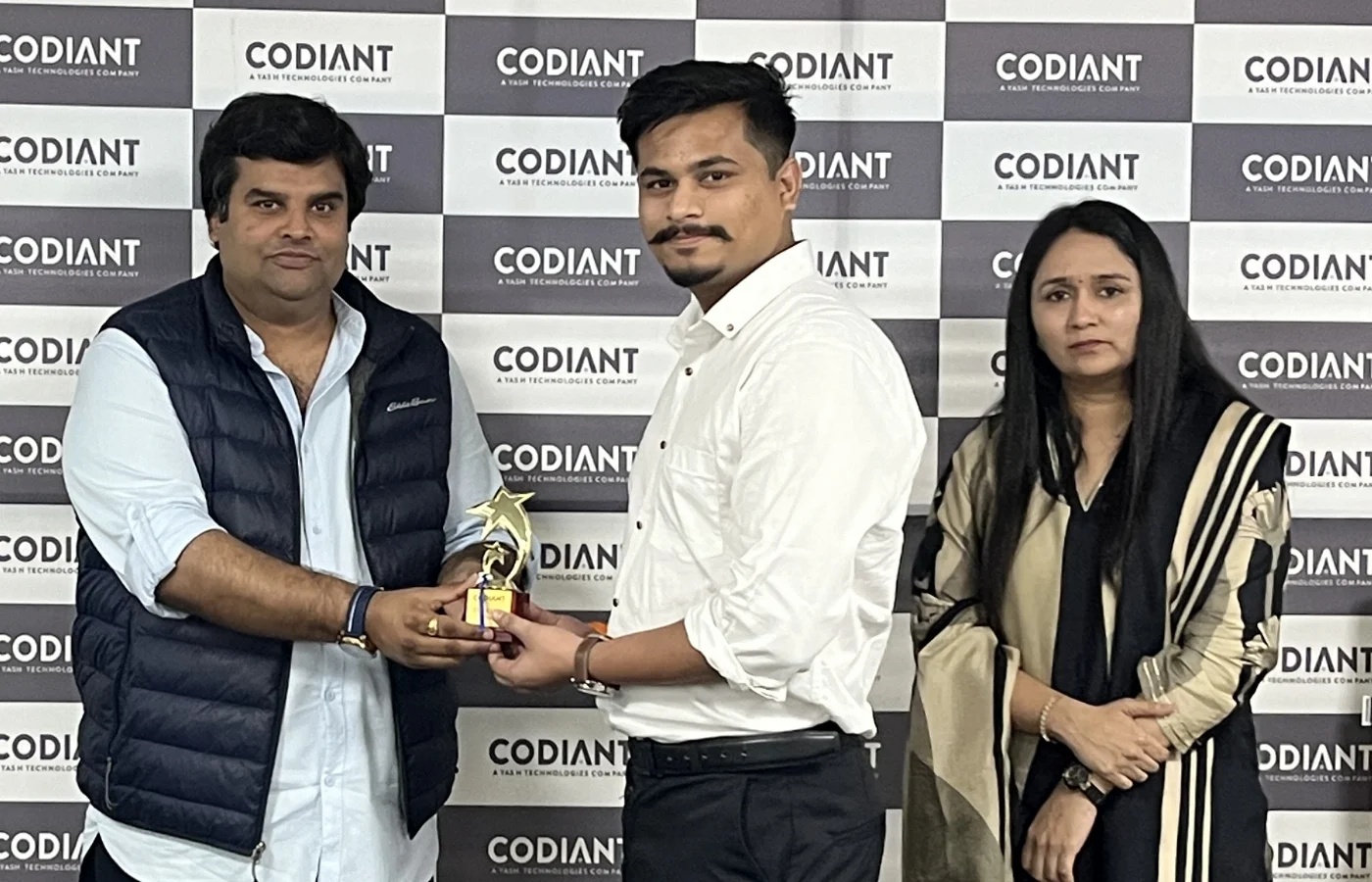
At Codiant’s 2025 recognition gathering, he appears beside colleagues presenting awards. The photograph supplies a welcome change of scale after the language of global delivery. There are people in the frame, a trophy between them and a company backdrop that leaves little danger of anyone forgetting where they work.
His stated vision gives room to employees’ different backgrounds and perspectives, and to their contribution to the business. That is an aspiration with everyday consequences for a founder whose product is made by teams. Software services depend on people being able to work together long enough to turn an agreement into something useful.
Jain closes his CEO message with an invitation: “We’re excited to start a visual dialogue, learn about you, and make something beautiful together.” The phrasing returns him to the beginning of the job. Before the prototype, the staffing plan or the AI demonstration, there is somebody to understand. Sixteen years after Neuron began, the next conversation is still available.