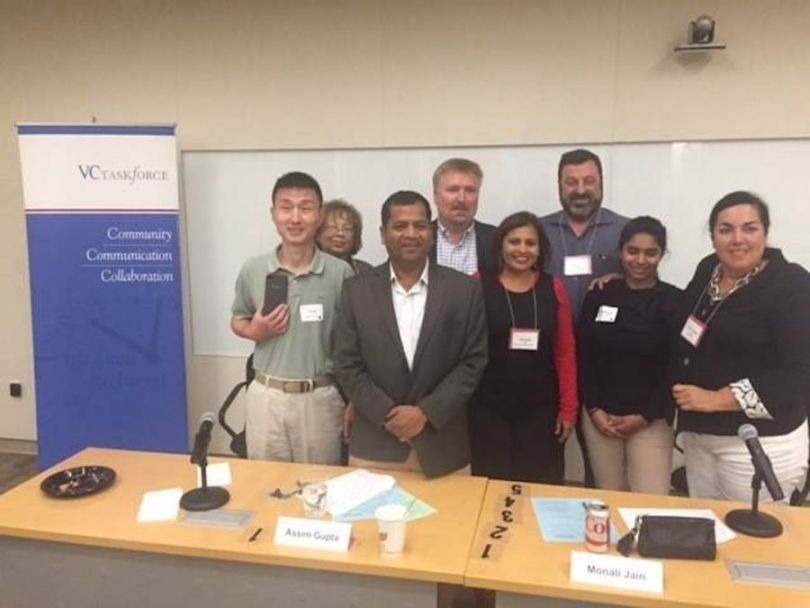
At a VC Taskforce gathering, the furniture tells part of the story. A long table. Microphones. Paper name cards. People standing together for a photograph. It looks like a meeting because it is one. For an entrepreneur trying to find an investor, that ordinary arrangement can be the difficult thing to obtain: a room in which somebody who understands financing will listen.
- VC Taskforce convenes founders, investors and company executives.
- Its formats combine introductions with questions, workshops and pitch feedback.
- The lesson: learn what the investor needs to decide before polishing the presentation.
Founded in 2001, the Silicon Valley organization works in the space between building a company and persuading someone to back it. Founder and CEO June Riley described the gap at a 2017 women’s business panel: startups needed help connecting with venture capitalists. That makes the organization’s problem easy to recognize. Its more interesting work begins after the introduction.
The room has two audiences
A founder arrives wanting money. A venture investor may arrive wanting a better understanding of a market, a portfolio problem or another investor’s experience. VC Taskforce’s stated constituency includes limited partners, institutional investors, private equity professionals and portfolio company management. A useful conversation has to accommodate people who are making different decisions.
Its program history reflects that breadth. In April 2007, an Emerging Technology Forum panel examined smart cities at Wilson Sonsini’s Palo Alto offices. The advertised speakers included Google’s municipal WiFi product manager, Streetline Networks’ CEO and San Francisco’s CIO. The subject was urban infrastructure becoming digital. The room put technology, government and capital within conversational distance.
Later that year, a breakfast at Perkins Coie asked what might get Microsoft to acquire a company. The questions included preparation, deal processes and deal killers. In 2009, a Sales Town Hall turned toward selling. These were practical operating concerns, the sort that remain after a founder has finished introducing the product.
What a ticket bought
The historical prices make the proposition concrete. The 2007 smart cities event advertised admission at $55 for members, $65 for affiliates and $87 for general attendees, with another $10 at the door. The program included a two-hour panel and questions, plus refreshments. Membership status changed the price of entering the conversation.
Tickets and sponsorship are visible pieces of the business model. Professional firms supplied more than a backdrop. Dorsey & Whitney sponsored a November 2013 gathering comparing four crowdfunding portals. Those arrangements gave the organization venues and institutional connections while giving sponsors a place in the venture discussion.
VC Taskforce sits in a recognizable market alongside pitch events such as PeopleConnect’s PitchForce and Startup Network’s competitions. Its calendar extended into investor education and company operations. A founder could seek feedback; a fund professional could seek peers. The common product was a structured occasion to exchange useful information.
The guidelines didn’t finish the job
By 2017, Riley could describe a persistent limitation. VC Taskforce had been running pitch events for a decade, yet founders remained unsure about the information investors needed, she said. Written guidelines had not settled the matter. Getting stage time and knowing what belongs in the pitch were separate problems.
“what information investors are looking for”
June Riley · 2017
Its second annual Finding Your First Investor conference addressed that gap with investor panels, audience questions and pitching opportunities. The November 2017 announcement advertised a $49 discounted ticket and named Hogan Lovells and Retirement Administration as major sponsors. The event promised a chance to hear investors explain their requirements themselves.
That is a useful design choice. A presentation coach can improve delivery. A person deciding whether to invest can expose a different weakness: the missing information that prevents a decision. The value of the exchange depends on whether the founder hears that distinction and does something with it.
One founder’s recommendation on Riley’s public professional profile describes that combination in human terms. Anita Darden Gardyne recalled making her first Silicon Valley pitch in front of Riley, then receiving coaching and introductions. It is an individual account, not an outcome study. But it points to something an event agenda cannot quite capture: a useful introduction may continue as a relationship after everyone goes home.
The organization’s subjects could also get technical. A 2013 presentation preserved by the US Patent and Trademark Office advertised a VC Taskforce software patent discussion with participants from Google, UC Berkeley and Santa Clara University. Expertise here meant assembling people who could examine a particular problem. The specificity supplied a reason to attend beyond collecting another handful of business cards.
Even venture capital has a family album
Another strand of the organization’s work looked backward. Its Innovation Catalyst Award began in 2009 with a gala honoring Franklin “Pitch” Johnson at a Tesla Motors showroom. The setting put an established venture figure inside a company associated with a newer generation of entrepreneurial ambition.
Dick Kramlich followed in 2010, Reid Hoffman in 2011 and the Draper family in 2012. Recognizing three generations of Drapers gave the community a particularly literal family history. For VC Taskforce, the ceremonies placed the people who had financed companies on the same public calendar as people still learning to ask for financing.
The organization also worked beyond its own events. Founder World’s 2018 announcement listed VC Taskforce among communities contributing educational boot camp content. Riley later promoted an Angel Lunch for investors to exchange insights. The formats changed, but the recurring activity was bringing people together around a question.
Copy the question
The practical lesson is available to a founder without a conference badge. Ask what the other person needs to know. Record the questions that keep returning. Revise the explanation around those gaps. This is an inference from VC Taskforce’s formats, and a more useful habit than treating every meeting as another chance to recite an unchanged deck.
It works best when the audience understands the company’s market and the founder has evidence worth discussing. An introduction cannot create customer demand, and a ticket cannot commit an investor’s capital. What a well-designed room can offer is earlier feedback, clearer expectations and a reason to continue the conversation. The next move belongs to the founder.