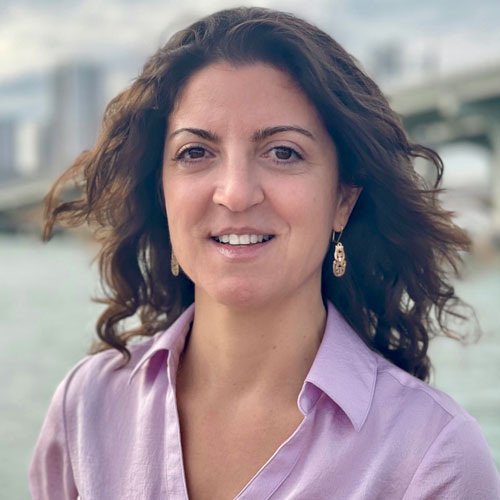
Profile
The Eye as Entrance
There's a detail Vicky Demas returns to in interviews: 80 to 90 percent of diabetic patients never see an ophthalmologist. They show up at primary care appointments for blood pressure checks and prescription refills. Thirty percent of them are quietly developing retinopathy - a leading cause of blindness - and no one in that room has the equipment or training to see it. That gap, she decided, was the problem. Not a feature request. A problem worth building a company around.
identifeye HEALTH, which she took over as CEO in 2021 and rebranded from the cryptic "Tesseract Health," is her answer. The company's AI-powered retinal camera - portable, FDA-registered, designed to be operated by a medical assistant with minimal training - captures clinic-quality fundus images and flags early signs of diabetic retinopathy, glaucoma, and macular degeneration in the same visit a patient already attends. No dilation required. No referral bottleneck. No specialist gatekeeping what the eye already knows.
The camera launched commercially in August 2025. Pilots are running with Remote Area Medical in Ohio and Dare to C.A.R.E. in Maryland - organizations that reach communities where specialist access is a theoretical concept, not a practical one. A Spanish-language version exists because a clinician asked for it and Demas's team built it. That feedback loop - from field to feature - is the operational philosophy in miniature.
"We can sit in isolation in our beautiful lab and build something. But what's really important is to test that the device or the prototype is safe."
- Vasiliki Demas, CEO, identifeye HEALTH
Before identifeye, Demas spent nearly a decade inside the laboratories where the architecture of modern precision medicine was poured. She was a founding member of Google Life Sciences - the initiative that eventually spun out of Google[x] to become Verily - when it was still a skunkworks project trying to figure out whether hardware could be as programmable as software. She led teams across diagnostics, medical devices, and translational lab science. When Verily's shape clarified, she moved to GRAIL, where she contributed foundational platform technology for the Galleri test: a single blood draw that screens for more than 50 types of cancer using cell-free DNA signal detection. Galleri is now commercially available. Demas holds 20+ patents that span the territory between those two eras.
The question a profile like this usually asks is: what's the through-line? For Demas, the answer comes out plainly. A career crystallizing moment arrived when she learned that infectious disease detection technology she had worked on helped save a patient's life. The abstraction - "diagnostic innovation" - collapsed into a specific person who did not die. That, she has said, is when she understood what she was building toward.
"Once I find a focus, a problem worth solving," she said in one interview, "it gives me that perseverance to speak to it until I see it through."
Origin Story
Engineer by Inheritance
Her father was an engineer. She adored him. At age 10, she visited Kennedy Space Center and wanted to work for NASA. What she eventually built - retinal imaging systems, cancer detection platforms, real-time AI diagnostic tools - is not so far from the original ambition: machines that see what human eyes cannot.
Demas earned her BS in Chemical Engineering at the University of Illinois Urbana-Champaign, then her PhD at UC Berkeley in Chemical Engineering and Physical Chemistry. Postdoctoral fellowships at Lawrence Berkeley National Laboratory and Livermore followed. The scientific formation was rigorous and quantitative. Then - unusually - she added an executive education at Harvard Medical School, earning an Executive MD in Medical Sciences and the Healthcare Ecosystem in 2015-2016. She didn't just cross disciplinary lines. She built a bridge between them.
The clinical literacy mattered. Understanding how hospitals actually work, what primary care physicians have time for, what a front desk assistant can reasonably operate - these aren't details you absorb in a materials science lab. They're what separate a device that works in a controlled study from one that survives a Tuesday morning at a federally qualified health center.
"It's really about finding a problem that's worth solving and truly understanding it. There has to be an unmet need because there have to be people that will help you drive adoption."
- Vasiliki Demas
Leadership Philosophy
The Right Kind of Obsession
Demas describes herself as "almost addicted to learning." She calls it the right kind of addiction - deep, productive obsession with problems that matter. It shows up in how she built the team at identifeye. When the company needed a new identity - shedding the Tesseract name for something that actually communicated what the technology does - she didn't hand it to a branding agency and wait. She pulled the whole team into the process. The name they chose together. The values encoded in it, collectively owned.
On fundraising, she is pragmatic without being cynical. "Market conditions I have no control over," she said during a period when medical device funding had tightened considerably. "Which means you need to focus on things you can control." Her approach: concrete milestones, defensible projections, relationships built over time rather than in the sprint before a close. The $90 million identifeye has raised - led by Foresite Capital, Glenview Capital Management, and Hildred, within the 4Catalyzer ecosystem - came from demonstrated progress, not promises.
She treats feedback the way a scientist treats data. Not personally. Not as criticism to deflect. As information that updates the model. The Spanish-language version of the platform didn't come from a market research report. A clinician asked for it. Demas's team shipped it.
The Technology
What the Eye Already Knows
The retina is one of the few places in the body where blood vessels and neural tissue can be observed directly and non-invasively. Ophthalmologists have known for decades that retinal changes correlate with systemic conditions - diabetes, hypertension, cardiovascular disease, neurological markers. What identifeye HEALTH built is a way to read those correlations at scale, in settings without specialists, using a camera that guides the user through image capture with real-time AI feedback on alignment and focus.
The platform is FDA-registered under 510(k)-exempt classification. It does not require pupil dilation. It outputs clinical-grade images that can be read by automated AI or reviewed by remote specialists. In practice, a medical assistant runs it as part of a standard primary care visit. The whole workflow adds minutes, not a referral waiting list.
The broader vision - retinal biomarkers as windows into systemic and neurological disease - is where identifeye HEALTH is building. Diabetic retinopathy is the first commercial application. The eye, as Demas has described it, is a window. The question is how much it can eventually show.
Education
Built at the Intersection
BS, Chemical Engineering
Univ. of Illinois Urbana-Champaign
1999 - 2001
PhD, Chemical Engineering / Physical Chemistry
University of California, Berkeley
2001 - 2006
Postdoctoral Fellowship
Lawrence Berkeley & Livermore National Labs
Post-2006
Executive MD, Medical Sciences
Harvard Medical School
2015 - 2016
In Her Own Words
Quotes Worth Keeping
"I'm almost addicted to learning. I do think that's probably one of the most exciting parts of life."
"Once I find a focus, a problem worth solving, it gives me that perseverance to speak to it until I see it through."
"Market conditions I have no control over, which means you need to focus on things you can control."
"There has to be an unmet need because there have to be people that will help you drive adoption."
Career Timeline
The Long Arc
1999-2006
BS → PhD in Chemical Engineering, University of Illinois then UC Berkeley. Postdoctoral fellowship at Lawrence Berkeley and Livermore National Laboratories.
Early Career
Engineering consulting work; senior positions at T2 Biosystems in diagnostic innovation.
2013
Founding member of Google Life Sciences (later Verily), built inside Google[x]. Led teams across diagnostics, medical devices, and translational lab science as the spinout took shape.
2015-2016
Executive MD at Harvard Medical School - adding clinical fluency to an engineering foundation.
2016
Joined GRAIL; contributed foundational platform technology for the Galleri multi-cancer early detection test - now commercially available, detecting 50+ cancer types from a blood draw.
2021
CEO and Founder at identifeye HEALTH (formerly Tesseract Health). Led rebrand, strategic repositioning, and Series B close at $80M.
2023-2024
Keynote/plenary speaker at Design Day 2023; featured at HLTH US 2024. Continued platform development, partner clinics, and commercial infrastructure build.
August 2025
Commercial launch of identifeye AI retinal screening platform. Pilots with Remote Area Medical (Ohio) and Dare to C.A.R.E. (Maryland).
Watch
Vicky Demas on Video
The AI Podcast - Interview #48 with Vicky Demas
YouTube · January 2025
HLTH US 2024 - Dr Vicky Demas, identifeye HEALTH
YouTube · January 2025
Design Day 2023 Plenary Session - Vicky Demas
YouTube · May 2023
Broadcom Design_Code_Build with Vicky Demas
YouTube · April 2016