The St. Louis Startup Giving Away Its Pandemic-Detecting Breakthrough
Two brothers, a sensor the size of a credit-card chip, and a $20 million bet from Vitalik Buterin - Varro wants to catch the next pandemic in 60 seconds, then hand the recipe to the world.
In 2020, most of the world learned the same uncomfortable lesson at roughly the same time: we find out about airborne threats far too late. A cough travels a room in a second. A lab result takes a day, sometimes three. Varro Life Sciences, a company run by two brothers out of St. Louis, was built to close that gap - and then it did something biotech almost never does. It decided to give the core invention away.
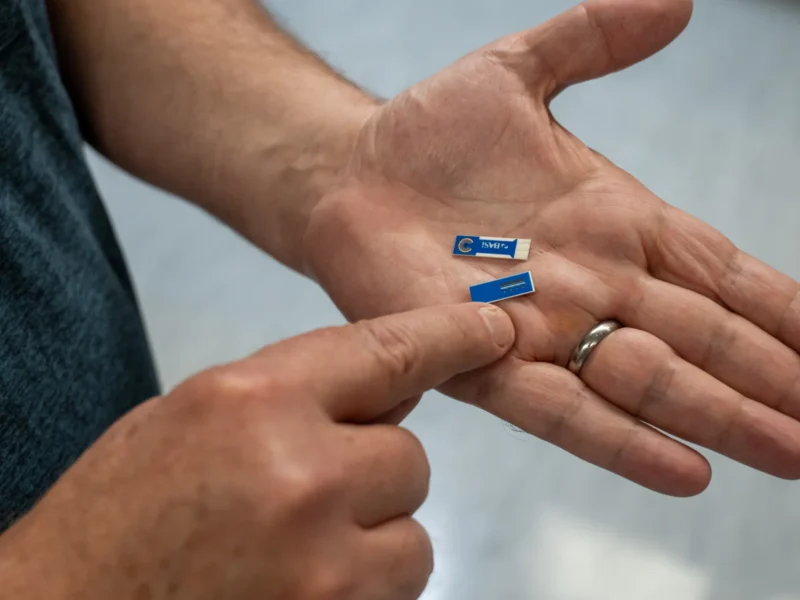
Varro makes a biosensor called a micro-immuno electrode, or MIE. Tom Cirrito, the company's CEO, chairman and co-founder, describes it as the "secret sauce" - essentially a bridge between a semiconductor and the biological world. It is slightly larger than the gold chip on a credit card, and it can identify a pathogen with PCR-level sensitivity in seconds rather than the hours or days a lab needs. In one demonstration, the platform flagged as few as ten SARS-CoV-2 particles in about twenty seconds.
The science came out of Washington University in St. Louis, where Tom's brother, John Cirrito, is a professor of neurology. Varro holds an exclusive license to the platform, which was developed by university faculty with support from the National Institutes of Health's RADx program and the Flu Lab foundation. What started as academic instrumentation became a company - one that now occupies a purpose-built clean room in the Cortex Innovation District.
What it actually doesA smoke detector, but for viruses
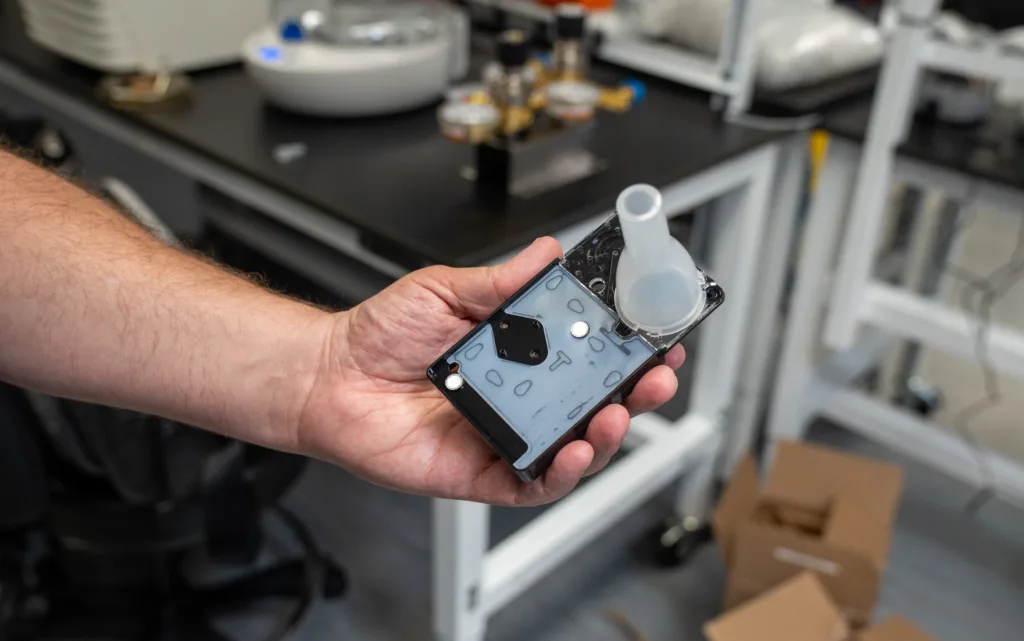
Varro packages the MIE into two very different devices. The first is a breath-based diagnostic - a handheld unit often compared to a kazoo. You exhale into it, and about a minute later it tells you whether it detected Influenza A or B, RSV, or COVID-19. It needs minimal training to use, which is the point: the value only shows up if a school nurse, a clinic aide, or a front-desk worker can run it without a lab tech standing by.
The second is the Pathogen Air Biodetector, a continuous monitor for shared indoor air. Instead of testing a person, it watches a room - a classroom, a waiting room, an office, a senior living center - and looks for airborne pathogens in real time. Think of it as an early-warning layer for buildings, the environmental cousin of the personal test.
Time to a result, by method
Approximate, illustrative. Speed is not the same as regulatory approval; Varro's devices are still moving through development and commercialization.
The counterintuitive partWhy give the invention away?
Here is the move that makes Varro interesting. Rather than locking its breakthrough behind patents, the company pledged not to enforce them and published its designs openly - software under the GNU General Public License, hardware under Creative Commons Attribution-ShareAlike 4.0. It runs a public GitHub organization and a Discord community, and released three core technologies into the open. As Cirrito put it, "There's not a lot of precedent for this in biotech."
The logic is less charity than strategy. Anyone can copy a design; almost no one can cheaply manufacture the sensor at the heart of it. That is where Varro plans to make its money - producing the micro-immuno electrode at semiconductor scale and selling it to whoever wants to build products on the open platform. "Margins will be lower, but we'll be selling hopefully many more of them," Cirrito has said. "Our manufacturing capacity is essentially infinite."
Given away
Designs, firmware and documentation - published under copyleft licenses so any developer, hospital or government can build with them.
Sold at scale
The micro-immuno electrode itself - the hardest, most capital-intensive component - manufactured in Varro's clean room and shipped in volume.
It is copyleft applied to a medical device, and it reframes the competitive question. Varro is not trying to be the only company with the idea. It is trying to be the cheapest, most reliable place to get the part - the way a foundry sells chips to companies that design their own.
The moneyGrants, a foundation, and a crypto founder
Varro has raised its war chest almost entirely without selling equity. Roughly $8.4 million came from federal grants through the NIH's RADx program, and about $3.6 million from Flu Lab, a foundation reportedly backed by Google co-founder Larry Page. Then, in October 2024, the company announced $20 million in non-dilutive funding from Ethereum co-founder Vitalik Buterin's Kanro fund - delivered, fittingly for the source, as USDC stablecoin.
Buterin's money came with a condition that fit the company's instincts: open-source the technology. His stated reason reads like a mission line for the whole project. "A d/acc future is one where everyone can verify that the air they breathe is clean and free from airborne pathogens," he said. Balvi and Kanro, his scientific-finance and donation vehicles, have distributed hundreds of millions toward biosecurity and pandemic prevention.
The build-outA biosensor foundry in the Midwest
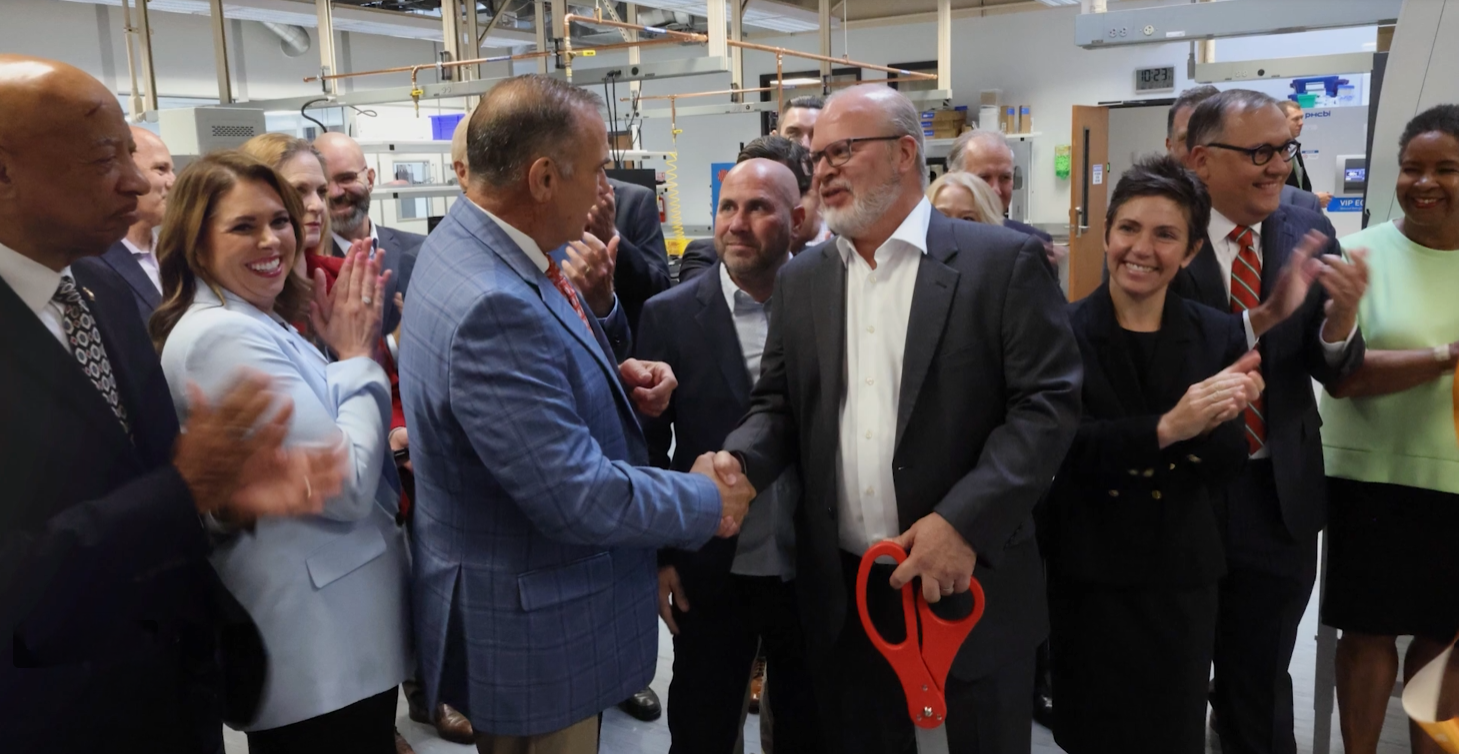
In August 2025, Varro opened a $42.5 million lab, R&D and manufacturing facility at CIC St. Louis in the Cortex Innovation District, a move expected to create 33 jobs. Missouri Governor Mike Kehoe and St. Louis Mayor Cara Spencer helped cut the ribbon. The centerpiece is a clean room designed like a semiconductor foundry, with filtration and temperature controls - because the biosensor really is a chip, one that happens to talk to biology.
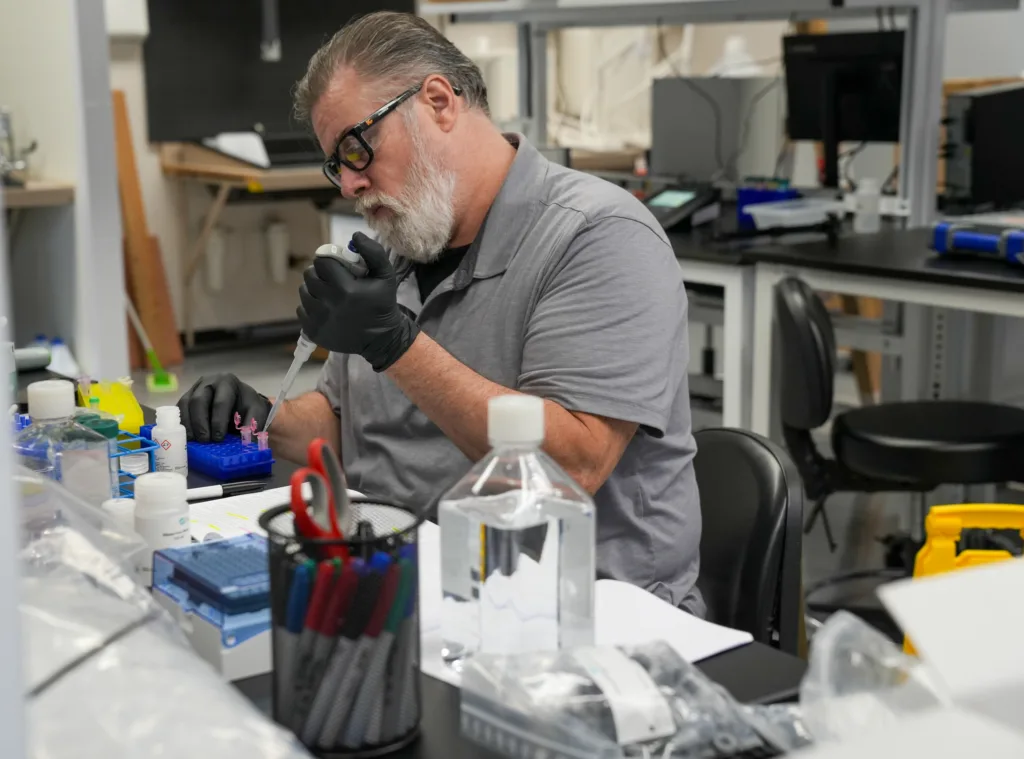
The location is not incidental. St. Louis has spent a decade trying to convert Washington University's research output into companies, and Varro is a clean example: a faculty discovery, an exclusive license, a founder who happens to be the inventor's brother, and a manufacturing plan that keeps the jobs local. The company employs around 19 people today, with the expansion adding to that.
Who it is forRooms full of people who share air
Varro's customers are, broadly, anyone responsible for a room full of people who breathe the same air. That means schools and clinics, offices and senior living centers, hospitals, and public-health and biodefense buyers on the government side. The open-source layer widens the circle further: developers and hardware builders who take the freely published designs and adapt them for settings Varro would never reach on its own. The company is early - commercialization is ramping through 2025 and 2026 - but the target is deliberately broad, because a surveillance network only works if it is everywhere at once.
There is also a cultural signal in how Varro operates. The company attends open-source hardware conferences, showed up at a UN health assembly, and signed a global pledge on pandemic-prevention technology. Addie Cobb, its ecosystem architect, argues that the hard part of open source is not the code but "the human aspect of it - the relationship between individuals." For a biotech company, that is an unusual thing to say out loud, and it tells you where Varro thinks the real work is.
Where it fitsSpeed, cost, and openness against the field
Varro sits between two established markets. On one side are diagnostics - central-lab PCR and rapid antigen tests from the likes of Abbott and Cepheid, accurate but either slow or comparatively blunt. On the other side is environmental pathogen surveillance, still an emerging category. Varro's pitch is not that it beats any single competitor on their home turf, but that it collapses the trade-off: lab-grade sensitivity, delivered in seconds, at a price low enough to put in a classroom - and open enough that a public-health agency in a developing country can build on it directly.
The ambition that ties it together is speed against the unknown. Varro says the platform can be tuned to detect a newly emerged airborne virus, bacterium or fungus within weeks - the difference, in a future outbreak, between watching a curve and getting ahead of it. Whether the regulatory and commercial path matches the science is the open question every young diagnostics company faces. For now, Varro has done the harder rhetorical thing: made a genuinely novel bet - open the design, sell the sensor - and put real money behind it.
What can a reader take from this? The reusable idea is the open-plus-foundry model: give away the part everyone can copy, and own the part almost no one can make. It works when your defensible moat is manufacturing rather than IP, and when a large, underserved market rewards ubiquity over exclusivity. It would not work for a company whose only edge is a patent, or one selling into a market too small to reward volume. Varro is a live test of whether that trade makes sense in medicine.