Before the new warehouse, there was the awkward business of saying no. Valley Wide Beverage had brands it could have distributed and too little room to take them. A beverage company can spend years earning the right to carry a drink, then discover that its next opportunity depends on a surprisingly ordinary question: where will the pallets go?
- A family wholesaler puts major beverage brands into Central Valley stores and hospitality businesses.
- A crowded warehouse helped force a move; another expansion followed.
- The old building found a second career distributing food.
The Fresno company occupies the space between the name on the bottle and the place that sells it. Its work includes warehousing, sales and delivery. The shopper sees the label. The retailer needs the stock. Valley Wide’s usefulness lies in making those two things meet, repeatedly, across a large patch of California.
The building that said no
In December 2017, The Business Journal described a distributor squeezed by its own acquisitions. New brands had been declined because the existing facility lacked space. Lou Amendola, the founder, was considering whether to expand or relocate. Then California’s planned high-speed rail alignment made the calculation much less comfortable.
The problem was underneath the train. Support pillars would occupy parking space; restrictions would interfere with truck use and leave little room to expand. Relocation became the practical option. Amendola described the new facility as a project costing more than $30 million. That was his reported budget at the time.
“We’re in the center of the state of California. I thought this was the perfect distribution center.”
Lou Amendola · ABC30 · 2018
The replacement opened in 2018. ABC30 reported a refrigerated section, beverage-wrapping technology and rooftop solar. It also recorded the daily movement: roughly 25 to 35 incoming truckloads and 50 to 60 outgoing ones. Those were a snapshot of operations then, but they explain the building better than an architectural photograph could.
A route is a relationship
Valley Wide began when Amendola bought a Coors distributorship in Yuba City in 1981. Subsequent acquisitions brought the business to Fresno and widened its footprint. Today its published territory covers Fresno, Madera, Merced, Kings and Tulare counties, most of Mariposa County and selected communities in southern Stanislaus County.
Its suppliers include Molson Coors, Constellation Brands, Heineken USA and Diageo. The range extends beyond beer into wine, spirits and non-alcoholic drinks. For a restaurant or store, the attraction is access to a portfolio through an established regional operation. For a supplier, it is a working path to local accounts.
+ delivery→Retailer
The supplier inquiry form is revealing. Alongside the brand and product category, it asks about chain mandates and other retail commitments. A good drink needs somewhere to land. For a producer approaching Valley Wide, evidence of retailer interest belongs in the conversation alongside the product itself. The form makes that commercial question visible before anyone schedules a delivery.
The business model is wholesale distribution. Its market position rests on supplier access, territorial reach and the ability to handle stock. A different distributor may carry different rights and brands. Retailers cannot assume that another delivery truck offers an interchangeable catalog. The relationship has a physical footprint and a commercial boundary.
Growth needs somewhere to sit
January 2023 reporting put the company at more than 4,000 customers and over 1,300 stock-keeping units. Following a March 2022 local Constellation portfolio acquisition, the business had grown about 15 to 20 percent. More selling opportunities produced an immediate operating requirement: more storage.
The response was 150,000 additional square feet, bringing the reported total to 500,000, plus 20 loading docks for a total of 50. About 50 additional employees were being added. Planning and construction had taken roughly two years. Winning the volume and being ready to handle it operated on different clocks.
500,000 total reported footprint. Added space represents 30% of that total.
There is a useful lesson here for anyone building a business around physical goods: inspect the constraint before celebrating the sale. Shelf demand, warehouse space, dock capacity and staffing have to agree. Copying the expansion without dependable volume or access to desirable brands would leave a much less cheerful asset: expensive empty space.
The sun clocks out. The coolers do not.
Electricity creates another capacity problem. Generac’s project account describes around 1.5 megawatts of solar and 330 kilowatt-hours of battery storage at Valley Wide’s Fresno distribution center. Its controller coordinates production, batteries and facility demand. Sunshine helps during the day; stored energy can be discharged as solar production falls.
The point is timing. Generac describes managing demand charges and time-of-use costs, with the batteries responding when consumption crosses a chosen limit. That makes this an operating-cost decision as well as an environmental one. The lesson travels only with its conditions: electricity tariffs, load patterns and system costs determine whether another warehouse gets similar value.
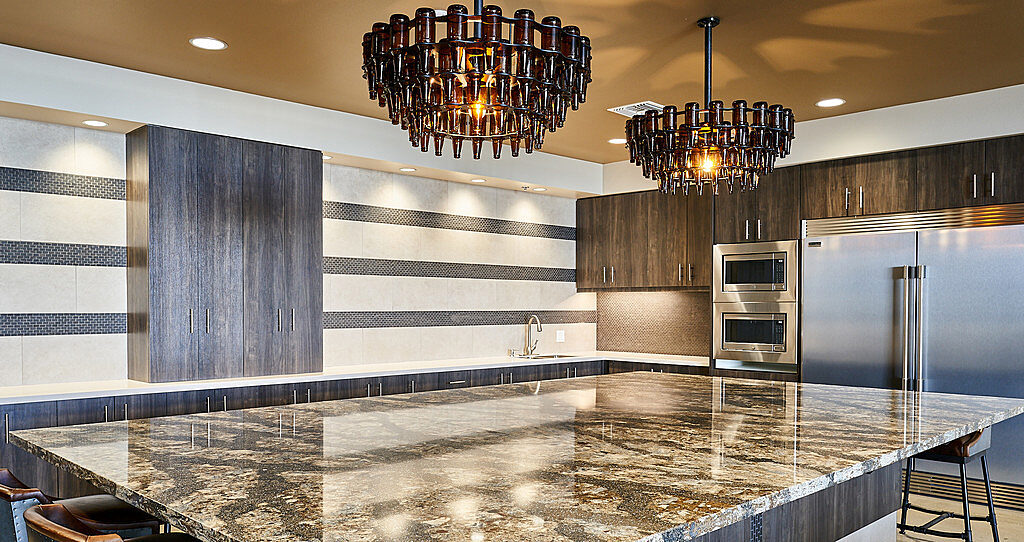
Inside, the company found a more playful use for its inventory’s packaging. Facility Designs describes custom chandeliers made from Lagunitas bottles. Its project also brought distribution, sales, administration and warehousing teams into one complex, with a sales room that doubles as event space. Even the break room gets a brand partnership.
The next tenant needed room, too
The old warehouse’s story did not end with the move. The Amendola family offered it to Central California Food Bank at a discounted price. ABC30 later reported a $1 million donation as well. A building that had become restrictive for one distribution operation could give another room to work.
Even payment has two routes. The company advertises Fintech Distributor Autopay as a no-cost option for automating beverage invoices. Customers who prefer to initiate an electronic payment themselves can use PayLink through DSDLink. These tools handle the administrative end of a physical transaction. They also show how a regional wholesaler uses outside software without becoming a software company.
For prospective customers, Valley Wide’s website offers a new-account form requesting an ABC license number, DSDLink ordering and electronic payment options. Suppliers can submit a new-brand inquiry, including retail commitments. These are practical doors into the business. Beyond them sits the enduring job: making enough room for the next delivery, and enough demand to justify it.