A business can spend years getting its software right, then discover that getting it right again will require taking it apart. Upen Varanasi reached that awkward passage at Riversand. The company he had co-founded in 2001 already had customers, an established product, and a place in the enterprise data business. By the middle of the next decade, he was making the case for a different foundation. Success, it appeared, came with the occasional obligation to disturb the furniture.
The decision gives his story its shape. There is the long stretch of building Riversand with co-founder Anil Kini; the move toward a cloud platform; institutional funding in 2017; and the acquisition by Syndigo in May 2021. Running through those milestones is a fairly practical question: what should happen after a company has collected all that information?
For Varanasi, the answer kept returning to what people could do with it. A tidy record has its virtues. A record that helps someone make a decision has a rather more persuasive business case.
Before the cloud, an engineer’s education
Varanasi studied mechanical engineering at the Indian Institute of Technology Madras, earning a B.Tech, and then completed a master’s in mechanical engineering at the University of Missouri-Rolla. His eventual business would deal in products, their attributes, and the information that follows them between organisations. The subject matter changed from physical engineering to enterprise software; products remained somewhere in the picture.
Houston became his base. Riversand began there in 2001, with Varanasi and Kini building a business in product information management and master data management. Those names do little to advertise the human inconvenience underneath them. A product passes through many hands before anyone buys it. Each hand may belong to a different department, supplier, or retailer, with a different system and a slightly different description of the same thing.
Consider a hypothetical retailer trying to put a new item on sale. Dimensions arrive from one place, photographs from another, and a supplier’s identifying code from somewhere else. Someone has to make those details agree and get them into the right channels. It is an unromantic assignment, although customers tend to notice when it goes wrong.
Riversand made that territory its business. Product information management concentrates on the information needed to describe and sell products. Master data management reaches across core business records. Varanasi spent his chief executive years working in that intersection, where an apparently modest disagreement about a record can become everybody’s afternoon.
Sixteen years to a Series A
By the time Riversand announced its $35 million Series A, on June 5, 2017, it was sixteen years old. That interval is a useful corrective to the impression that every software company begins life with a financing announcement. At a later TiE Silicon Valley event, Varanasi’s entrepreneurial story was introduced as a journey of bootstrapping the company from its 2001 beginnings.
The 2017 funding, led by Crestline Investors, had a stated purpose: further development of the MDM 2.0 platform and expansion internationally. Riversand already had offices beyond Houston, including Bengaluru, London, Stuttgart, Switzerland, and Sydney. More capital was intended to support product work, sales, and marketing across markets.
The company reported annualised revenue growth above 25 percent over the preceding six years. That is a historical company figure, rather than a forecast or a measure of Varanasi’s personal fortune. It describes a business that had been growing before the institutional round arrived. By 2017, the question was how to support the next stage without remaining tied to the assumptions of the previous one.
Software has a deliciously inconvenient habit of turning yesterday’s sensible choice into tomorrow’s constraint. A founder who has spent years defending a product must sometimes become the person arguing for its replacement. Varanasi’s cloud programme belongs to that less photogenic part of entrepreneurship.
The rebuild beneath the business
In 2017, Varanasi was already describing a shift in what customers expected from data. Reliable internal records still mattered, but businesses also wanted to understand the interactions happening around them: consumer responses, channels, assortments, and connected devices. He argued that information arriving from outside an enterprise needed to inform its decisions alongside the records already inside it.
His account of Riversand’s roadmap placed its beginnings in 2015, with the MDM 2.0 and PIM 2.0 vision taking shape in 2016. He also described changes to the organisation around customer and partner services. The ambition involved the business supporting the software as well as the software itself.
“We have dared to step back at times in order to take a bigger leap forward.”
Upen Varanasi, 2018
In July 2018, Riversand announced a release built around its integrated data platform and a suite of business applications. The initial applications covered product information, a vendor portal, and digital assets. Shared data underneath the applications was central to the design. Customers would work on particular tasks while the platform supplied a common foundation.
The release followed use by a small group of customers whose feedback helped prepare it for a wider market. That detail is worth lingering over. A platform can look wonderfully complete in a presentation. Customers have a talent for introducing situations the presentation neglected to invite.
Varanasi’s explanation of the rebuild emphasised the business user and the practical work at the end of a data process. His stated priorities included quicker implementation, recommendations, and less repetitive stewardship. The attraction was tangible: people might spend more time acting on information and less time tending it.
A photograph with the cloud in the background
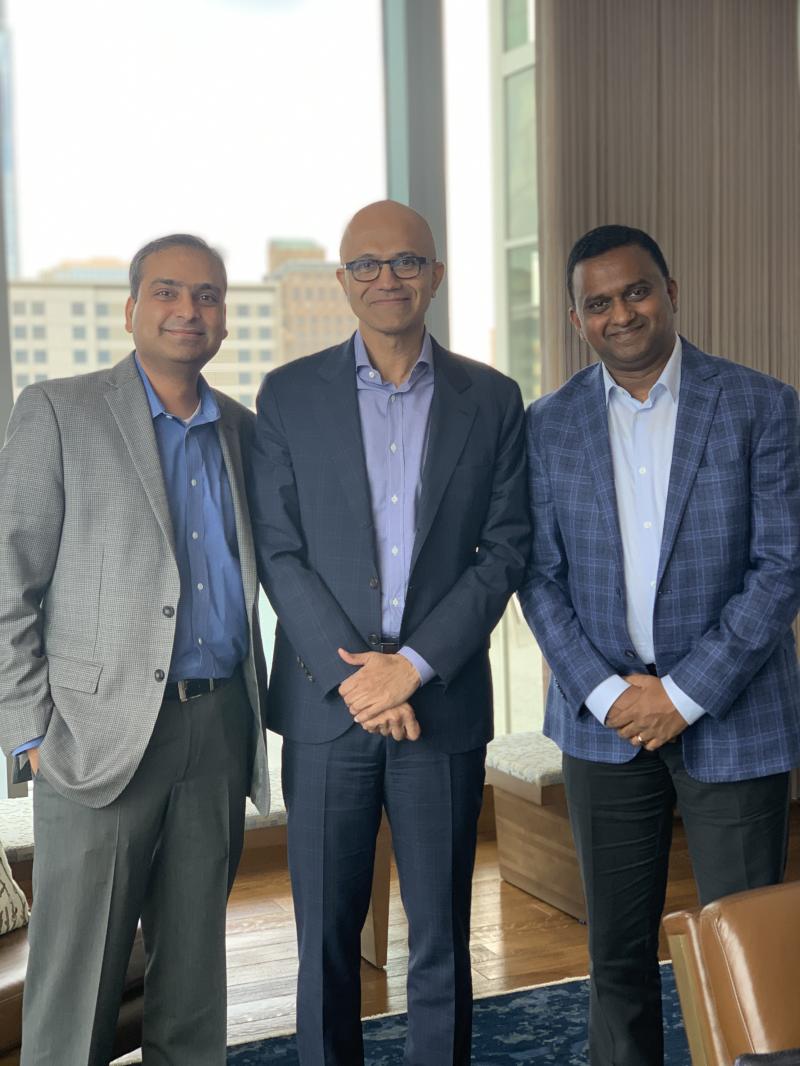
In 2019, Riversand shared a photograph of Varanasi meeting Microsoft chief executive Satya Nadella. Varanasi stands to the right, wearing a blue checked jacket. Nadella is in the centre. The accompanying company post connected the meeting to cloud-native data management and Microsoft Azure.
It makes an unusually literal illustration of Varanasi’s place in the business: an enterprise software founder building within a much larger technology ecosystem. The photograph records a meeting. Around it sits the longer work of making platforms, customers, and partners fit together.
His public posts from Riversand Confluence Europe in Amsterdam that year give a more conversational glimpse. He thanked speakers, including Scott Taylor and Dr. Tu-Lam Pham, and said he had learned about the influencer business from Pham’s presentation. The subjects stretched beyond the expected catalogue of enterprise software concerns.
That willingness to credit a lesson is a small but pleasing detail. A data conference had room for a discussion of changing audiences and digital culture. The chief executive was publicly acknowledging that he, too, had something to learn.
Recognition, then a change of ownership
In December 2019, Crestline supplied another $10 million. Riversand intended to use the additional investment for continued product development and growth, including sales, marketing, and new geographies. The sequence matters: a new platform had reached the market, and further money followed to support its expansion.
On February 2, 2021, Riversand announced that it had been placed in the Leaders quadrant of Gartner’s January report for master data management solutions. The company had occupied the Visionaries quadrant in the four preceding reports. For Varanasi, it was a visible milestone after years of work in the same field.
Then, on May 27, Syndigo announced its acquisition of Riversand. The fit brought Riversand’s master data and product information capabilities together with Syndigo’s content syndication and analytics business. Varanasi’s explanation centred on the information supply chain serving customers. The business he had helped build would become part of a broader set of commerce tools.
A transaction compresses a long company history into an announcement and a date. Here, the span from founding to acquisition was twenty years. The more revealing story occupies the space between those two numbers: a company had to keep serving customers while changing the technology on which its next chapter depended.
The next founders in the room
Before that acquisition, Varanasi had already taken an interest in people beginning their own entrepreneurial education. In January 2021, Moonpreneur announced him as an investor and advisor. He spoke of the interest he and his wife, Mythily Varanasi, shared in children’s education and preparing young people for changing work.
He wanted children to encounter entrepreneurship early. That interest offers a personal counterpoint to the long Riversand timeline. After spending years building a company, he was supporting a programme that lets younger people start experimenting with ideas, projects, and products.
His subsequent roles keep him close to business building. GrowthAXL lists him as Group Chairman. The Houston-based startup studio works on taking product ideas through development and execution. TADA also lists him on its board of directors, with a remit that includes guidance on its SaaS business and operating strategy.
In June 2022, TiE Silicon Valley invited him to discuss his entrepreneurial journey in its My Story programme. There is a fitting change of position in that invitation: someone who had spent two decades making decisions inside one company could now explain them to people making decisions inside theirs.
Varanasi’s career makes patience look rather active. It includes staying with a difficult business problem, finding that the original solution needs rebuilding, and carrying those lessons into other ventures. For someone whose work concerns information, that may be the most useful kind to pass on: knowledge with a few years of use behind it.