A freight car can spend a remarkable amount of its working life doing absolutely nothing. In 2025, Union Pacific’s average terminal dwell was 20.9 hours. That is the time cars spend inside terminals, where trains are sorted and assembled. Consider what that means for a company selling movement. Some of its most consequential work happens while the wheels are still.
- Union Pacific sells long-distance freight transportation, with trucks and other railroads extending its reach.
- Its geographic advantage includes access to all six major U.S.-Mexico rail gateways.
- The Norfolk Southern merger proposal promises fewer handoffs. Approval and execution remain the tests.
The railroad reported freight-car velocity of 225 daily miles per car in 2025, up 8%. This measures progress across time, rather than a locomotive’s speedometer reading. It rewards an organization for getting freight through the system. For a grain processor, automaker or retailer, that distinction matters: a fast train is useful only when the shipment arrives when needed.
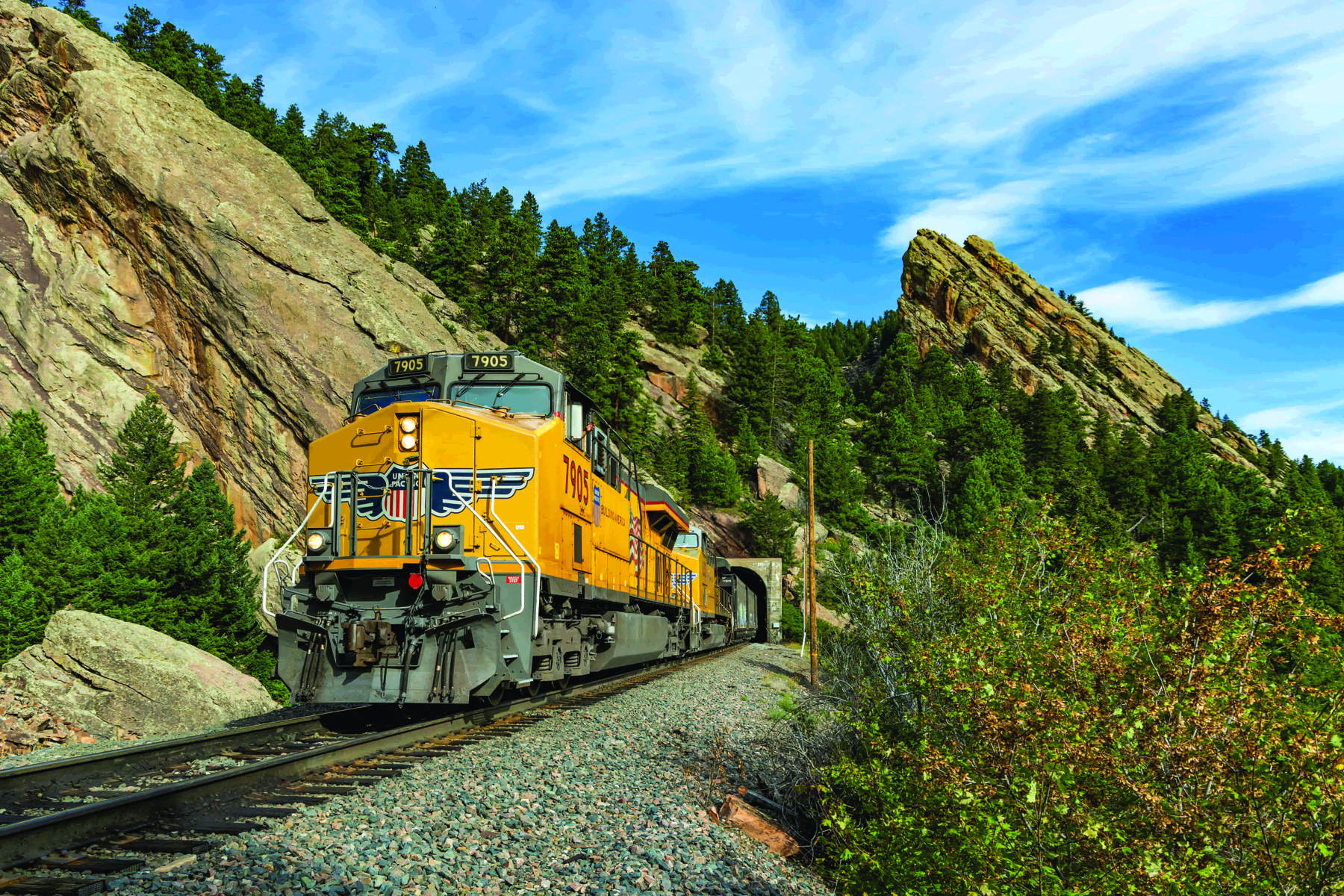
The business between the rails
Union Pacific carries the ingredients of everyday life: grain, fertilizer, chemicals, lumber, finished vehicles and containers. Its customers include producers shipping heavy materials, manufacturers connecting plants and logistics companies moving other people’s goods. The parent corporation generated about $24.5 billion in operating revenue in 2025. This is a business paid to make an enormous number of separate journeys behave predictably.
There are several ways to buy that journey. A rail-served plant can load a freight car directly. An intermodal customer uses a container that can travel by ship, train and truck. A business without a siding can use transloading, transferring products between road vehicles and railcars. Union Pacific’s Loup Logistics subsidiary helps arrange that bridge between modes.
Schneider supplies a useful example. Union Pacific became its primary western U.S. intermodal rail provider in January 2023. Schneider handles the critical first and last miles. The train handles the long middle. Trucking, so often described as rail’s competitor, becomes the means of reaching customers the tracks cannot reach themselves.
- 01Truck
Pickup - 02Terminal
Transfer - 03Rail
Long haul - 04Truck
Delivery
Illustrative journey. The connections are part of the product.
The selling point is partly geography. Union Pacific’s western network meets ports, border crossings and connecting carriers. BNSF is its principal western rail rival; trucks compete wherever speed and flexibility outweigh rail’s economics. Access to all six major U.S.-Mexico rail gateways gives Union Pacific multiple ways to participate in cross-border manufacturing and trade.
The traffic jam that belongs in the pitch
The company began with a federal law. Abraham Lincoln signed the Pacific Railway Act in 1862, creating Union Pacific. Seven years later its tracks met Central Pacific’s at Promontory Summit. The transcontinental connection was built by two railroads. Even the origin story contains a handoff.
Expansion later exposed the difficulty of making connected networks function as one. The Southern Pacific merger took effect in September 1996. Congestion followed in 1997, and Union Pacific filed a service recovery plan that October. The immediate failure was operational: freight could not flow adequately through the enlarged system. A bigger map had produced a very practical bottleneck.
The response carried a price tag. In May 1998, Union Pacific filed a five-year plan calling for $1.4 billion of capacity investment in Texas and Louisiana. That was a proposed regional remedy, rather than an accounting of every loss from the disruption. The episode offers a warning for anyone combining businesses: connections on a diagram still need capacity on the ground.
Even the origin story contains a handoff.1869 / UNION PACIFIC MEETS CENTRAL PACIFIC
A bigger map, a harder test
In July 2025, Union Pacific and Norfolk Southern announced a stock-and-cash combination that valued Norfolk Southern at an enterprise value of $85 billion. The proposed network would cover more than 50,000 route miles across 43 states. The commercial argument is straightforward: remove some exchanges between carriers and make cross-country rail more attractive to shippers.
Jim Vena put the breadth of the business neatly: “You name it, and at some point, the railroad hauled it.” Steel, tomato paste and plastics featured in his announcement. These are different supply chains with a common irritation: every extra transfer can introduce another wait, another coordination problem and another opportunity for the delivery plan to slip.
Regulators require more than an appealing route map. After the first application was rejected as incomplete, the companies submitted a revised application. The Surface Transportation Board accepted it for consideration in May 2026 but paused proceedings for additional information. In August, the board resumed the process and set a schedule. Those procedural steps did not decide the merger’s merits.
By September 22, the companies reported that requests to dismiss the revised application had been denied. They continued to target a second-half 2027 closing, subject to approval. Their argument had also become more specific: convert 10,000 interline lanes to single-line service. Those are proposed changes. Whether shippers receive better service at competitive prices remains the question the review must examine.
Leave room for the surprise
The existing network still needs investment. Union Pacific’s 2025 capital program totaled roughly $3.5 billion, while cash capital investments, including lease buyouts, reached $3.791 billion. Replacement infrastructure absorbed much of that cash. Keeping a railroad useful involves repeatedly buying the less photogenic essentials: ties, rail, ballast, bridges and signals.
There is a less obvious investment: slack. During the unexpected 2024 import surge, Union Pacific repositioned equipment and used overtime. Vena described keeping about 500 stored locomotives ready for shifts in demand. Spare equipment costs money before it earns any. Its value appears when the plan changes and the railroad can still accept the freight.
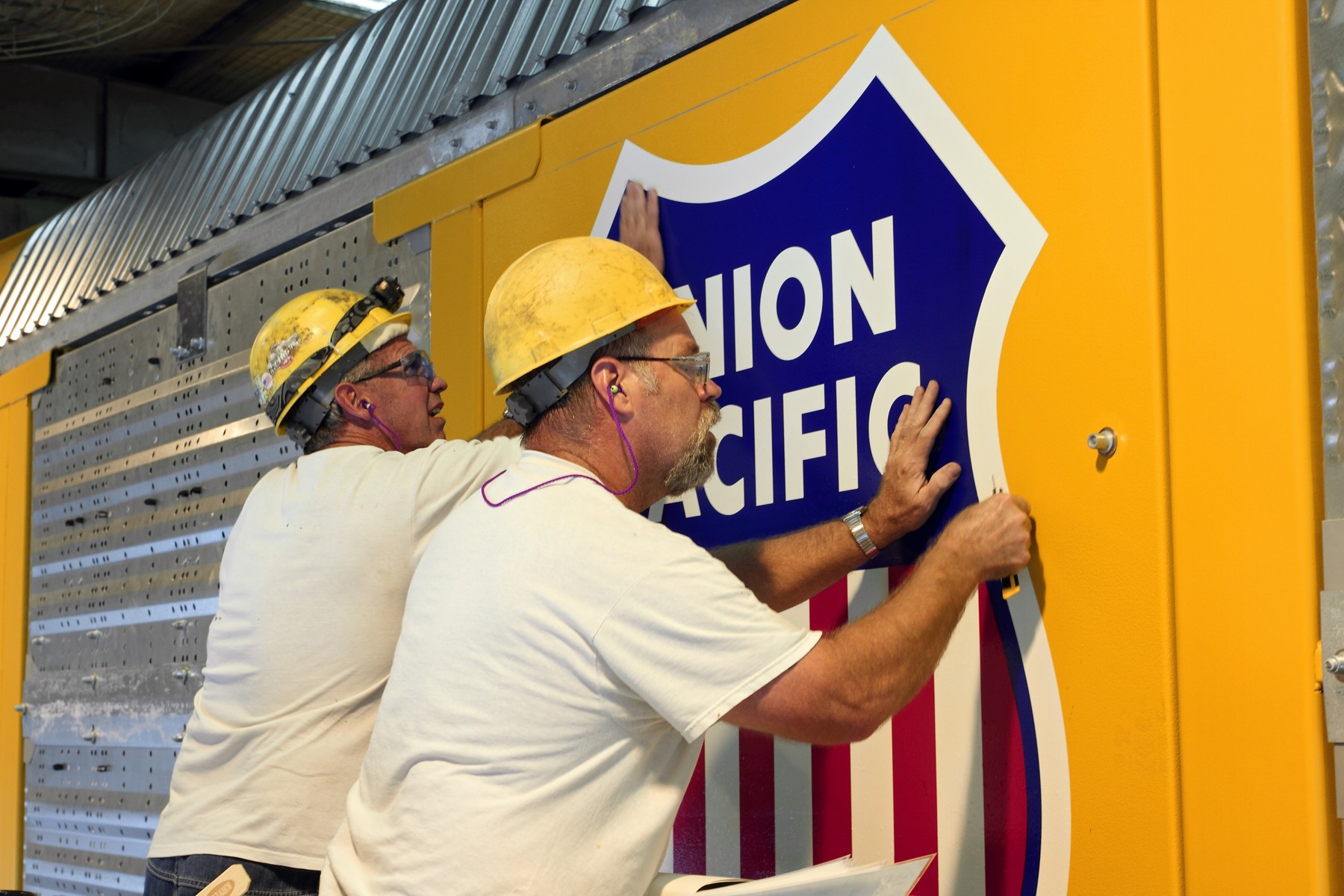
Technology is being tested against similar practical demands. In September 2026, two Wabtec battery-electric locomotives arrived in Southern California. Union Pacific planned to test switching and local service, collecting evidence about performance and reliability. A working yard is where a promising specification meets the daily timetable.
For a prospective customer, the useful move is to price an entire lane: terminals, transfers, local trucking and inventory time included. Rail can suit substantial, repeatable flows with workable connections. Small, urgent shipments or awkward terminal access can erase the advantage. For anyone running another kind of business, the lesson is equally concrete: measure the waiting, inspect the handoffs and leave enough room to recover when demand changes.