Jim Filter’s route to the chief executive’s office began in a maintenance shop. In 1998, he joined Schneider as a maintenance team leader in Green Bay, Wisconsin, while still a student at the University of Wisconsin-Green Bay. The company would eventually give him responsibility for its operating segments, then its top job. First came the work of a much smaller part of the business.
There is something pleasingly literal about that beginning. Transportation companies sell movement. A maintenance operation deals with the machinery that makes movement possible. Before a shipment can become a customer relationship, a growth target or a point on an investor presentation, the equipment has to be ready. A truck has a rather limited appreciation of an inspiring speech.
On July 1, 2026, Filter became Schneider’s president and CEO. Twenty-eight years separated the first assignment and the appointment. Along the way came Mexico operations, intermodal leadership, commercial responsibility and oversight of the company’s businesses. His career had moved across the organization as well as up it.
1998: the shop and the classroom
Filter was a first-generation college student and a military veteran. Before Schneider, he had served in the United States Marine Corps and worked at UPS. He graduated from UW-Green Bay in 1998 and also earned an MBA from Wayne State University. The undergraduate diploma and the Schneider start belong to the same year.
Those overlapping beginnings give his story a particular geography. Green Bay was both a place to study and a place to begin building a transportation career. Much later, he would return to the university with a different kind of contribution to make. For now, the connection between classroom and workplace was immediate: he was participating in both.
His subsequent assignments included managing Schneider de Mexico. By 2015, he was leading the Intermodal segment. In early 2021, his responsibilities expanded to include chief commercial officer duties. The progression brought operating experience into contact with the question that follows any business into a sales conversation: what can we promise, and can we deliver it?
team leader
leadership
segments
and CEO
The handoff problem
Intermodal is an inelegant name for a useful arrangement. A shipment combines transportation modes, with trucks handling the road portions and a train carrying the container over the rail portion. The customer buys a journey. The operator has to coordinate its separate pieces.
That distinction helps explain why Filter’s intermodal years matter. A train’s progress alone cannot settle whether a shipment arrives as expected. Equipment, terminal activity and the truck movements around the rail trip belong to the same service promise. A company can have capable people at each stage and still have trouble at the joins.
In 2021, Filter was also discussing intermodal’s environmental case. He pointed to rail’s lower carbon output and the opportunity to use terminal-based truck operations for electric charging: vehicles could return to a designated location at the end of the day. It was an argument grounded in the shape of the work. The route, the equipment and the place a truck finishes its shift all affect what is possible.
He had been writing publicly about those concerns for years. His LinkedIn articles included an announcement of expanded Montreal service lanes in 2015, discussions of market disruption and driver availability in 2019, and a reflection on Schneider’s 30 years in intermodal in 2021. The subjects were the routes, constraints and changing conditions customers had to plan around.
The interest here is practical. A network is an arrangement of dependencies. Changing one part can create room to change another. Filter’s public explanations repeatedly return to the conditions that let an operating idea become a service a customer can actually use.
A different railway for a different journey
In January 2023, Schneider completed the transition of its western rail operations to Union Pacific. Filter described the appeal in operational terms: more coast-to-coast connections, company drivers and company-owned containers and chassis. Schneider and the railroad were also working on driver efficiency at terminals. The ambition included less time lost around the train ride.
That April, CPKC announced a separate multiyear agreement with Schneider for Mexico-U.S. traffic. The newly combined railroad offered a single-line route between Mexico and the United States. Schneider would begin transitioning that traffic in mid-May, becoming an anchor domestic intermodal customer on the north-south service.
Filter’s explanation on the April earnings call concentrated on interchanges. Each transfer between railroads introduced another potential point of failure. A single rail delivery from Schneider’s Mexico ramps to the Midwest could reduce those complications. The advantage he described was in the connections that no longer had to happen.
The two arrangements concerned different journeys: western rail operations and a north-south cross-border corridor. Read together, they show why running intermodal requires more than choosing a railway and waiting for the containers to arrive. A partnership has to fit the freight, the geography and the service being offered.
When the timetable becomes the product
By November 2025, Schneider was making a more explicit pitch to customers with little appetite for delay. Its new Fast Track service combined truckload and intermodal capabilities with selected rail partnerships for time-sensitive freight. The company said it had already been used for automotive shipments from Mexico to Kansas City, Chicago and beyond.
Schneider reported on-time performance above 95 percent and transit times up to two days faster than competitors on key U.S. and Mexico lanes. Those figures described the company’s selected Fast Track services. They were a claim about a particular offering, rather than a universal promise for every rail shipment.
“Reliability is a cornerstone of our operations.”
Jim Filter · Fast Track launch, November 2025
The operating ingredients included priority rail placement and dedicated planning. That is where the apparently simple proposition becomes demanding. A shipper can understand “arrives sooner” immediately. Making it happen requires several groups to agree about what deserves attention, when it needs to move and what happens if the plan slips.
For Filter, the launch connected earlier parts of his career: cross-border operations, rail service and the commercial task of persuading a customer to use them. The subject was still the delivery promise. The number of people needed to keep it had grown.
July 1, and the people around the desk
Filter had already taken a broader operating role in April 2022, succeeding Dave Geyer as executive vice president and group president of Transportation and Logistics. The assignment included operations, commercial sales, marketing and logistics. He acknowledged Geyer’s mentorship at the time. The next four years gave him responsibility across Schneider’s operating segments before the CEO transition.
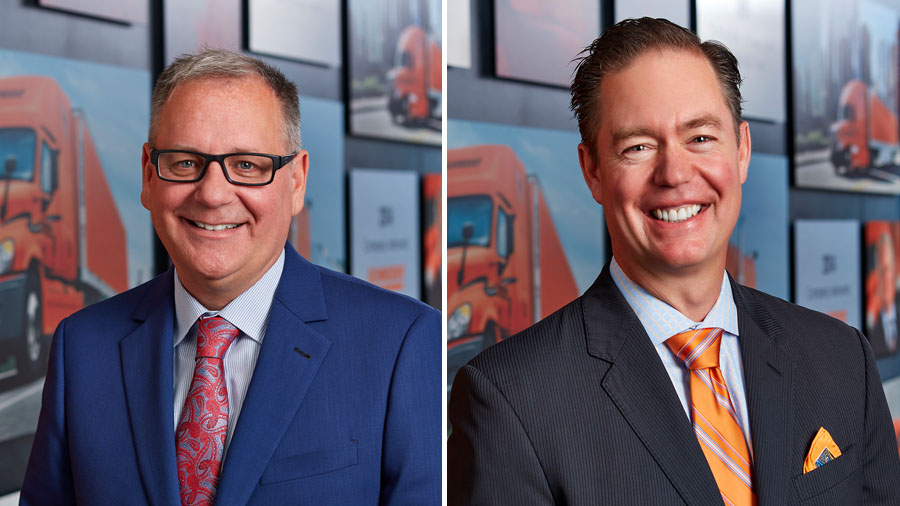
Schneider announced the succession in January 2026. Mark Rourke, CEO since 2019, would become executive chairman. Filter would take over on July 1. The arrangement preserved a formal role for his predecessor while moving responsibility for running the company to someone already familiar with its businesses.
There was an organizational change alongside the personal one. Schneider created two executive portfolios, each combining services with their supporting functions. Michael Baumgardt would lead Intermodal & Logistics. Steve Wells, coming from Schneider subsidiary Cowan Systems, would lead Truckload. Both would report to Filter. Accountability had an address on the organization chart.
As CEO, Filter outlined priorities including growth in areas where Schneider could distinguish its service, a lower-cost organization, customer loyalty and disciplined acquisitions. These are ambitions whose value depends on execution. A customer eventually encounters them as a shipment handled well, a problem resolved or a reason to keep buying.
The route back to campus
Another strand of Filter’s career leads back to UW-Green Bay. In May 2023, the university welcomed him to the Cofrin School of Business Advisory Board. He spoke about helping develop future business leaders in Northeast Wisconsin. The institution that had shared his attention with the maintenance shop now had a place for his experience.
In March 2025, the university highlighted his support for its new Master of Science in Supply Chain Management program, through Schneider and as an individual donor. “UW-Green Bay helped get me where I am today,” he said. His involvement brought the relationship between education and employment into view again, this time from the other side.
He also took part in the university’s public conversations about leadership. In October 2024, he facilitated the question-and-answer portion of Rourke’s campus appearance. In March 2026, UW-Green Bay announced he would lead a discussion with Union Pacific executive Kenny Rocker. A rail partnership could become a classroom conversation, with students invited into the room.
He had also addressed a Cofrin School of Business audience on leadership and innovation in supply chain and logistics at its 2024 keynote and networking event. It was a subject that joined his operating responsibilities with the school’s interest in preparing students for business. The relationship had become more than an alumnus returning for a photograph.
The campus work supplies a useful counterpoint to the corporate timeline. Advancement gave Filter more responsibility inside Schneider. Returning to the university gave him opportunities to connect that experience with people still deciding where their own careers might begin.
A new title, a familiar question
In September 2026, Filter appeared with Craig Fuller and Julie Van de Kamp to discuss trucking conditions and the freight outlook. His public agenda had broadened to the market around Schneider as well as the business within it. Other interviews addressed technology, freight matching, investment and the judgment needed to distinguish a temporary cycle from a longer change.
Those are large subjects for someone whose first Schneider assignment was a maintenance team. Yet the connection is easy enough to see. Every plan eventually meets the equipment, the schedule and the people doing the work. Filter has reached the job from which he can influence all three. The delivery still has to arrive.