The most important product Understory ever abandoned was a weather station for people who enjoyed weather stations. In 2012, atmospheric scientist Alex Kubicek and mechanical engineer Bryan Dow imagined a consumer device for makers, hobbyists and backyard forecasters. People liked the data. The trouble was what came next: almost nothing. A hyperlocal reading could satisfy curiosity, but it rarely changed a decision worth paying for.
That early miss now reads like the first useful measurement the company took. Understory moved into business-to-business weather data, built networks of rugged sensors, learned how hail behaves at ground level and eventually climbed into the business with the clearest price on uncertainty: insurance. Today the Madison company combines hardware, catastrophe models, alerts, policy administration and risk transfer. Its main public wedge is the acres of shiny metal sitting outside American car dealerships.
A metal ball with a balance sheet attached
Understory's Dot is a solar-powered, cellular weather station with no moving parts. It measures hail size, force and angle, plus wind, rain, temperature, pressure, humidity and solar radiation. The company says each unit captures 125,000 measurements a second. A single sensor can sit on a dealership roof; a network can map a farm or wider region. The hardware matters because radar is looking into the atmosphere. Understory wants evidence from the place where the expensive thing is parked.
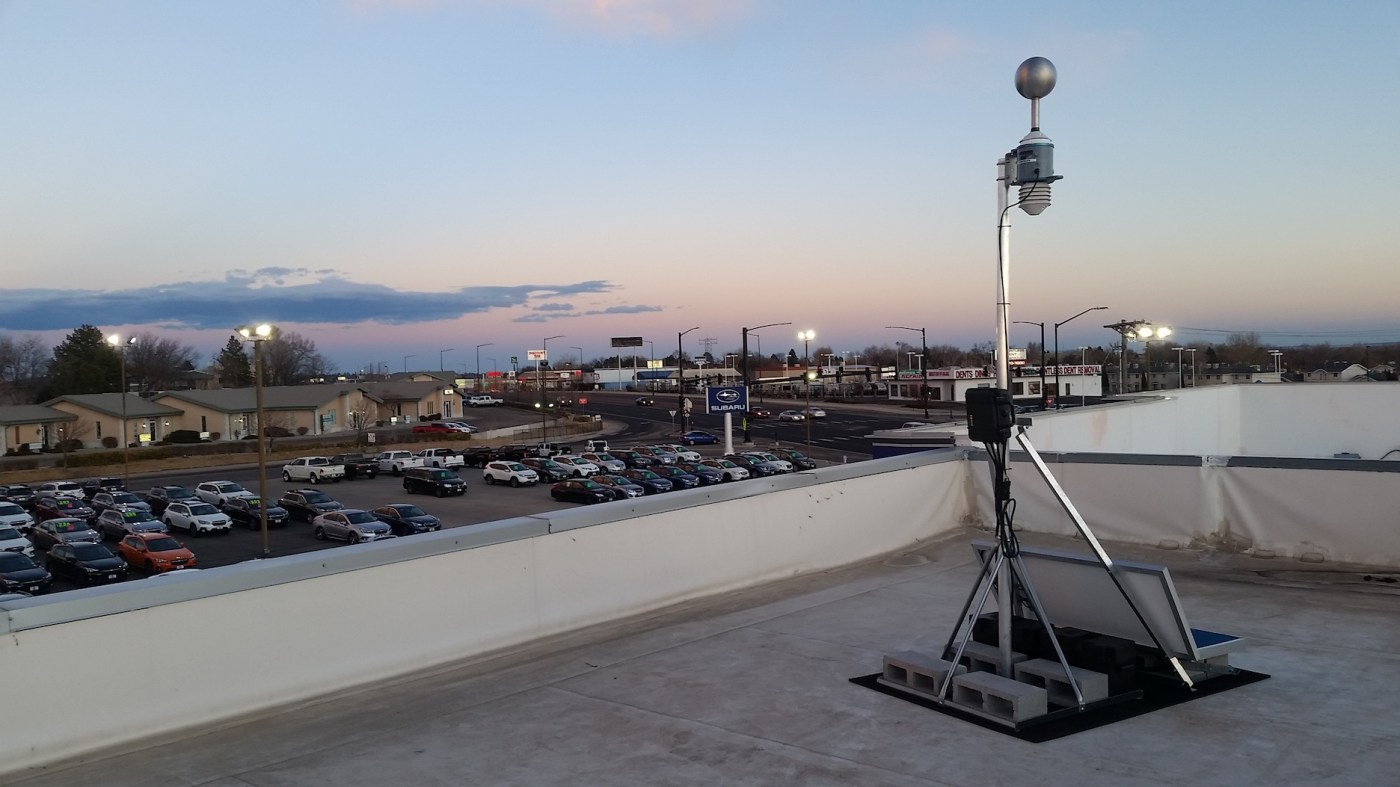
The measurements feed a climate risk engine trained with proprietary observations, historical records and third-party models. Understory also tests the connection between weather and damage. In Madison, that has included a wonderfully literal piece of laboratory equipment: a hail gun that fires simulated ice at roofs and other materials. The result is a damage function - an estimate of what a particular storm does to a particular asset.
Around that core sits UnderstoryOS, software for brokers, quoting, policy administration, alerts and claims workflows. Customers receive daily outlooks, nearby-storm warnings and post-event summaries. A measured threshold can supply first notice of loss without waiting for a person to climb a roof and squint at shingles.
The first thing that failed was usefulness
Understory's consumer plan did not fail because the sensing idea was silly. It failed the action test. Backyard users wanted to see local weather but lacked a valuable response to it. Enterprise customers did have responses: insurers could position claims teams, farms could adjust operations and cities could understand conditions block by block. So the company moved from selling an object to selling information.
Hardware brought another education. Field equipment had to survive the storms it measured, stay online with limited solar power and recover data after cellular interruptions. Earlier network rollouts surfaced switches, connectivity and maintenance problems. The team designed on-device processing, remote updates, stored readings during outages and installation with a single wrench. By 2018, it said a unit needed service about once every five years, compared with much more frequent care for traditional stations.
“Radar only looks at the top of the storm, and to know how weather affects people we need to know what is going on at ground level.”Alex Kubicek, co-founder and CEO
Capital was its own storm system. The company, then moving through names including WInstruments and Subsidence, received a combined $68,000 from the gener8tor and Bolt accelerator orbit. Kubicek has said Wisconsin investors initially would not fund it. Understory moved to the Boston area, raised a $1.9 million seed round led by True Ventures in 2014, then returned to Madison after a $7.5 million round in 2016. TechCrunch reported that the company had raised roughly $40 million by 2024. Building a proprietary global dataset took years, hardware deployments and patient money.
What changed their mind: the model was worth more than the dashboard
After years of deployment, Understory had enough data to build global catastrophe models. Reinsurance partners validated them and suggested the obvious business: sell historical data as software or a service. The founders chose the less obvious route. With insurance executive Neil Irwin joining the leadership group, Understory began building insurance products itself.
The move captured more of the value chain. A data vendor gets paid for evidence. An insurer can use that evidence to select risk, set a premium, warn a customer, manage a claim and share in good underwriting performance. Understory's first major expression was Auto-Hail Safe in 2019, a supplemental parametric policy offered with MSI GuaranteedWeather. A Dot on the dealership measured hail; when an agreed threshold was crossed, the policy could trigger without traditional adjustment.
In 2022, Understory and Skyward Specialty launched Dealers Open Lot, a broader group-captive property program. Dealer members pool risk and, when the book performs well, may participate in underwriting profit normally kept by an insurer. The structure turns prevention into more than a safety lecture. Better behavior can improve the economics for the group.
The product is the move before the claim
A dealer lot is a useful first market because the exposure is concentrated, visible and movable. Hundreds of vehicles can be damaged in minutes, while coverage in hail-prone states has become expensive or scarce. Understory can price a specific location, place a sensor there and give the operator a playbook: send inventory to cover, stage protective material or change operations before impact.
The best reported result is startling but should be treated as a company example, not a controlled experiment. Understory told TechCrunch that one client reduced hail damage from $110 million to $50 million after using early notice. It also said ten major incidents and about $3 million in losses had been avoided in another account context. The point is less the exact attribution than the mechanism: a forecast becomes financially useful when it arrives early enough for somebody with authority to move something.
That logic points naturally toward renewable energy. Solar farms put large, fragile surfaces in open country where severe convective storms occur. Some panels can be tilted or stowed to reduce impact. Understory says certain models can provide up to 45 minutes of notice and that active mitigation can cut hail repair costs. In June 2024, it raised an oversubscribed $15 million Series A co-led by True Ventures and Prelude Ventures to pursue this market.
What competitors sell - and what Understory bundles
Traditional carriers sell property coverage. Verisk and Moody's RMS sell catastrophe intelligence. ZestyAI applies machine learning to property risk. Arbol and Descartes Underwriting build parametric climate products. Weather companies sell forecasts, and sensor companies sell instruments. Understory's distinction is the bundle: proprietary on-site measurement, a loss model, an operating system, alerts and an insurance program tied together.
That bundle can also be a burden. Hardware is capital-intensive. Insurance is regulated. Brokers control distribution. Captives require careful risk selection, reinsurance and enough members to diversify losses. A pure data company can ship an API; Understory has to install equipment, support customers during storms and keep the insurance machinery credible after them. The harder business may create a sturdier moat, but only if each layer works.
The part a founder can steal
- Pick one expensive, recurring loss instead of a broad industry.
- Own a measurement the incumbent cannot collect cheaply or locally.
- Connect the reading to a specific action with a named operator and deadline.
- Charge for the financial outcome, not merely the dashboard.
- Align incentives so customers benefit from prevention, not just reimbursement.
The portable lesson is not “build a hail sensor.” It is to keep moving closer to the customer's balance sheet. Understory began with fascination, found information and ended at financial consequence. The same progression can work in water leaks, equipment failure, crop stress or logistics delay when measurement is proprietary and the response is concrete.
Where the playbook breaks
Parametric products carry basis risk: the trigger may fire when damage is light, or fail to match a customer's actual loss. Ground sensors reduce some uncertainty, but they do not erase contract design. The approach also weakens when an asset cannot move, the warning window is too short, connectivity is unreliable or nobody has authority to act. A perfect alert sent to an empty inbox is still just weather content.
If panels cannot tilt and cars have nowhere covered to go, prediction does little to change loss.
If measured hail and real damage diverge, parametric certainty can feel unfair.
A captive needs enough disciplined members and reinsurance to absorb correlated storms.
Sensor installation and insurance complexity need a large enough problem to justify them.
Understory is now trying to prove that its dealer-lot formula travels. More than 100 leading dealer groups were using its program by a recent company account, and renewable energy was nearing a dedicated launch. The next chapter will be judged less by sensor specifications than by underwriting performance: fewer damaged assets, sustainable premiums, dividends for disciplined members and claims that behave as promised.
For a company born from sparse weather data, that is an appropriately unforgiving forecast. The clever object got Understory into the storm. The business is what customers do before it hits.