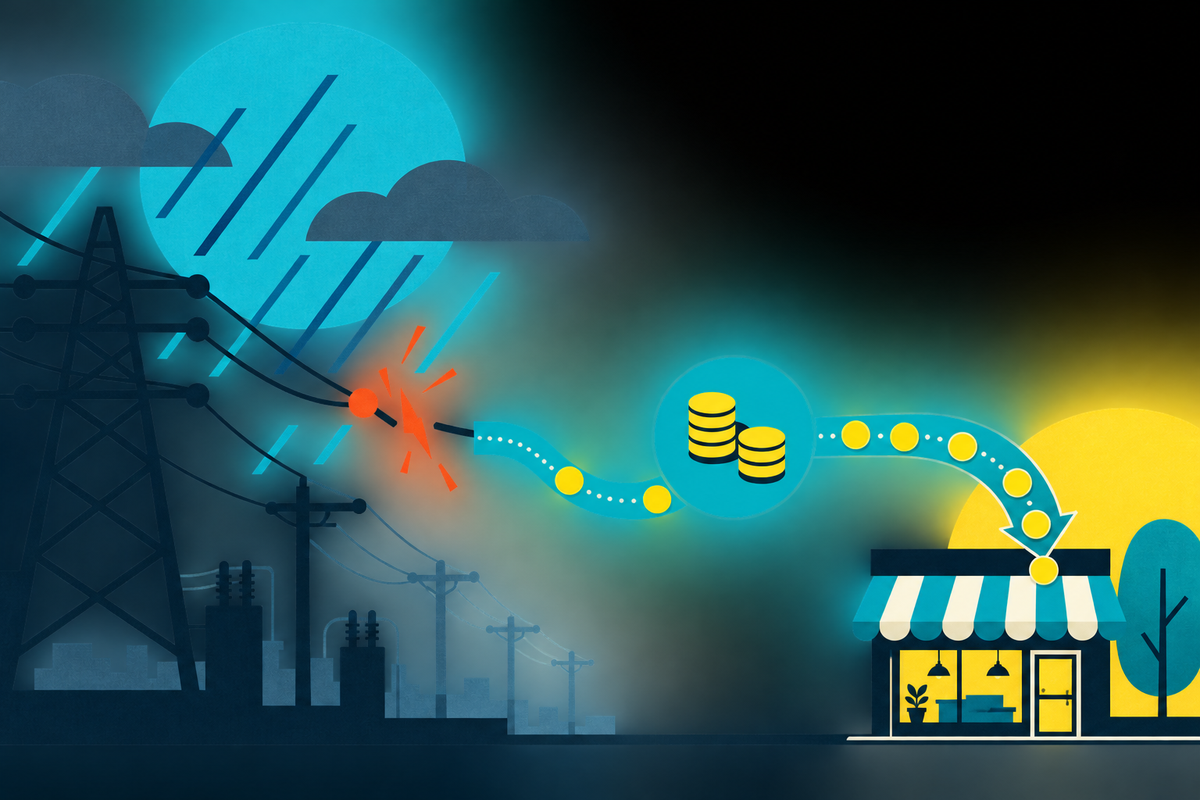
The revealing number in Adaptive Insurance's origin story is not $10 million, the amount it has raised. It is 13 hours. Imagine a Dallas pizza restaurant that has selected a 12-hour power-outage trigger and $20,000 of coverage. The lights die before a packed day. Independent data shows the outage lasting 13 hours. Adaptive starts the claim, the owner confirms the event and the money lands in days. No one needs to debate the replacement cost of a melted tub of mozzarella.
That example, published by the company to explain its flagship GridProtect product, reduces insurance to an if-then sentence. It also explains what the Austin startup actually sells: coverage for a narrow, expensive gap, packaged so the decisive fact can be observed in the world rather than reconstructed afterward from invoices and photographs.
Michael Gulla and Arik Yelovitch, two former Hippo executives, founded Adaptive in 2024. Gulla had spent more than 20 years around underwriting and digital insurance at companies including Esurance, Allstate, Nationwide, Verisk and Hippo. Yelovitch became CTO. Their first target was not the hurricane or the wildfire that dominates a television forecast. It was the ordinary, business-killing interruption beneath those events: the grid going dark for less than a day.
The first thing to fail was the clock
Conventional business-interruption policies can impose waiting periods, often making short outages somebody else's problem. Yet short does not mean cheap. A restaurant can lose chilled inventory and a dinner service. A dental practice can lose two days of appointments after a 20-hour interruption. A pet kennel can close, send staff home and reschedule 40 animals. The larger neighborhood may stop functioning even if one shop owns a generator: traffic signals are out, garage doors will not open and customers stay away.
Adaptive's insight was to separate the speed of recovery from the slow work of measuring every dollar of loss. With GridProtect, the customer chooses an outage threshold and coverage amount in advance. Adaptive monitors independent, real-time information. Once the agreed duration is exceeded, it sends a first notice of loss. The customer verifies the outage and payment follows, typically within days. Standard limits reach $50,000, with higher limits available by request.
This is parametric insurance. Traditional indemnity coverage asks how much the policyholder lost. Parametric coverage first asks whether the specified event happened. The distinction produces speed and clarity, but also a boundary: a parametric payout is a financial lifeline, not a promise to make the buyer whole.
“Adaptive's parametric policy isn't designed to make a business entirely whole after an event but provide a crucial financial lifeline.”Michael Gulla, in RBC Capital Markets' climate-resilience report
What changed Gulla's mind
Adaptive did not begin with a founder discovering insurance on a whiteboard. After leaving Hippo, Gulla consulted on the long-term profitability of insurtech and the role of data in product design. Montauk Climate then asked him to examine whether parametric insurance could address grid and climate resilience. Better event data made a product possible that would have been awkward to verify at scale years earlier. Montauk's venture-studio model supplied the incubator; Yelovitch supplied a technical co-founder who already knew the insurance machinery.
The change in perspective was practical. An outage did not have to be treated as a fuzzy claim with an adjuster at the center. It could be treated as an observable condition with the economic terms decided up front. AI belongs in Adaptive's underwriting, pricing and data models, but the customer proposition does not require a lecture about machine learning. The lights were out for longer than X, so the policy pays Y.
What it cost - and what buyers buy
The public cost of building the company so far is $10 million in disclosed financing. Congruent Ventures led a $5 million seed round announced in February 2025, alongside Montauk Climate, Generation Space, the U.S. arm of Seraphim Space, and private backers. In July 2026, Adaptive announced another $5 million from IAG Firemark Ventures, Sunna Ventures, Room & Pillar, Connecticut Innovations, Congruent, Seraphim and private stakeholders.
For the policyholder, there is no universal sticker price. The premium changes with location, exposure, the chosen trigger and payout. That variability matters. A 12-hour trigger with a $20,000 limit is a different financial promise from an eight-hour trigger or a $50,000 limit. Adaptive's digital workflow lets an agent quote, bind and issue its products online, which the company says can take less than five minutes. The purchase is quick; the underwriting still prices a specific risk.
The wedge became a product factory
GridProtect was the opening, not the whole catalogue. Adaptive now markets residential and commercial wind and hail deductible buy-backs, designed to reduce the out-of-pocket hit from percentage deductibles. Its own example is sobering arithmetic: a 5 percent wind and hail deductible on a $2 million commercial property produces a $100,000 bill before primary coverage does its work. For a homeowner, 3 percent of a $400,000 property is $12,000. The buy-back product can shrink that exposure.
The company also offers standalone residential flood coverage, commercial equipment-breakdown insurance and Restaurant Recovery, a Tokio Marine HCC product powered by Adaptive for losses and reputational harm particular to restaurants. Custom programs let carriers, brokers, agents and other companies ask a more interesting question: what new risk is painful, observable and currently wedged between policies?
That sequence reveals Adaptive's place in the market. It is not trying to replace the homeowner's policy, the commercial package or the National Flood Insurance Program with a single app. It sits around those products, closing holes with specialty coverage and a software layer for quoting, underwriting, verification and distribution. In industry language, it operates as an MGA and technology platform, pairing product design with the capacity and licenses of established carriers.
The unglamorous advantage: distribution
Tokio Marine HCC brought financial strength and specialty-insurance infrastructure to GridProtect's 18-state launch. Bold Penguin gives agents digital access. Adaptive has named Amwins, retail agents and wholesalers as routes to market, while its website displays relationships with Applied Underwriters, First Connect, Hippo, Pathpoint, Wholesure, Smart Choice and The AC. ZestyAI now supplies property-level Z-STORM scores for wind and hail underwriting, distinguishing risk using roof geometry, accumulated damage, local climatology and other structure-specific traits.
There is a fourth route: embed the coverage where a business buys resilience equipment. Adaptive has described working with commercial equipment makers so an insurance offer might appear alongside a refrigeration unit, generator or IoT monitor. That B2B2SMB approach meets a business owner at the moment risk is already on the invoice. It also gives Adaptive distribution without asking a small team - about 14 people in supplied company data - to become a national direct-sales army.
What a founder can copy
The transferable lesson is not to paste “AI” onto an old policy. Start with a loss that hurts, recurs and is poorly served. Then test whether a neutral data source can observe the trigger quickly and consistently. Make the buyer choose the threshold and benefit before the event. Find a rated carrier willing to supply capacity. Finally, distribute through the people and products already trusted by the customer.
Adaptive's public example passes the test. Twelve hours. Twenty thousand dollars. Thirteen hours of darkness. Money in days. Even a skeptical buyer can locate the value and argue about the price. That is a stronger starting point than promising a generalized climate-risk platform.
When the model does not work
Parametric coverage is narrower because it is faster. If the outage lasts 11 hours and the trigger is 12, the parametric condition has not been met even if the restaurant loses a full freezer. If the event data is delayed, disputed or too coarse for the property, automation loses its advantage. If the customer's actual loss is $80,000 and the selected benefit is $20,000, the payout remains $20,000. This mismatch is called basis risk.
The product also makes less sense where losses are idiosyncratic, causation matters more than the event, or no reliable third-party dataset can establish what happened. A generator, stronger refrigeration or a larger cash reserve may be a better investment for some buyers. Primary insurance remains necessary for rebuilding physical assets and adjusting complex losses. Adaptive works best as a precisely sized complement, bought by someone who understands both the trigger and the uncovered remainder.
A useful kind of modesty
Adaptive's most credible claim is smaller than “reinvent insurance.” It can take a known disruption and shorten the distance to usable capital. For a business owner, that can mean paying staff, replacing inventory or opening again before a bad week becomes a permanent closure. For an agent, it is a specialty product that plugs into an existing relationship. For a carrier or equipment company, it is a way to create coverage around an emerging risk without building the entire data and workflow layer from scratch.
The company's larger bet is that climate volatility will keep creating gaps faster than conventional policies close them. The test will be whether Adaptive can keep each new product as legible as the first. When the grid fails, 13 hours is not a vision statement. It is a fact you can insure.