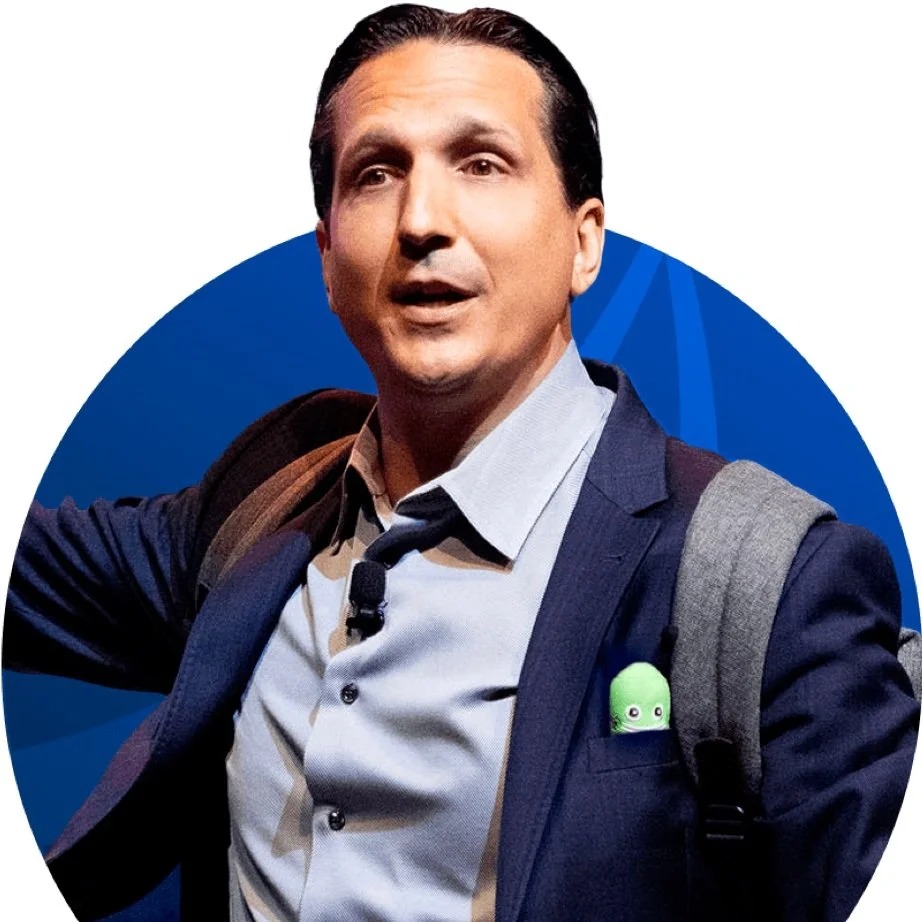
The cleanest line in Tyler Lessard's career is an admission. He trained as a systems engineer, began in software development, and discovered he was better at explaining technology than coding it. There is no grand conversion scene, no rejection of engineering. He simply moved toward the part of the system where his skills worked better: between a complicated product and the people trying to understand it.
That boundary became a career. Lessard moved from mobile application development at BlackBerry into developer relations, alliances, product work, marketing, video strategy, authorship, and media. Today, from Kitchener, Ontario, he serves as chief marketing officer of TechnologyAdvice, the Nashville-based company that helps business buyers research software and helps technology vendors reach them.
His route is unusually coherent when viewed backward. At each stop, the technology changed while the task remained: translate, humanize, create trust, and give people a reason to pay attention before asking them to do anything expensive.
A systems engineer changes systems
Lessard graduated from the University of Waterloo's Systems Design Engineering program in 2001. His first professional chapter unfolded at Research In Motion, later renamed BlackBerry, during the period when the company's devices helped define mobile work. He began close to the product and migrated toward developers and partners, eventually becoming vice president of Global Alliances and Developer Relations.
Developer relations is a revealing apprenticeship for a marketer. The job cannot survive on slogans. Developers want documentation, access, practical support, and evidence that a platform is worth their time. They are an audience, but they are also participants. Lessard learned to work with people who could extend the value of the technology when treated as partners rather than targets.
In 2011 he left BlackBerry for Fixmo, a mobile security company, as chief marketing officer. The role also included product strategy, pulling him closer to the decisions that shape what a company sells rather than merely how it describes the thing afterward. Three years later, he joined another Waterloo-region company whose product sat at a useful intersection of software and communication: Vidyard.
Video, before every meeting became a video
Vidyard hired Lessard as CMO in 2014. He would spend nearly a decade there, later working as vice president of marketing and chief video strategist. At the start, online video in business was often treated as a polished object: an expensive homepage film, a campaign centerpiece, or a product demo tucked away in a resource library. Vidyard's proposition was that video could behave like software - measurable, personalized, connected to sales systems, and useful across the customer journey.
Lessard became one of the people explaining that transition. He spoke about video for prospecting, lead generation, deal acceleration, education, and the small moments when a real face can reduce the chill of a digital exchange. His engineering background again proved useful. He could talk about analytics and integrations without losing the human point of the medium.
In 2020, after much of business had abruptly acquired a webcam habit, Lessard and Marcus Sheridan published The Visual Sale. The 220-page book offered a practical system for using video in marketing and sales. Its timing was striking, but the work rested on years of watching video move from an optional production to an everyday business language.
The feed learns to entertain
Then came Sales Feed, the media network Lessard founded for sales professionals. It grew beyond 150,000 followers and fans by behaving less like a software company's content calendar and more like something people might voluntarily watch. There were shows, podcasts, social clips, memes, recurring personalities, and parody music videos. Lessard even produced a B2B remake of Dr. Dre's Nuthin But a G Thang.
The joke had a serious spine. Professional audiences do not set aside their taste, boredom, curiosity, or sense of humor when they open LinkedIn. Yet business content has often addressed them as if they were procurement software wearing a blazer. Sales Feed gave Lessard room to test a more generous assumption: that useful ideas travel farther when they have character.
It also changed the unit of marketing. A campaign ends. A media brand has to return tomorrow with another reason to care. That recurring obligation rewards a clear point of view, recognizable people, and formats that can develop over time. Lessard's public description of the project is bluntly practical: he did not merely advise companies to build audiences; he wanted to live the creator life and learn from the machinery himself.
Turn the telescope around
Those experiments became the evidence behind Lessard's Outside-In approach. His diagram begins with a familiar corporate habit. Inside-Out marketing starts with the company's product, campaign, and immediate need for pipeline, then pushes outward toward the small group already shopping. Outside-In begins in the audience's world: its unresolved questions, professional anxieties, interests, ambitions, and jokes.
Lessard argues that active buyers represent less than one percent of a total target audience. The exact boundary will vary by market, but the strategic consequence is clear. If all the creative energy is aimed at people ready to book a demo today, the brand has little to say to everyone who may enter the market next month or next year.
Inside-Out
Begin with the product, the quarter, and the campaign. Search for the buyer who is ready now.
Outside-In
Begin with the audience's world. Earn attention, remain useful, and be present when timing changes.
Outside-In does not relieve a CMO of commercial responsibility. Lessard talks plainly about pipeline generation, sales collaboration, outbound support, and expansion within current accounts. The distinction is temporal. Demand work captures an opportunity that exists. Audience work improves the chance that the company is known and trusted when an opportunity appears.
This is why his favored phrase, “favorite follow,” is more demanding than “brand awareness.” Awareness can be passive. A follow is permission to return. A favorite has earned preference. The standard forces a marketer to ask a slightly uncomfortable question: if the promotional message disappeared, would the content still deserve a place in someone's day?
The CMO as company translator
Lessard joined TechnologyAdvice in 2024. The company operates a portfolio of business technology media brands, including TechRepublic, eWeek, Datamation, and Channel Insider. For a marketer interested in the boundary between media and demand generation, the fit is neat. TechnologyAdvice serves buyers looking for guidance and vendors looking for those buyers. Trust is both an editorial concern and a commercial asset.
One of his early programs was The Marketing Insiders, a thought-leadership brand built around Lessard and several colleagues rather than an anonymous corporate voice. Team members contribute research, video, social content, and newsletters. The model borrows the durable machinery of a media property: named people, recurring expertise, and an audience that can recognize who is speaking.
His description of the CMO role also reaches beyond the marketing department. He argues that marketers should carry their understanding of buyers into product, sales, and business strategy. This returns him to the work of alliances and developer relations, where value lives in the connections among groups. The executive's job is to keep those connections from becoming a sequence of handoffs.
A servant with a little stagecraft
Asked in an interview for one word to summarize leadership, Lessard chose “servant.” He applied it broadly: serving customers, teammates, the organization, and other functions inside the company. The word is earnest. His delivery rarely has to be. Public bios mention interactive talks and magic tricks. His own LinkedIn introduction blends “Art. Science. And a bit of magic.” His X biography adds two more useful data points: dance dad and purveyor of fine hip hop.
The mixture explains the work. Engineering supplies the system. Marketing supplies the exchange of value. Media supplies rhythm and character. Service keeps the audience from becoming an abstraction. Lessard's personality in public is playful, but the play has a job: it makes technical and commercial ideas easier to approach.
His next stated project is a book called Outside-In Marketing. The aspiration is already visible in his workshops, speaking, advisory work, and current role: help companies turn from their own reflection toward the people beyond the glass.
A career that began with code now revolves around attention, but the engineer has not vanished. Lessard still designs systems. They simply contain stories, creators, sellers, buyers, and the fragile human decision to keep listening.
Continue the conversation