The pivotal job in Trish Stromberg's career began with a job she never worked. She had accepted a position, prepared to begin, and then learned that she had been laid off before day one. The neat version of a career story would have her choosing the perfect next industry after a period of careful reflection. The true version has more weather in it. She happened across a listing from Qqest, a Utah company making time-and-attendance software, and followed the opening.
That accidental turn became a long education in how businesses buy technology. Stromberg joined Qqest in 1996 and remained through years of product evolution and corporate change, eventually becoming vice president of marketing. She went on to lead demand generation and then marketing at iSolved, the cloud human-capital-management business that grew from the Qqest lineage. What looked like a detour became the road.
Today, she is chief marketing officer at Centerbase, a Dallas-based maker of cloud software for midsize law firms. She works from the Salt Lake City area, where most of her career has unfolded. Her current product category has changed from employee time to lawyer time, but the commercial puzzle is familiar: take a dense bundle of workflows, financial controls and professional obligations, then make its value clear enough for a cautious buyer to act.
Marketing with its sleeves rolled up
Stromberg's public description of marketing is conspicuously short on ornament. In a 2023 essay, she pushed back on the idea of the department as the team asked to “make it pretty.” Her preferred remit reaches into positioning, competitive intelligence, demand generation, customer experience, sales alignment and the operational plumbing that turns attention into revenue. There is wit in the complaint, but also an executive's impatience with waste. A beautiful asset cannot rescue an unclear buyer, a muddy handoff or a market promise the product cannot keep.
The same essay reveals how she assembles the people who do that work. Marketing groups contain unlike roles: designers, analysts, developers, writers, event planners and product marketers. Stromberg argues that one managerial script cannot fit all of them. Curiosity and collaboration matter to her because specific skills can be taught, while a closed mindset is harder to renovate. Her favorite evidence is a receptionist she noticed for enthusiasm and attention to detail. When an entry-level marketing role opened, Stromberg brought her onto the team. The employee later became an event manager.
Her test for leadership is almost mischievously self-effacing: after a year, the team should feel comfortable holding meetings and making decisions without her. She has written that her job is to build a team capable of running in her absence. For an executive, making oneself less necessary can be the most convincing proof of usefulness.
Her career kept enlarging the laboratory. At iSolved, she did not simply oversee brand and demand. By 2017, she was also site manager for the Salt Lake City office, responsible for more than 160 people. She helped lead the launch of iSolved University, which became a learning system containing hundreds of courses, forums and game elements for partners, customers and employees. Education sat beside marketing because a complicated product becomes more valuable when people know how to use it.
“My aspiration has always been to be a part of the C-suite and be driving the marketing for a fast-paced company.”Trish Stromberg, 2017
She had reached that aspiration by the time Utah Business named her a CXO of the Year in 2017. Yet her response contained a useful correction to the trophy-case version of ambition. Reaching the title, she said, was “only the start.” What animated her was watching a team grow, develop and make the brand into something special. Authority might arrive with a new line on the organization chart. Leadership, in her telling, still had to be earned in the work.
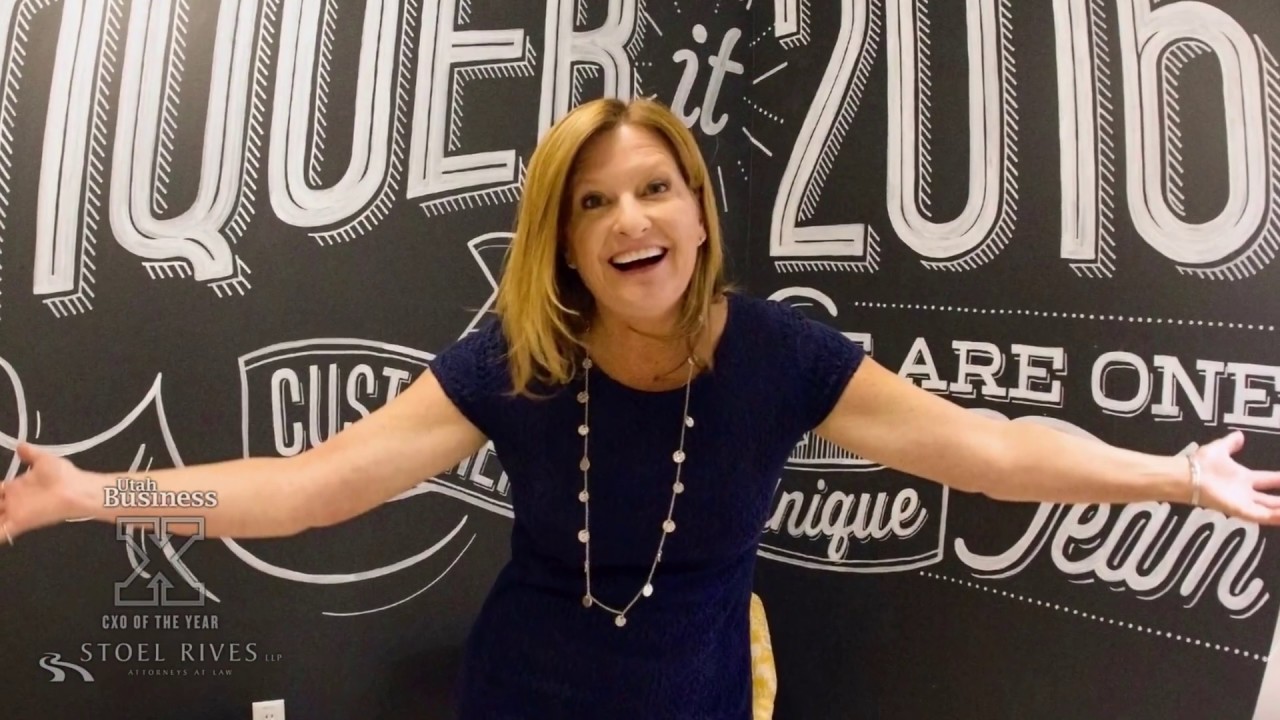
A marketer crosses the revenue border
In 2020, Stromberg moved to Swipeclock, another Utah workforce-management software company. She began as chief marketing officer and later became chief revenue officer. The promotion was more than a bigger title. It placed sales and marketing under the same accountability, converting an old corporate border into one shared number. A former colleague, Paul Stevens, later wrote that working with Stromberg showed him the force of sales and marketing operating together. He emphasized repeatable processes, constant review and her role in revenue growth.
The work culminated in 2024, when IRIS Software Group acquired Swipeclock. In a post about the deal, Stromberg looked back on roughly three and a half years spent driving growth and scale. Her attention went first to the marketing, product-marketing and sales teams that had reached the moment with her. The pattern repeated: the achievement was corporate, but her language made it communal.
Her next stop, ACI Learning, placed her in professional training. The company introduced her in October 2024 as a B2B leader with experience scaling technology businesses from $10 million to more than $200 million. She oversaw brand strategy, demand generation and sales alignment. The stay was brief compared with the long chapters before it, but it reinforced the range of her playbook: the machinery works across workforce tools, learning platforms and, now, legal operations.
The time clock in the footnotes
There is a delightful object hiding in Stromberg's résumé. In 2010, the United States Patent and Trademark Office issued design patent D622,168 for a time clock. Four inventors are named, including Stromberg, and the patent was assigned to Qqest. Its drawings show the ornamental design from every practical angle. A marketer's name on a hardware design patent is a compact rebuttal to the notion that marketing should stay downstream from the product.
Stromberg shares inventor credit with Burke Plummer, Tad Allen and William F. Goelz. Qqest Software Systems was the assignee.
It also makes literal the subject that has followed her career. Qqest measured employee time. Swipeclock organized it. Centerbase now helps law firms capture and bill it, while connecting that activity to accounting, matters, documents and profitability. Time is among the least glamorous raw materials in software, yet it decides payroll, invoices and margins. Stromberg has repeatedly worked where those ordinary minutes become business facts.
Her interests have extended outside the revenue plan. An iSolved executive biography records that she served on the board of Make-A-Wish Foundation of Utah. She has written about HR as a small-business function and argued that recruitment benefits when marketing and HR build the employer story together. One article began with a parks-and-recreation manager asking how to attract seasonal workers without much budget or a marketing department. She answered by collapsing the departmental wall: begin the conversation, combine the skills, then make the plan together.
Now, the business of law
At Centerbase, Stromberg is back inside vertical SaaS, this time amid trust accounting, billing, collections, documents and matter management. The company describes her as hands-on and strategic, data-driven and customer-obsessed. Those phrases can become executive wallpaper. In her case, earlier chapters give them shape: running an office while running marketing, building customer education, moving into revenue leadership and standing close enough to the product to share a patent.
The current assignment is to help make the operating complexity of a midsize law firm legible. In 2026, Centerbase introduced an AI capability that lets firm leaders ask questions of their own billing, financial, matter and productivity data and receive source-backed answers. Stromberg was the media contact for the launch. She later described a payments partnership as closing the loop across billing, trust, accounting and money moving both in and out. The wording is operational rather than theatrical. The loop matters because a law firm does not experience software as a list of features. It experiences fewer missed hours, cleaner bills and a clearer view of the business.
“Well, now that I'm here, I know that just reaching that title is only the start.”Trish Stromberg on arriving in the C-suite
A long executive career invites a tidy moral, usually about planning. Stromberg's beginning argues for something more interesting. The first plan failed before it began. What followed was not passivity, but responsiveness: spot the unexpected opening, learn the product, listen to the market, build the process, give the team room to carry it. Then do the same at a larger scale.
Her industries have moved from legal services to radio, workforce software, professional education and legal software again. The through-line is not a category. It is an appetite for the unglamorous architecture of growth. Positioning has to connect with the product. Demand has to connect with sales. Sales has to connect with the customer experience. Teams have to know why the system exists. A polished hood is welcome. Stromberg simply wants to hear the engine turn over.