The church fatigue arrived after three months. Trinity Nguyen had left her previous job for a voluntary sabbatical and the European trip she wished she had taken a decade earlier. She was meant to stay away for six months. Instead, somewhere in Lisbon, she looked up the website of UserGems, a tiny company whose product she knew because her former startup had been an early customer. Her assessment had the gentle bedside manner of a fire alarm: “Your website won't get you any customers. Let me build you a new one.”
There was no contract. There was not yet a marketing department to commission one. UserGems consisted of two technical co-founders and two engineers. Nguyen learned Webflow in less than a week, built the site for free and, in her own telling, talked herself into a job. In August 2019 she became the first business hire and Head of Marketing. She was also the first SDR, because startups have a way of making tidy job descriptions look ornamental.
The episode has become her professional origin story because it compresses a good deal of her operating style into one scene: the direct diagnosis, the impatience with an obvious bottleneck, the willingness to learn an unfamiliar tool, and the cheerful admission that she had no design credentials. “Heck no,” she replied when asked whether she had design skills. The website was not a portfolio piece. It was a lever.
The product marketer takes the wheel
Nguyen arrived with a background that moved between finance, strategy, operations and product marketing, including work associated with Intel, HP, Sisense for Cloud Data Teams and noble. She earned a bachelor's degree from Arizona State University's W. P. Carey School of Business and an MBA from Northwestern's Kellogg School of Management. On LinkedIn, she calls product marketing her area of expertise. In conversation, she calls it her “major.”
That distinction matters. She thinks of marketing as roughly seven disciplines, too many for one person to master. A leader needs a major and a few minors. Hers began with the strategic questions: Who is this for? What problem is important enough to buy against? Where does the company play? Why should it win? The early UserGems product was simple enough to describe - track champions when they change jobs, then help revenue teams act on that signal - but simplicity does not settle positioning. It merely removes the hiding places.
She started with customer conversations and her own experience as a customer. She tested inbound, attempted a version of the HubSpot playbook and found it too slow for her taste. Outbound fit her temperament better. UserGems was bootstrapped in those years, which made focus compulsory. Its early account-based motion produced about 90 percent of pipeline during the first two years. Later, paid media and inbound widened the mix. Nguyen has said she would be nervous if any single program still carried 90 percent.
Even the organizational chart was an argument. At a previous company she had watched marketing, sales and account-based work struggle to coordinate. Before UserGems had salespeople, she put in her offer that sales development should report to marketing. She became the first SDR herself. The choice was not presented as universal doctrine. Her answer to most “where should SDR report?” debates is that it depends on which leader has the attention and practical understanding to support the work.
What she dislikes is alignment performed as theatre. Her compensation as CMO has been tied to sales-qualified pipeline and net revenue, while demand, outbound and sales leaders share responsibility across adjacent pipeline stages. The arrangement turns a pleasant slogan into a financial fact. This is also why her argument about AI begins with incentives: a command center cannot make leaders trust one another. It can only accelerate whatever arrangement the humans have already built.
The badly designed ad that did its job
There is an early advertisement Nguyen still remembers with the tender embarrassment usually reserved for old haircuts. It was made with PowerPoint and a screenshot. She called it ridiculous and badly designed. A future colleague later explained why it caught his attention: it looked so rough that it felt personal.
The lesson was not that bad design is secretly good. It was that polished B2B work can become anonymous. UserGems' brand objective was once phrased as the sentence the team kept hearing on calls: “I keep seeing UserGems everywhere.” Turning that remark into an OKR brought the engineers, sellers and marketers into the same campaign. Advertising was only one instrument; social posts and employee voices supplied the surround sound.
Nguyen adds an unusually valuable asterisk when she tells the story. The public examples are the ones that worked. There were plenty of failed experiments. “Experiments are meant to fail,” she has said. “If you don't fail, you don't really learn anything.” It is both sensible and commercially inconvenient. Case studies prefer a straight line. Operators live among eraser marks.
A skeptic gives AI a job description
By 2025, Nguyen's title was CMO and the market around UserGems had become considerably noisier. AI was being fitted to every old promise in sales technology. She initially doubted that AI-written outbound would be persuasive enough to earn replies. Then her position changed. In interviews, she described cutting spend while creating more pipeline with AI-assisted outbound and using agents to expand the capacity of a lean team.
The conversion was operational, not devotional. UserGems had begun with a contact-level signal: a past champion who changes jobs. AI could combine that clue with product use, web visits, engagement and other context; prioritize an account and buying group; draft an email or call track; and send the next action into the tools a seller already used. The agent was useful when it reduced the work required to begin useful work.
signals + context
account + buyer
the next action
In this framework, AI does not get to be an oracle. It is an orchestrator with a measurable assignment. Nguyen has argued that established companies should resist demolishing processes merely to appear AI-native. If a business reached hundreds of millions in revenue, she observes, something in its system worked. The saner move is to locate friction and layer AI where it can make a proven motion better, faster or easier.
She also protects the untidy part. Brand, creative strategy and judgment remain human-led in her version of the hybrid team. AI can do more of marketing's science. It does not acquire taste merely by producing polished sentences. In a 2026 conversation about storytelling, she offered a compact definition: taste is lived experience plus judgment. A model can assist with expression. It has not had the life.
Harvesting, planting and the loose-plank raft
The philosophical border met a practical test in 2025 and 2026. UserGems shifted much of its resource from brand toward pipeline, a choice Nguyen later described as harvesting rather than planting. The company needed reliable cash flow while AI rearranged the go-to-market technology market. The bet worked in one sense and accumulated a debt in another. Brand cannot be switched back on like paid search.
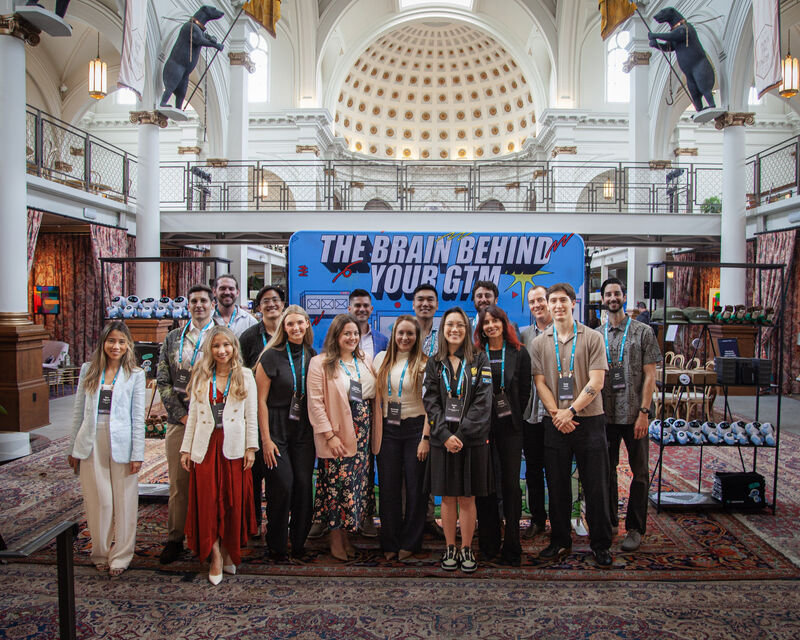
So UserGems organized Humans of GTM in San Francisco. The event carried the revenue machinery one expects - customers, operators, workflows and influenced-pipeline dashboards - but its stated promise was trust. Sessions featured people carrying real targets and discussing how they were working through a confusing market. A keynote was about building a life worth wanting, not software. Nguyen's summary was pointed: humans first, AI second.
Soon afterward, she reported UserGems' largest quarter to date: more than twice its previous record for net-new annual recurring revenue, a 2.5-times increase in average contract value, and its first seven-figure deals. She did not flatten the outcome into a victory lap. Running a startup, she wrote, felt like standing on a raft made of loose planks - growth, cash flow, morale, hiring and retention - while trying not to lean so hard on one that another sank.
It is a revealing metaphor from someone whose public work is devoted to scoring, prioritization and orchestration. A dashboard would suggest that the planks are independent metrics. A leader discovers that they are tied together and moving in water. The work is less like controlling a machine than continually correcting balance.
That helps explain Nguyen's longer tenure in a profession famous for short ones. She has remained through the bootstrapped stage, a Series A, the broadening of an initial champion-tracking product, the AI shock and several rewrites of the marketing playbook. The job expanded because she kept revisiting the underlying question: what does the business need now?
The unfinished build
The builders are now everywhere. Nguyen has watched buyers arrive at UserGems after assembling light versions of its system with general-purpose models and connected tools. She thinks building is the right instinct: a company understands its own go-to-market nuances better than any vendor. The surprise comes after the prototype. Someone must keep sourcing reliable signals, joining them, scoring them, maintaining the system and paying its compute bill.
That is the less photogenic 80 percent, the part after “I made a thing.” It is also the territory Nguyen has occupied since Lisbon. The improvised website earned attention because it solved the immediate problem. The career that followed has been an education in what happens next: distribution, incentives, repetition, maintenance, trust.
Her title now appends AI GTM to CMO, but the addition does not cancel the original craft. Product marketing still supplies the questions. Finance supplies the insistence on an outcome. The backpacker with church fatigue supplies a slight impatience with ceremony. And the operator knows that a machine earns its place only when the people around it can do better work.