At Mission Asset Fund, the problem was almost embarrassingly ordinary. A nonprofit helping families build financial security also had to offer financial security to its employees. Its neighbors in the Bay Area included technology companies with attractive benefits. Good intentions would not fill the gap in an offer letter.
The organization had moved from a fiscal agent to handling HR with inexpensive tools, including basic payroll. Growth made that arrangement insufficient. It chose TriNet for benefits access and HR support. The useful detail is what broke first: the collection of tools stopped matching the organization’s needs. Paying people was only one part of employing them.
- TriNet combines HR specialists, payroll, benefits and software for smaller employers.
- Its PEO shares specified employer responsibilities; HR Plus works without co-employment.
- Service fees are only part of the bill. Benefits and other employer costs matter.
José Quiñonez, Mission Asset Fund’s founder and CEO, put the staffing alternative plainly:
“We would have to hire two or three people to manage all those processes”José Quiñonez · Mission Asset Fund
This is a customer account published by TriNet, rather than an independent cost study. Still, it reveals the purchase: a way to keep a growing organization from having to construct every administrative function itself.
Borrowing the machinery of a bigger employer
Martin Babinec founded TriNet in 1988. The company’s central proposition remains legible nearly four decades later: small organizations need capabilities usually associated with larger ones. Their employees still need health coverage. Payroll still has deadlines. Hiring across state lines still creates administrative work.
TriNet’s professional employer organization, or PEO, bundles payroll, access to benefits, workers’ compensation, compliance support and HR expertise with a technology platform. Co-employment allocates certain employer responsibilities through a service agreement. The client keeps directing its workforce and running its business.
That distinction matters. A founder can delegate payroll administration while retaining responsibility for deciding whom to hire, how to manage them and what kind of workplace to create. Buying administrative capacity does not settle a difficult personnel decision.
Builds culture
Payroll + benefits
Support access
The target stretches beyond startups. TriNet publishes customer stories from Kajeet, an internet-connectivity business, and Mission Asset Fund. A commercial technology company and a nonprofit can have very different missions while facing remarkably similar benefits and payroll questions.
Two doors into the same problem
Some employers want administrative help without co-employment. TriNet’s HR Plus serves that market as an administrative services organization, or ASO. It combines software with HR and payroll support while the employer keeps its own tax identity and benefits sponsorship.
The choice reflects a deliberate expansion. TriNet acquired Zenefits in February 2022 to broaden its software offering beyond the PEO model. Its financial filing records a $209 million purchase price, including $192 million in cash and $17 million in stock.
By June 2026, TriNet said HR Plus supported more than 40,000 users. Optional Payroll Pro and People Pro packages add dedicated payroll or HR expertise. Buyers can choose between advisory help and more hands-on support. That makes the level of service a purchasing decision alongside the software.
The bill comes in several pieces
TriNet quotes services per employee per month. It does not publish one universal PEO price. Benefits, workers’ compensation, payroll taxes and add-ons sit alongside the service fee. HR Plus also uses tailored per-employee pricing. A sensible comparison therefore begins with the complete bill, including the benefits employees would actually receive.
The company’s own accounts explain why this matters. In 2025, TriNet reported $5.010 billion in total revenue. Insurance services contributed $4.224 billion; professional services contributed $719 million. Interest income supplied the remaining $67 million. Treating the whole number as software revenue would obscure the business.
Insurance costs create exposure that a software subscription does not. TriNet’s 2025 annual report said those costs outpaced insurance revenue growth. It repriced health-benefit services and linked some workforce losses to that repricing. Average worksite employees fell 5% to 333,886. These are employees at client businesses, not TriNet’s corporate staff.
There was a different combination in the second quarter of 2026: revenue fell 5% to $1.178 billion, while net income rose to $53 million from $37 million a year earlier. TriNet raised its earnings guidance. Those results show why growth and profitability deserve separate questions.

Hiring now comes with a laptop
TriNet’s 2026 product announcements follow the administrative trail beyond payroll. Multiplier powers international workforce support. Electric AI connects device provisioning and access management with onboarding and offboarding. Retirement integrations connect payroll information with providers including Voya and Vestwell.
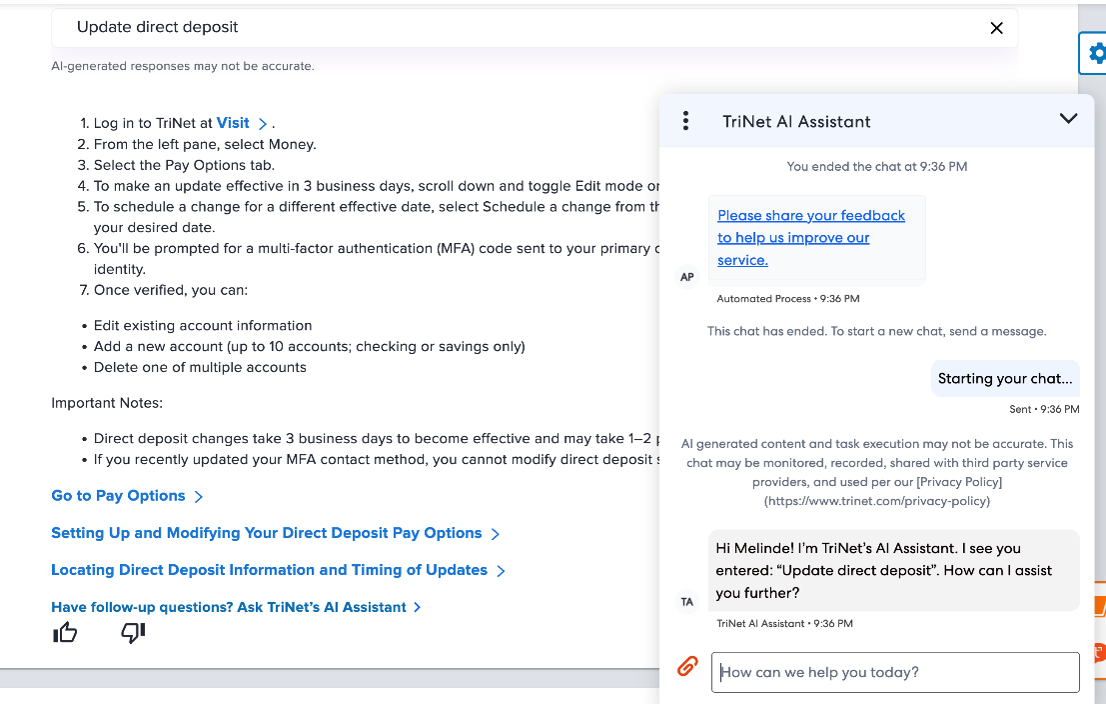
In April, TriNet completed its acquisition of leave-management company Cocoon. In October, it announced a phased rollout of TriNet Leave, powered by Cocoon, alongside recruiting and spending products planned for early January. Its AI Assistant also gained expanded mobile and analytics capabilities. Availability depends on the product and rollout.
The logic is practical: a new hire needs pay, benefits, equipment and access. Connecting those tasks can reduce repeated data entry. Whether a particular integration saves a buyer time depends on the systems and processes already in place.
Copy the question before the purchase
Against alternatives such as ADP TotalSource and Insperity, TriNet’s case rests on the combination of benefits access, service and technology. A buyer should test that combination against actual needs: benefits in employees’ locations, payroll support, migration work and the full annual cost.
Bring a real hiring scenario to the sales conversation: an employee starting in another state, a benefits election, a payroll correction and an eventual departure. Ask who performs each step, which system holds the information and where extra charges arise. Repeat the exercise with the current setup. This produces a more useful comparison than counting features, because it exposes the handoffs a growing employer will have to manage after the contract is signed.
A company with capable internal HR staff and satisfactory benefits may need less outsourced help. An employer that wants to keep its current arrangements may prefer an ASO. Global services introduce separate agreements and fees. Scale is useful when the capabilities gained justify the cost and coordination.
Mission Asset Fund’s experience suggests a question readers can copy before signing anything: which parts of employing people are consuming time that the organization needs elsewhere? Once that answer is specific, the demo becomes much easier to judge.