Paul Sarvadi’s first taste of financial independence came in a jar of pickles. In his large family, the contents of a grocery bag came with an understanding: there had to be enough for everyone. A pickle apiece meant a pickle apiece. Then he earned a few dollars caddying, crossed to a general store and bought a jar for himself. Years later, recalling the episode, he described the satisfaction of taking initiative and getting something he wanted. The reward was modest. The ownership was complete.
The golf course supplied another education. Carrying clubs meant learning how to serve people whose personalities became considerably easier to read as a round progressed. His older brother was the caddy master. Family employment had its complications, too. The boy watching golfers would eventually spend his working life thinking about employers, employees and the arrangements that help both get through the day.
Today, Sarvadi is the co-founder, chairman and chief executive of Insperity. The company turned forty in 2026. Its subject is the work surrounding other people’s work: payroll, employment administration, recruiting, performance and the many obligations that arrive when a business starts hiring. Behind the corporate vocabulary sits a familiar predicament. An owner has built something people want. Now the owner needs help keeping the whole thing running.
The work behind the work
Sarvadi arrived at that predicament through experience. He attended Rice University and the University of Houston, then left college for entrepreneurship. He has described running six businesses in his twenties, with both successes and failures. By the time he co-founded the company that became Insperity in 1986, he had spent enough time on the owner’s side of the desk to know how crowded it could become.
His explanation of the opportunity starts with five areas: finance, sales, operations, technology and people. The first four depend on the fifth. That observation gives his career a particular direction. He wants a business owner to treat the workforce as part of the central business plan, with deliberate attention to what employees need to contribute.
For a smaller employer, the problem is painfully practical. Specialist knowledge costs money. Administration takes time. Recruiting the next person does little to shorten the list of responsibilities attached to everyone already hired. The founder’s freedom can become a schedule so full that freedom itself would require an appointment.
Insperity developed around a professional employer organization, or PEO, model. Through co-employment, it takes on agreed employment responsibilities alongside the client business. The client gains administrative services and access to HR expertise. Sarvadi’s commercial proposition was that smaller companies could obtain support they would struggle to assemble individually. His personal connection to those owners gave the proposition its urgency.
A plan depends on the people who put it into practice.
A business needs room to change
The first office was in Kingwood, Texas, and measured 600 square feet. The original company name was Administaff. Building the service also meant helping establish a framework for it. Co-employment challenged familiar assumptions about who an employer was and which responsibilities belonged where. The business needed customers, but it also needed its model to be understood.
Texas’s Staff Leasing Act took effect in 1993, following efforts by company executives and others to establish industry standards. Administaff went public on the New York Stock Exchange in 1997. In 2017, Insperity obtained certified professional employer organization status from the IRS. Those dates record a less picturesque part of entrepreneurship: the long process of making an unfamiliar arrangement legible to institutions.
By 2011, even the company’s name needed attention. Administaff suggested temporary staffing, Sarvadi explained, although that was not its business. The company had also developed services beyond its original comprehensive offering. It became Insperity, a combination of inspiration and prosperity. Familiarity had commercial value; so did being understood correctly. The change made room for a broader business.
Sarvadi’s own role acquired unusual continuity. He has been a director since the company’s founding and chairman and CEO since 1989. He also served as president until August 2003. The work brought recognition: a national Ernst & Young Entrepreneur of the Year award for service industries in 2001, a Mays Business School new-venture leadership award in 2004 and induction into the Texas Business Hall of Fame in 2007.
He also served as president of the National Association of Professional Employer Organizations and spent five years on its board. His career involved the company and the wider category in which it operated. For a business selling an unfamiliar relationship with employment, explaining the category was part of the job.
Five words on a book cover
In January 2019, Sarvadi published Take Care of Your People: The Enlightened CEO’s Guide to Business Success. The main title has the advantage of being understandable before the first meeting begins. The book argues for a human capital strategy tied to a company’s values. It brings the people question into decisions about leadership and business performance.
The wording also places an obligation on the person at the top. Taking care requires decisions, time and follow-through. Sarvadi’s writing about culture repeatedly returns to what employees can observe: whether leaders demonstrate the values they promote, whether recognition supports those values, and whether feedback produces a visible response. A framed statement has very little to say when a colleague asks what happens next.
“In small and midsize companies, every person needs to be a game-changer, because there are not that many people.”
Paul Sarvadi
His hiring philosophy follows the same logic. He places value on the ideas and strengths a person brings into a company. A job description specifies work to be done; a new colleague can also change how that work gets done. That distinction matters in a small team, where one person’s judgment travels a long way.
The emphasis on individual contribution gives his management argument its scale. Large organizations can make people seem interchangeable on a chart. A smaller company has fewer places for that assumption to hide. The person who notices a problem, suggests a different approach or helps a colleague has consequences for everyone nearby.
Two authors, one difficult workplace question
His next book brought another perspective to the table. Making Differences Work, co-authored with Eli Jones, appeared in 2023. Jones is a marketing professor at Texas A&M University, a former dean of Mays Business School and an Insperity board member. The collaboration paired an operating executive with an academic who knew the company.
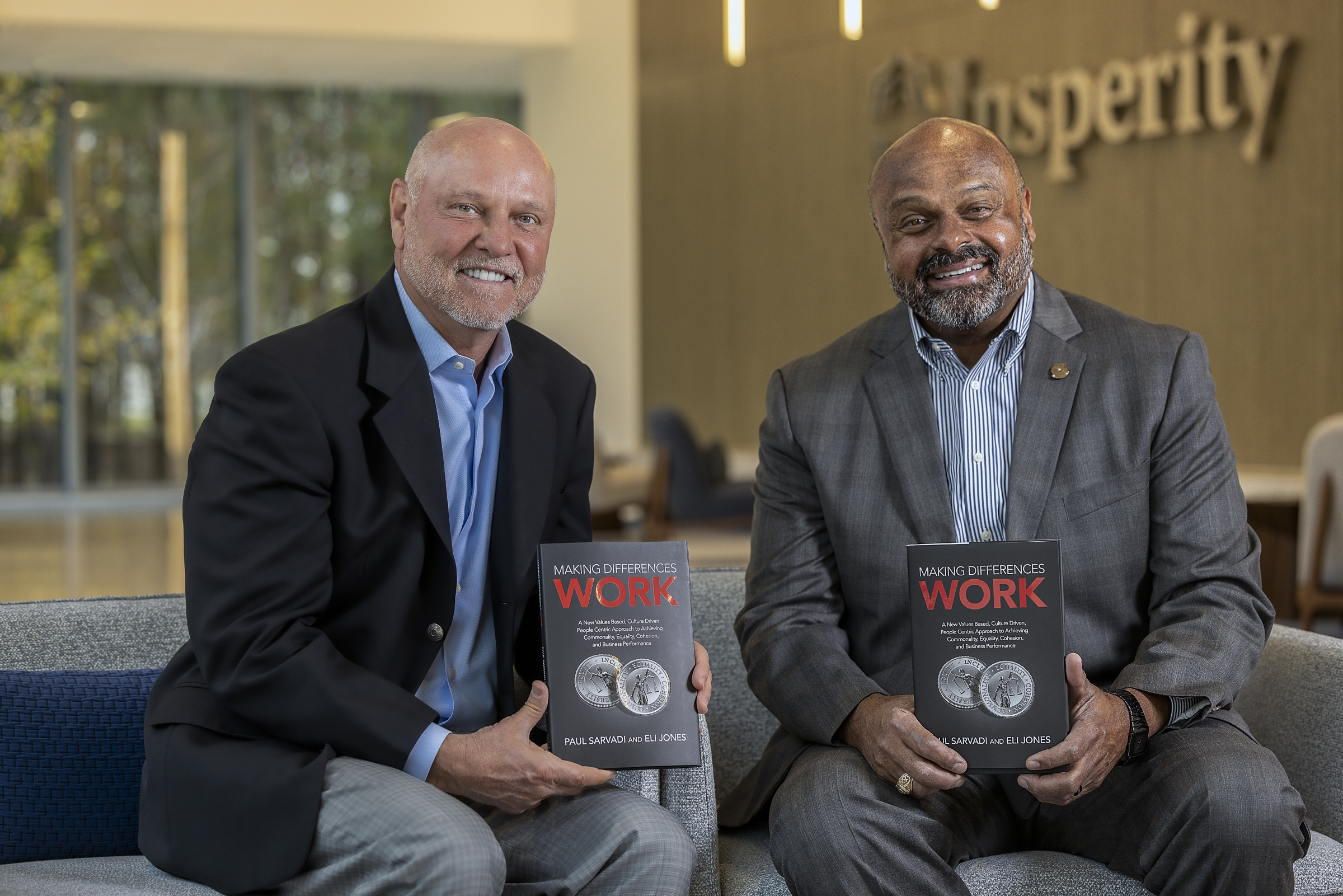
Their framework centers on commonality, equality and cohesion. They present it as building on the unifying aims of diversity, equity and inclusion. The practical ambition is a workplace where people from different backgrounds appreciate one another and share a sense of belonging. Difference supplies perspectives; working relationships determine how those perspectives enter the conversation.
Sarvadi and Jones also examined the proposition through research. In a July 2024 account, Sarvadi described focus groups followed by a customized survey of 1,999 Insperity employees. They considered four outcomes: team creativity, collaborative culture, alignment of values and discretionary effort. He reported positive relationships between their framework, belonging and those outcomes.
Four outcomes examined: creativity, collaboration, values alignment and discretionary effort.
The setting matters. This was research involving Insperity employees, described by a company leader and developed with a board member. Its findings belong in that context. The useful question for another employer is what its own staff experience and what its own measurements reveal. A survey is a starting point for inquiry, rather than permission to assume everyone feels the same way.
Sarvadi’s implementation advice makes the inquiry concrete. He recommends leadership commitment, employee involvement, a baseline survey and a report card to track progress. He wants responsibility spread through the organization. Belonging becomes something leaders must revisit during the employee’s time at work, with evidence of whether their efforts are reaching people.
In his account of business outcomes, he describes discretionary effort through employees helping clients and colleagues beyond the immediate task. Collaboration, similarly, means working toward a shared goal. These are ordinary actions with substantial consequences. They also give an abstract culture argument a place to be tested: in what happens between people when a difficult piece of work arrives.
Forty years, and another set of tools
In February 2026, Insperity and Workday announced general availability of HRScale. It combines Insperity’s PEO model and HR services with Workday’s human capital management technology, including payroll, time tracking and workforce information. The partnership addresses growing businesses that want more capable systems alongside human support. Sarvadi is still pursuing the gap he identified as a small-business owner, now with a different collection of tools.
The fortieth anniversary followed in March. Anniversaries make a company’s history look tidier than running it can feel. The milestones line up; the daily decisions rarely do. Sarvadi’s current work still concerns the relationship between employment administration, individual contribution and business performance. Each new product adds another way to address it, and another promise that employees must deliver.
His stated mission connects business success with community prosperity. That is a larger destination than an orderly payroll, though an orderly payroll remains a useful place to begin. The attraction of his career lies in that connection between a broad ambition and a specific service. Someone has to answer the question, process the record and help the owner make the next decision.
The boy with the pickle jar had found the pleasure of earning something for himself. The executive’s occupation became helping other owners keep enough time and attention to build what they had started. Forty years offers plenty of occasions to change the subject. Sarvadi keeps returning to the people who make the work possible.