Tosin Eniolorunda once had to borrow from his wife to pay his employees. She had a salary and savings. He had a company with salaries to meet. For an engineer accustomed to solving problems, this was an unusually personal piece of financial infrastructure.
Years later, Moniepoint would announce a financing round above $200 million. The earlier episode deserves to remain in the picture. It puts the founder back at human scale, before the transaction volumes and investor names begin crowding out the person. A business can have a promising future and still need money on Friday.
Eniolorunda’s career has involved repeatedly shortening the distance between a useful idea and the person who needs it. First he built things for other students. Then he built software at Interswitch, and later for banks through his own company. Eventually, the business moved closer to the shop counter. Each step brought a different customer, and a less abstract understanding of what money does.
The boy who supplied his own toys
Born in Lagos and raised in Ibadan, Eniolorunda grew up with an engineering contractor for a father and a teacher for a mother. He was the eldest of three children. Engineering and education were present before either became a career choice.
There were relatively few toys, so he made his own from materials around the house. He also took an interest in his father’s textbooks, including electrical and electronics material. It is an appealing childhood detail because it describes curiosity with an immediate purpose: he wanted something to play with. Improvisation had a customer, even if that customer was himself.
At Obafemi Awolowo University, where he studied mechanical engineering, making things became a way to earn. He worked on hardware and software projects for students. The work involved deadlines, someone else’s requirements and the obligation to produce something that functioned. University gave him engineering knowledge; those projects gave him practice in making that knowledge useful.
He graduated in 2007. By 2009, he was working at Interswitch, entering the payments industry as a software engineer. Product management and technical leadership followed. His mechanical engineering degree had led him toward a world where the moving parts were mostly invisible, but a failure could still stop everything.

A payroll-sized lesson
He had intended to spend several years learning an industry before starting a business. Employment was part of the preparation. By his late twenties, the urge to build something of his own had become difficult to postpone.
In 2015, he and Felix Ike founded TeamApt. Their initial customers were banks. They offered the sort of software that makes financial organisations work behind the scenes, where a successful day can be distinguished by the absence of anything worth announcing.
The early operation took shape in a flat in Lagos’s 1004 estate. Customer projects helped finance it. In his writing about that period, Eniolorunda described using side projects, paid work and borrowing from friends or family to get started. He also explained the practical attraction of enterprise customers: payments from one project could help fund the next.
That approach required close attention to cash. A customer owing money and an employee expecting a salary occupy different positions in a founder’s calendar. The episode involving his wife’s savings belongs to that gap. It also complicates the tidy idea that bootstrapping means independence. Early companies often depend on people whose contributions never appear in a funding announcement.
“Hype is not value. Profit is value.”
Tosin Eniolorunda, 2018
His early public arguments were blunt about the importance of earning. Raising capital took time; serving customers produced revenue and taught the team what to build. He was also pragmatic about financing. Different businesses needed different approaches. The point was to keep the work moving and create something people would pay to use.
Another early test was technical. Eniolorunda has recalled a platform error that cost the company around ₦250 million. Fixing it required a shutdown lasting three and a half weeks, during which customers had to find alternatives. The decision exposed the uncomfortable arithmetic of reliability: carrying on could deepen the damage, while stopping meant interrupting people who depended on the service. He credits committed colleagues with helping the business through it. The episode gives some weight to his later emphasis on responsible risk-taking. A founder can choose a risk; customers may discover they have been brought along.
Closer to the counter
Supplying banks gave the team expertise, but it also placed an institution between the people building the product and the people using it. Around 2019, Eniolorunda and his colleagues shifted more attention toward customers they could serve directly.
Offline payments carried an awkward requirement for a software company: physical distribution. Terminals had to reach people. Relationships had to be formed. Someone had to help when a transaction became a problem. The work extended well beyond writing an application and waiting for downloads.
Moniepoint developed through that combination of technology and local presence. Agents could help people withdraw or deposit money closer to where they lived and worked. In Eniolorunda’s account of the product’s beginnings, colleague Tobi Amira’s lunch was interrupted by an agency-banking idea. A quiet meal is a fragile institution around an enthusiastic founder.
There was a serious problem underneath the interruption. Agents needed clearer records of transactions and earnings, along with systems they could depend on. Money that appears to have vanished is a software problem with an audience. The person standing across the counter generally wants an answer before an explanation of the architecture.
This helps explain the company’s evolution. Once a business relies on a payment tool, other needs become easier to see. An account, access to working capital and better records all sit close to the original transaction. Eniolorunda’s opportunity widened as he learned more about the work surrounding a payment.
When the product named the company
Moniepoint received its banking licence on February 14, 2022. The business bank launched that April. For a founder trying to bring more financial tools to merchants, this was a consequential Valentine’s Day present. A licence has limited romantic appeal, but unusually good practical uses.
The company’s public identity soon caught up with its customers. People recognised Moniepoint, the product they encountered, more readily than TeamApt, the organisation behind it. In January 2023, the company adopted the Moniepoint name. Years of technical work had produced something familiar enough to supply its parent with an identity.
The financial milestones grew larger. In October 2024, Moniepoint announced a $110 million Series C first close. In October 2025, the completed round exceeded $200 million, bringing together investors including Development Partners International, LeapFrog, Google’s Africa Investment Fund and Visa.
The timing matters: those figures describe successive closes of the same round. Behind them sat a business extending from payments into banking, credit, cross-border services and management tools. In its January 2026 review, Moniepoint reported that its microfinance bank had disbursed more than ₦1 trillion in credit during 2025. The company’s scale now included lending to the businesses it had first met through transactions.
One round, two milestones
Series C first close and completed round. Equity financing, US dollars; rounded display.
The organisation becomes the project
A larger company changes a founder’s work. Technical expertise remains valuable, but fewer decisions can pass through one person. Eniolorunda’s public writing increasingly considers how an organisation thinks and communicates.
His essays address candour, empathy and leadership without ego. In 2026, he wrote about a phrase in his WhatsApp bio: “Clarity and Context.” He had seen teams understand instructions without grasping their purpose, and other teams understand the ambition without agreeing on the practical result required.
The distinction is familiar to anyone who has left a meeting convinced that everyone agreed, then inspected the work a week later. A clear instruction needs an explanation of why it matters. A shared ambition needs a clear description of what people should do next.
Reflecting on a leadership retreat, he described the value of shared principles for making decisions. Leaders need room to challenge one another and sharpen their judgment. His account suggests a founder learning to make the company less dependent on his presence in every conversation. The engineer’s project has expanded to include the conditions under which other people can do useful work.
Back to the workshop
Education gives that interest a wider setting. The Tosin Eniolorunda Foundation supports STEM learning and business development through resources, mentorship and financial support. Its connection to his childhood is direct: curiosity benefits from somewhere to practise.
In May 2026, a ₦3 billion innovation-hub commitment was announced for Obafemi Awolowo University, Ahmadu Bello University and the University of Nigeria, Nsukka. The planned hubs bring practical technical work, industry contact and entrepreneurship onto campuses. Moniepoint’s recruitment description for their leadership makes the intention concrete: students across faculties should be able to acquire applied skills and find routes into industry or ventures of their own.
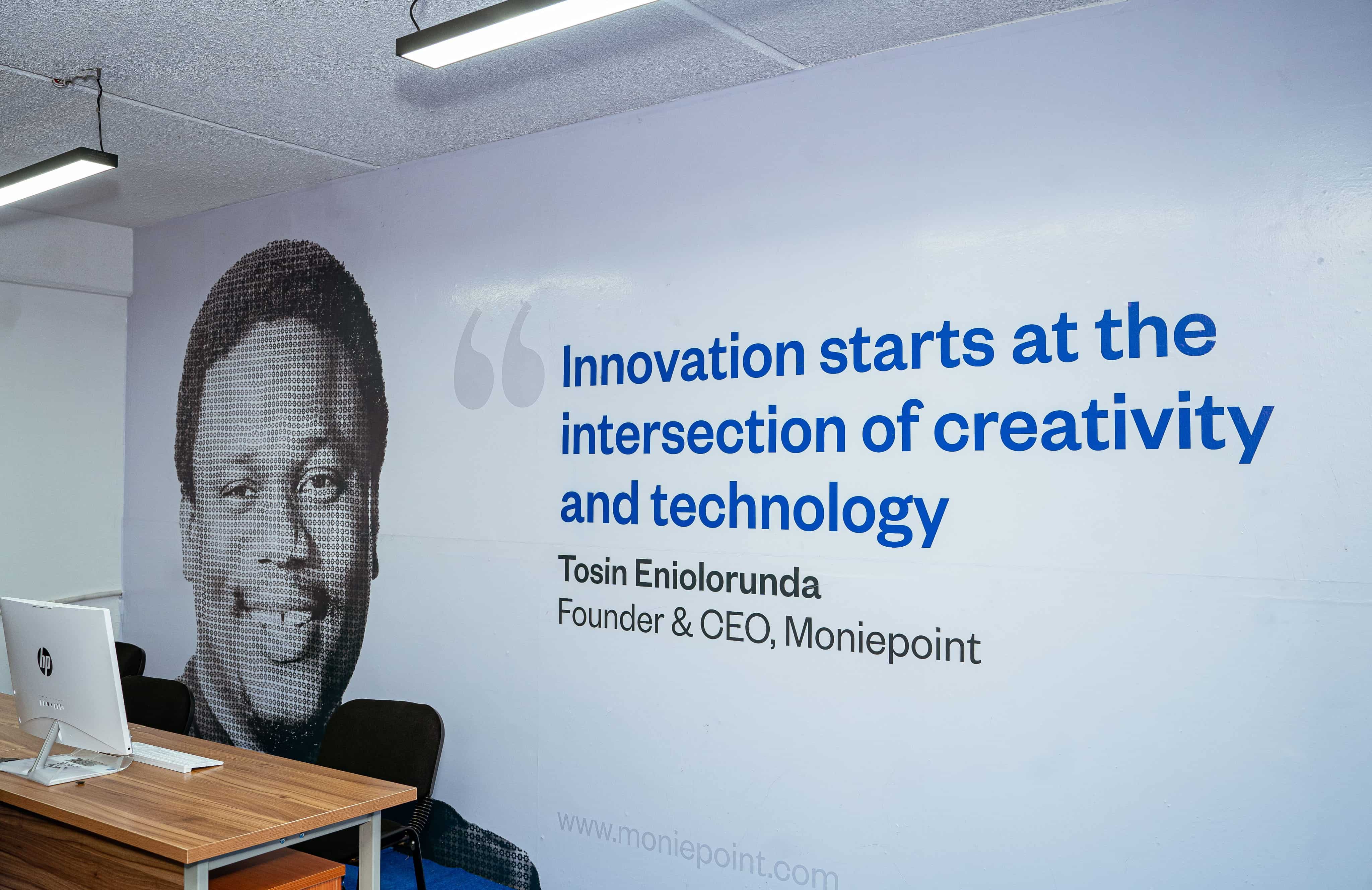
In October 2026, Eniolorunda was named to TIME100 Next, with a tribute by Tony Elumelu. He and Ike had already joined the Endeavor entrepreneur network in 2021. Recognition now reaches well beyond the rooms where the early software was written.
Yet the university work brings the story back to a smaller unit: a student, a project, a chance to make something function. Eniolorunda once earned money helping other students build. Now he can help provide places where more students begin. For all the larger numbers attached to Moniepoint, that is a recognisable continuation of the boy in Ibadan looking around the house for parts.
Keep reading. Keep listening.
Photography: Business Insider Africa; Tosin Eniolorunda Foundation.