The salesperson’s problem used to be finding a prospect. Then software began giving itself away. A million people could sign up before one of them spoke to sales, leaving a smaller, stranger problem: which of those million deserved a phone call? Toplyne was built to answer it. The company joined the traces people left in a product - what they tried, how often they came back, whether their team was growing - to billing and customer records. Its models ranked the users and accounts most likely to buy, upgrade or drift away. The sales team could then act before a promising account vanished into the crowd.
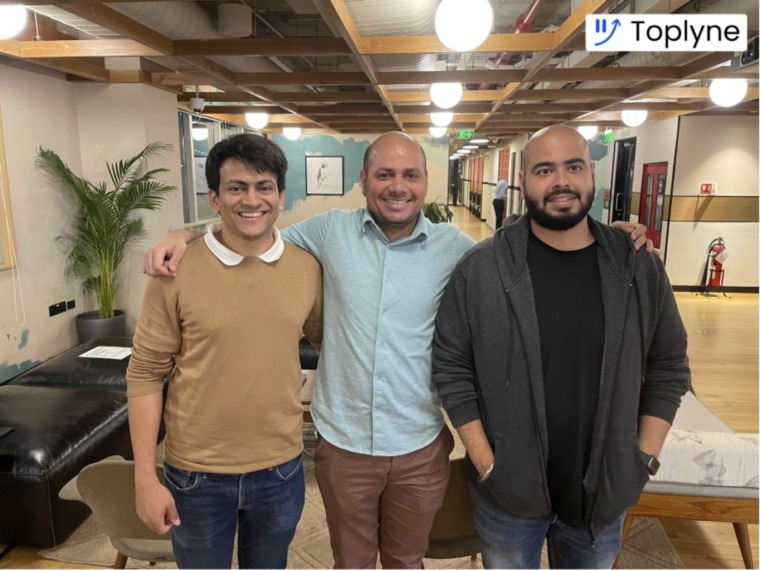
- Founded in 2021 by Rishen Kapoor, Ruchin Kulkarni and Rohit Khanna, Toplyne sold predictive customer intelligence to software growth teams.
- Named customers included InVideo, Canva, Grafana, Gather.Town, BrowserStack and Murf AI.
- It raised $17.5 million, later pitched predictive ad audiences, and announced a wind-down in October 2024.
The premise had charm because it reversed the order of the old sales script. The customer had already arrived. The product had already made an introduction. A salesperson’s task was to notice which introductions mattered. Toplyne’s founders, two with experience at Sequoia India and one a former product executive at CleverTap, had watched software buying move from a manager’s meeting to an individual’s browser tab. Their 2021 founding essay cast the product as the protagonist; sales and marketing were supporting players. It was a useful correction to the usual theater of business software.
One million users and a few hundred calls
InVideo offered Toplyne an early, clean example. The video creation service had more than a million users and hundreds of thousands of new sign-ups each month, according to Toplyne’s account of the work. Its sales team could reach only a few hundred people a day. The familiar answer - call the newest sign-ups, or sort by company size - would have mistaken convenience for intent. Toplyne connected InVideo’s product activity in Amplitude, billing records in Stripe and communication history in Salesforce. Its model suggested which actions and attributes correlated with conversion, and the resulting profiles were pushed into the sales team’s daily workflow.
InVideo founder Sanket Shah said the sales team’s conversion rate improved by 80 to 100 percent within days of using the tool. That is a customer-reported result from one early deployment, not a promise for every sales department. Still, the mechanism is plain enough to borrow. Combine the data that describes behavior, decide what outcome matters, then put a short, intelligible list in front of a person who can act on it.
The threshold that stopped being useful
Murf AI, the voice-generation company, later encountered a subtler version of the same problem. It had used Mixpanel to make hand-built cohorts: users who generated ten minutes of audio, users who tried five voices, users who shared during a trial. Each rule caught some genuine interest. Each also broke in a different way. Too many people crossed the ten-minute mark. Sharing was a strong signal but rare. A growing list of rules became harder to maintain and harder to trust. Toplyne’s pitch was that a model could weigh the combination instead of making the team choose a single magic threshold.
In Murf’s reported A/B test, a cohort chosen by Toplyne’s model converted at seven times the rate of a cohort Murf had defined in Mixpanel.
One customer test, reported in 2023. It measures a particular campaign, not the whole business.Murf also reported a 10 percent lift in free-to-enterprise conversions and a 20 percent immediate lift in revenue closed for the sales team over the first two months of a separate playbook. Those figures made the product sound less like an analytics dashboard and more like a sorting machine connected to action. The distinction matters. A beautiful prediction that never leaves a chart is only a new way to admire the problem.
By May 2022, the roster of publicly named customers included Canva, Grafana, Gather.Town and BrowserStack. Tiger Global and Sequoia Capital India led a $15 million Series A, five months after a $2.5 million seed round. The company planned to enlarge its data science, engineering, product and design teams. It had clients whose names open doors, a product with reported wins, and money to keep building. It did not yet have the one thing none of those can certify: a large, repeatable market of buyers who would keep paying for the same solution.
A market is larger than its first admirers
Toplyne knew the question was difficult. A public case study by sales consultancy JJELLYFISH describes early success with customers alongside a limited addressable pool of product-led growth companies. The founders engaged the consultancy to test buyer assumptions and refine US outreach. That is an unusually revealing piece of the story: the company that modeled which users were likely to buy was itself trying to learn which companies were likely to buy its model. It is easy to find ten enthusiastic design partners. It is much harder to find the next hundred at a cost the subscription can repay.
This was business-to-business software: a subscription product for growth, sales and marketing teams, wrapped around data those customers already held. Buyers could compare it with product-led revenue tools such as Pocus or Calixa, or build a simpler score inside their own analytics and CRM stack. Toplyne’s distinguishing promise was to learn from behavior and deliver an actionable audience, rather than leave a human to maintain a brittle list of rules. For the later ad use case, the alternative was often an audience assembled directly inside the advertising platform. Each option faced the same buyer’s test: does the extra layer improve the outcome enough to earn its place?
Toplyne’s positioning widened. Its LinkedIn description spoke of audiences generated from first-party customer data for ads, in-app nudges, email and sales. A 2024 D2C industry report described a product for brands advertising on Meta and Google. A website pixel would collect behavior, a model would estimate purchase likelihood and lifetime value, and the resulting audiences could be synced to ad platforms. The report described a 30-day free trial to test those audiences. Toplyne presented a potential 35 to 70 percent improvement in return on ad spend; that was a marketing claim in the report, not an independently established average.
The wider pitch had a logic. A company selling a prediction about customers might serve a salesperson choosing whom to call or a marketer choosing whom to show an ad. The data is related; the buyer, budget and proof of value are different. Public material shows the change in offer, though it does not show exactly what internal decision triggered it. The practical question for either buyer remained the same: can the model change a measurable action, and can the resulting gain cover the cost of the software and the work of connecting the data?
The result the model could not predict
In October 2024, co-founder and CEO Rishen Kapoor said Toplyne would wind down after three and a half years. The company had not reached the scale or product-market fit its founders wanted. It would return capital to investors and help customers through the transition. Roughly 30 people had worked across sales, customer success, machine learning, product, design, HR and engineering. Kapoor and Kulkarni said they would help those colleagues find their next roles. Kapoor returned to Peak XV Partners in January 2025.
“Despite our best efforts, we couldn’t reach the scale or product-market fit we aimed for.”Rishen Kapoor, announcing the October 2024 wind-down
It would be tempting to supply a tidy cause: a rival, a bad price, a failed pivot, a shrinking runway. The founders’ closure statement did not offer that breakdown. Kapoor later wrote, in his Peak XV biography, that Toplyne had built and shipped with companies including Canva, Cloudflare, Notion and Dropbox but that the founders eventually realized it was not a venture-scale business. His retrospective is more specific than a generic failure label, though it still does not turn the company’s private economics into a public ledger. Toplyne solved specific customers’ problems, then struggled to turn those wins into the scale it had set out to build. A software company can be good at the first task and unsuccessful at the second. A famous logo in a sales deck proves someone bought something; it does not show how often the sale can be repeated.
For growth teams, the copyable part survives the company. Start with a decision that matters, such as whom to call or which users should see an upgrade offer. Compare the existing rule with a modeled cohort in a real test. Measure revenue, not merely clicks or score accuracy. Then count the operational cost: clean event data, identity matching, CRM plumbing, campaign setup and a person who will use the result. This method works best when there are enough users and enough conversion events to learn from, and when a team can actually act on the ranking. With sparse data, a tiny user base or no clear route from prediction to action, the exercise can produce an elegant list nobody needs.
Toplyne’s story has a last little irony. It asked customers to stop treating every free sign-up as equal. Its own early success might have benefited from the same discipline applied to markets: a promising customer is a signal, a repeatable market is a pattern. Toplyne found the signal. By its founders’ account, the pattern never grew large enough.