Tony Stahl’s contribution to the February 2022 announcement of KOS’s $12 million investment was an explanation of how to listen. The company had a direct connection with hundreds of thousands of consumers, he said. That connection helped it understand changing tastes and test products before offering them to a wider retail audience. A funding announcement is usually an occasion to admire the size of the cheque. Stahl used his turn to describe the conversation that preceded it.
It was a revealing choice for a founder whose earlier working life had been in online marketing. KOS, the consumer brand he co-founded with Allan Stevens, had grown into a business selling through national chains. The internet remained more than a checkout. In Stahl’s account, it was where the company could hear what people wanted while there was still time to do something about it.
Look at his story through that lens and the familiar milestones acquire a different emphasis. A retail launch becomes a test of whether knowledge travels. An investment becomes a way to bring experienced people closer. A regional entrepreneurship nomination becomes an opportunity to talk about developing employees. Stahl’s public remarks return to the people around the transaction: customers, colleagues, partners. The machinery of growth is present, but so are its operators.
Chocolate, vanilla, then the shopping aisle
Stahl and Stevens came to KOS with experience in online marketing. They were entering a business in which a persuasive page eventually has to be followed by a physical delivery. The two founders began with an online range in late 2017, including chocolate and vanilla protein powders. Subsequent coverage dates the brand’s broader launch to 2018. The early proposition had the useful simplicity of two familiar flavours. There would be time for a more crowded cupboard.
The early range sold primarily through Amazon, before the business expanded its own direct sales and retail operations. That order matters. A marketplace gives a young company an existing place to meet shoppers; its own storefront offers another relationship with them. KOS was learning about purchases in environments where the distance between seeing a product and ordering it could be a few clicks.
By August 2020, KOS had raised $2.1 million with backing from Springdale Ventures, former Whole Foods chief executive Walter Robb and Horizon Bank chair Jim Schneider. Money was earmarked for distribution, product development and marketing. These were practical ambitions for a business moving beyond its first online audience. The next customer might encounter KOS while pushing a trolley, with neither a browser tab nor an advertisement in sight.
The change also asked something of the founders. Online marketing expertise does not automatically confer an understanding of every retailer’s buying process. KOS’s early move into stores was difficult, Stevens later recalled. The company’s Whole Foods rollout in the first quarter of 2020 became an important step. For Stahl, the path from digital marketer to consumer brand executive included learning a new setting for an old problem: persuading someone to give a product a chance.
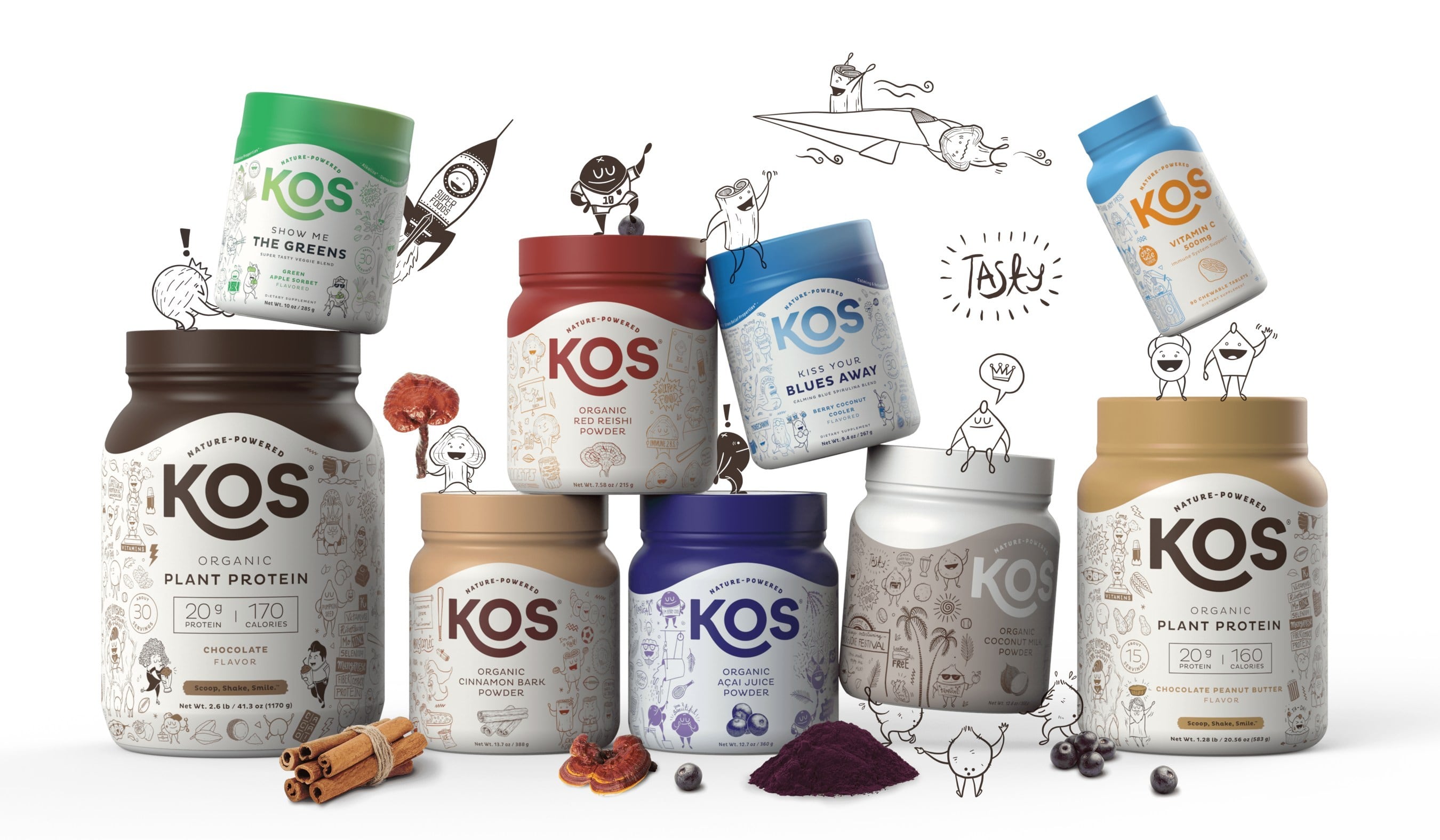
A jar with a sense of humour
The packaging supplied part of that introduction. KOS’s products arrived with pale colours, illustrated characters and names that seemed comfortable making a small joke. “A Whole Latte Gold” and “Kiss Your Blues Away” were rather less solemn than the language one might expect on a tub of powder. A person looking at the range could register the tone before reading the small print.
This was a collaborative construction. Design studio Tofu Design worked on KOS’s shopping experience during 2018–2020, alongside illustrator Juan Montes and collaborator Nolan Heyer. Its account describes the effort to preserve a familiar, usable shop without giving it the appearance of a standard template. That is a useful distinction in a business selling through screens: a visitor needs to recognise where to click while remembering whose shop it was.
Tofu’s work also extended to the unglamorous business of the cart. Bundles and stacked promotions had made it crowded; the studio developed a dropdown arrangement to clarify the items and offers. The detail is small enough to escape an investment announcement and large enough to affect an order. A brand can have charming drawings and still leave someone wondering what, precisely, is in the basket.
The visual identity belongs to the company and its collaborators. It would be too easy to assign every bright label to a founder’s personality. What it does show is the environment Stahl helped build: an enterprise willing to make its commercial introduction with a wink, then work through the layout that gets a customer to the end of the purchase.
The question behind the click
Stahl’s own LinkedIn activity offers a more technical view of that environment. In one post, he asked about the disadvantages of starting again with a fresh Facebook Pixel. He described plans involving higher lifetime value customers, audience matching and the relevance of advertising. This was a founder asking a specific question about the instrument panel, with the bonnet open for anyone with useful experience.
That question makes an interesting companion to his later explanation of direct customer relationships. One deals with advertising signals and audience selection. The other deals with learning what people want. Both put attention on the quality of information entering the business. A bigger audience can be an expensive achievement if a company has learned very little about the people inside it.
The distinction helps explain why Stahl’s funding remark is worth pausing over. Testing online before expanding into retail suggests a sequence: introduce, observe, decide, distribute more widely. It is an approach with room for revision. His description gives the customer a role before the wider launch, when feedback may still change the decision. The shop is doing two jobs at once: selling today’s range and informing tomorrow’s.
- 01Sell directly
- 02Hear customers
- 03Test products
- 04Expand to retail
The company grows a team around it
As KOS expanded, it brought in people with experience beyond the founders’ original field. Derek Dearwater joined as chief revenue officer in February 2020. Kevin Dalaeli arrived that August as chief marketing officer and later became president and chief operating officer. Those appointments placed additional operating experience around the two co-founders as retail became a larger part of the business.
In July 2021, Stahl was named a finalist for EY’s Entrepreneur Of The Year award in the Pacific Southwest - Orange County region. The accompanying announcement quoted him on a responsibility he attached to leadership: “We have an obligation as leaders of today to raise up the leaders of tomorrow.” His stated aim was to help team members develop, understand the company’s purpose and see their own contribution to it.
There is a practical reading of that ambition. A company entering more shops needs people who can make decisions without sending every question back to its founders. Training colleagues to lead can change the number of useful decisions a business is able to make. Stahl’s statement placed time and effort behind that responsibility, extending the idea of growth from the sales figure to the person doing the work.
The recognition was a finalist selection, a precise distinction worth keeping. Its interest here lies in what Stahl chose to say at the moment. He had been given an occasion to talk about himself. He spoke about the people expected to lead after him. The shift of subject is modest, but it offers a clearer view of his aspirations than a ceremonial adjective would.
“We have an obligation as leaders of today to raise up the leaders of tomorrow.”Tony Stahl · July 2021
Twelve million dollars, and more people in the room
The February 2022 round brought Clayton Christopher and Brian Goldberg into the next stage of KOS’s development, with Springdale Ventures investing again. Christopher joined the board. Goldberg also took part in meetings. Their backgrounds included building consumer brands, giving the founders access to people familiar with the operating demands of a business that sells physical goods through multiple channels.
At that stage, the work ahead included strengthening sales coverage and spending more time with retail category managers. The company planned to add national and regional sales roles, alongside marketing and ecommerce staff. Such appointments turn a broad intention to expand into someone’s daily responsibility. Behind the neat investment figure were questions about accounts, merchandising and who would have enough hours to follow up.
Later operating work supplied another, less photogenic measure of progress. A 2023 Inventory Planner customer account reported that KOS had released $1.5 million from excess stock. That was a company result rather than a personal claim by Stahl. It belongs in his story because it shows the other side of a consumer brand’s expansion: after winning orders, someone has to make the quantities work.
A warehouse has a stern sense of humour. It records enthusiasm in boxes, and boxes require space. The inventory example gives the earlier funding ambitions a physical setting. Growth creates opportunities to sell more, and obligations to coordinate more. The founder who once studied an online audience now belonged to an organisation managing the consequences of reaching it.
Separate rounds. Funding figures describe the company, not Stahl’s personal wealth.
The conversation has to travel
KOS also connected purchases to a Feeding America partnership. By January 2022, the company reported providing more than two million meals toward its ten million meal project. The undertaking gave customers another way to understand what buying from the brand supported. Its progress was expressed as a count, with a goal still ahead of it.
Across those years, Stahl’s public story follows a widening circle: an online customer, a retail buyer, a specialist colleague, an experienced investor. His description of direct selling offers a way to connect them. Information gathered close to a customer can help a much larger organisation decide what deserves a place on a shelf.
The interesting question in that expansion is how long the conversation can stay useful. More distribution introduces more distance. More employees introduce more handoffs. Stahl’s remarks about customers and future leaders suggest an answer built around keeping other people informed and involved. A jar can travel across the country. Carrying an understanding of the person who buys it takes a little more organisation.