Tomas Vykruta bought his first airplane on eBay. It was a Cessna 172, it needed an annual inspection, and it would not start. This is an unusually literal way to acquire a learning opportunity. Once the aircraft was running, he took flying lessons on the journey west to San Francisco. The trip lasted four days. At one point, the cold persuaded the travelers to head south toward Arizona.
There is a temptation to turn an episode like that into a founder’s horoscope: of course the person who bought the airplane would someday start the company. Lives are less obliging. What the episode does establish is a habit of getting close to a complicated machine, learning its requirements, and accepting that the instruction manual is only a beginning.
Years later, Vykruta would leave Google and help build EvolutionIQ, an insurance software company acquired by CCC Intelligent Solutions in a deal announced at $730 million. Between the airplane and the acquisition sits a career spent on a deceptively difficult question: how do you make software useful when the world refuses to follow a tidy set of rules?
Before the insurance files, there were dragons
Vykruta’s early credits belong to the world of games. He is listed as a programmer on Drakan: Order of the Flame, released in 1999, and Drakan: The Ancients’ Gates, released in 2002. Another 2002 credit appears on The Lord of the Rings: The Fellowship of the Ring. By 2004, he was a senior engine programmer on The Suffering; its 2005 sequel credits him as technology lead programmer.
These are specific jobs with specific outputs. An engine programmer works beneath the visible entertainment, making the machinery behave so that someone else can enjoy the dragons. It is a useful early chapter for understanding a later enterprise founder. The customer may admire the demonstration, but eventually the underlying system has to carry the weight.
His professional path also included Microsoft’s Xbox work before Google. The settings changed considerably. The recurring occupation was building the software underneath somebody else’s experience.
Google made the question bigger
At Google, Vykruta worked on machine learning, including a stint with the autonomous driving operation that became Waymo. One assignment involved improving the behavior of a test vehicle after a collision with a bus. The engineering question concerned how to move beyond an accumulation of manually written rules toward a system that could learn more effectively from data.
A road is a stern reviewer of software. Other drivers have their own plans. An engineer can anticipate many situations and still meet a new one around the next corner. That tension helps explain the appeal of machine learning to someone whose earlier work involved constructing simulated worlds. The actual world supplies its own test cases, often without notice.
Vykruta later described his Google work as taking large data problems handled with older heuristics and exploring whether a modern approach could improve them. The task required more than enthusiasm for a method. He had to understand the existing problem well enough to know whether the replacement helped.
A 2018 research paper places him among six authors studying how language models could use contextual signals. The work considered information such as a speaker’s geographic location or the application receiving a query. Its title, Modeling Non-Linguistic Contextual Signals in LSTM Language Models via Domain Adaptation, would challenge the patience of a bookshop window dresser. The underlying question is accessible: how can a system use the circumstances surrounding language to understand it better?
That work is a reminder that his interest in AI preceded the recent popularity of conversational tools. He was working with the details: what information a model receives, what it learns, and how that learning carries into a particular task.
A goodbye note, and a narrower bet
On September 20, 2019, Vykruta published a short announcement about leaving Google after eight and a half years. He introduced EvolutionIQ and acknowledged its earlier name, DeepFraud AI. The company’s stated initial focus was insurance fraud, using a classifier to identify and explain suspicious behavior.
The note catches a young company before its later identity became settled. Founding stories acquire clean lines in retrospect. An announcement written at the time preserves the awkwardness and openness of the beginning: a new name, an initial application, a technical team, and an invitation to visit a conference booth.
EvolutionIQ’s subsequent work centered on claims guidance. The ambition became helping insurance professionals decide where to direct their attention within large volumes of files. The software had to participate in a working day, with all the habits and obligations that a working day brings.
Three pilots, different jobs
Vykruta’s co-founders were Michael Saltzman and Jonathan Lewin. All three shared an interest in aviation, but their professional strengths differed. Saltzman brought experience from Bridgewater and took on commercial work. Lewin brought experience building companies and handling operations. Vykruta concentrated on technology.
Their early problem was painfully circular: they needed customer data to demonstrate the software’s value, while prospective customers wanted evidence before sharing data. A first design partnership with Reliance Matrix gave the team a way forward. The founders worked directly with users, including visits from New York to Philadelphia.
Vykruta initially held the CEO role. As responsibilities settled, Saltzman and Lewin became co-CEOs, while his attention remained on engineering. He is now EvolutionIQ’s co-founder and president. The changing titles reflect an unusually explicit accommodation of the founders’ different strengths.
The beach trip with a software warning
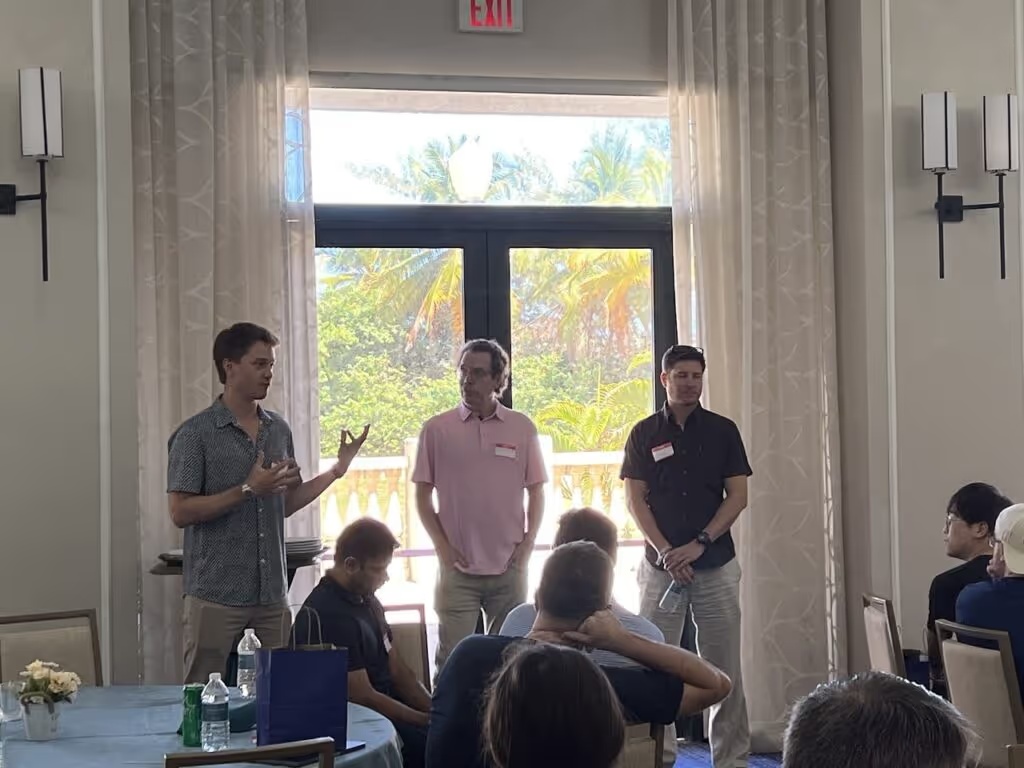
By March 2023, EvolutionIQ reported a team of more than 100 people. At its Puerto Rico offsite, the company mixed strategy sessions with time on the beach and excursions into the rainforest. Vykruta’s contribution to the proceedings included a warning about the consequences of technical decisions.
“Success for us is if our customers are successful using our software.”
Tomas Vykruta · Puerto Rico offsite, 2023
He described a software company whose underlying technology could not support its growth. Fixing problems gradually consumed the effort that should have gone into serving customers. His point to colleagues was that a developer’s decision could eventually become a customer’s problem.
It is a revealing subject for a gathering with access to umbrella drinks. He was asking the team to think about the future obligations hidden inside present choices. A working feature creates expectations. More customers create more of them. Someone has to keep the promises after everyone has returned from Puerto Rico.
The work after the demonstration
Vykruta’s paper on whether insurers should buy or build AI software offers a less glamorous account of technical progress. He describes extended experimentation, approaches that failed, and a long stretch before meaningful breakthroughs. His account puts the first viable business model at approximately $2.3 million of development effort, spanning a late-2018 prototype and a second-quarter 2020 launch.
Vykruta’s reported cost of developing the first viable business model, from the Q4 2018 prototype to the Q2 2020 launch.
The paper also treats adoption and continuing model maintenance as substantial parts of the job. Data changes. Users need support. Performance requires attention after launch. In this account, the demonstration is an early expense on the way to a functioning service.
These observations carry the perspective of a vendor arguing for specialist software, and the development figures are his account of the work. Even so, they offer a useful portrait of how he talks about engineering: budgets, uncertainty, sustained experimentation, and the people who must eventually use the result.
In a 2022 conversation on The Insurance Coffee House, his advice to other founders emphasized listening closely to carriers and recognizing their different ways of working. Passion mattered because the commitment was demanding. The advice was directed at the length and difficulty of the work, rather than the elegance of a pitch.
When EvolutionIQ announced its partnership with Guidewire, Vykruta was identified as co-founder and CTO. He described the agreement in terms of making AI easier for shared customers to use. It was another practical constraint on the technology: useful software has to find a place among systems and working relationships that already exist.
A transaction, then another flight lesson
CCC announced its agreement to acquire EvolutionIQ in December 2024. The stated value was $730 million, with a mix of cash and stock. The transaction closed on January 6, 2025. Later financial filings recorded $674.3 million in acquisition consideration under the transaction’s accounting. Those figures describe different measurements; the announced price remains the familiar marker of the deal.
For Vykruta, the transaction joined a company he helped start to a broader insurance software business. His current president title keeps him within the organization’s leadership. The public record continues beyond the announcement, and so do his interests outside the office.
On August 16, 2026, he published an essay about aviation risk, writing that he was in the final stretch of his Airline Transport Pilot rating. He argued for evaluating the particular conditions of a flight rather than relying on broad categories of aircraft. Weather, familiarity with the machine, and the timing of departure all featured in his discussion.
The essay shows him returning to conditional thinking: which circumstances matter, how they interact, and what a changed decision might accomplish. The founder with an acquisition behind him was still working on a qualification and questioning the model in front of him.
There is an earlier, quieter reason he became a flight instructor. His father, Oldrich, had long wanted to learn to fly. Vykruta wanted to teach him himself. For all the machinery, professional titles, and transaction arithmetic in his story, that ambition is wonderfully easy to understand. He learned something difficult so that he could share it.