Before Tomáš Gogár could teach a computer to read an invoice, he needed somebody to give him one. In the early days of Rossum, he walked around Prague asking for transactional documents. An artificial intelligence company, temporarily dependent on the kindness of people with paperwork. There are more glamorous ways to begin a business. There may be fewer ways to learn so quickly what it is for.
The collection had a flaw: the documents were Czech. Useful training material, certainly, but a company intended to work internationally would have to deal with other languages and layouts. Even the first pile of invoices was making a business decision for him. Rossum would have to learn to accommodate the world as it arrived.
By May 2026, the project had reached a different sort of transaction. Coupa acquired Rossum, bringing its document technology into a wider spend management platform. Between those two moments lies a founder’s education in choosing a problem, finding colleagues, and discovering that the difficult part of a clever idea often begins when somebody tries to use it.
A detour through medieval Prague
Gogár’s record contains a pleasingly unexpected prequel. In 2013, he presented Prague Chronicles, a mobile video guide to the city, at the AppParade competition. The project won both the audience vote and IBM’s award. Before the invoices, there were historical scenes, an app, and a cinema full of people to persuade.
The team mixed programming with filmmaking, history and music. Gogár worked with filmmaker Martin Klekner; scenes were made in a student room with a green screen, with computer reconstruction supplying medieval Prague. The horse scenes required other arrangements. There are limits to what even an enthusiastic student can accommodate indoors.
This earlier project puts some texture on the familiar description of an AI founder. Gogár had already been involved in turning technical work into something an audience could experience. A walking tour and an invoice processor have rather different entertainment budgets. Both, however, ask their makers to think about what the person holding the screen needs next.
Three researchers in search of a customer
At the Czech Technical University in Prague, Gogár earned degrees in software engineering and artificial intelligence. His academic path also included doctoral research. A 2016 paper on evaluating focused web crawlers records his interest in extracting information from the web. He was working on ways to find useful material within a much larger quantity of it.
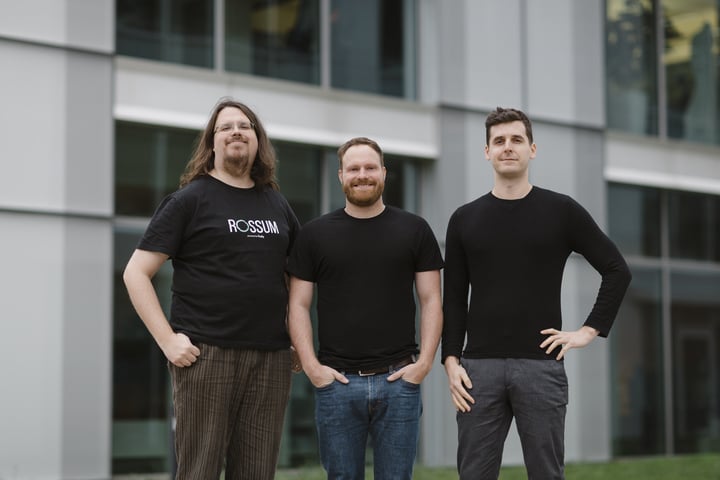
He met Petr Baudiš and Tomáš Tunys during his doctoral studies. The three eventually left that route to build Rossum together. Their technical experience gave them something to work with, but the original commercial idea was broad: an AI service that researchers or data scientists could apply to their own problems.
StartupYard helped narrow the question. The founders discovered demand for software that could interpret documents in changing formats. They had initially assumed optical character recognition had dealt with much of the problem. Recognition, though, leaves plenty of work unfinished. Reading the characters in a number does not establish whether it is an invoice total, an order reference or something else.
The business took shape around that unfinished work. The researchers were learning to connect a capability to a recurring customer need. It required giving up some possible directions in order to make progress in one. For people trained to investigate possibilities, choosing what to stop investigating can be a substantial piece of the job.
The founder learns to leave things out
Gogár had begun by studying physics before moving toward computing. He programmed mobile apps and fixed software in his mother’s office. Professor Jan Šedivý became an influence on his studies and the early business. The route was practical as well as academic: programs were things that could fix an annoyance for somebody he knew.
He also had to learn a less comfortable skill: explaining less. Scientific training encourages detail, qualifications and completeness. A prospective customer needs a reason to keep listening. The accelerator helped him work on presentations and the many unfamiliar tasks around running a company, from accounting to conversations inside the team.
“It is 100% necessary to leave your comfort zone.”
Tomáš Gogár, 2018
In 2018, he described himself as an extrovert within the company. He enjoyed the openness of meetings in Silicon Valley and the willingness of people there to help before knowing whether a favour would be returned. For a founder whose colleagues shared much of his technical background, building a wider circle mattered. So did becoming understandable to it.
When the customer suspects a trick
One early customer reaction deserves a place in any account of Gogár’s career. In 2018, he recounted that a large company wanted a longer testing period because it did not believe Rossum was extracting the invoice data automatically. The suspicion was that people must be typing it in behind the scenes.
That is an unusually flattering accusation, although probably less amusing when a sale is waiting on it. The founders had chosen a task so familiar as manual work that a demonstration could invite disbelief. Their challenge included proving that the machinery really was doing what the audience had just seen.
The anecdote also gives the product a human scale. An invoice passes through a working day as a small obligation: open it, understand it, transfer the information, check it. Repeat often enough and the small obligation becomes a department’s workload. Gogár’s business depended on taking that repeated effort seriously.
- 01ReceiveA document arrives
- 02UnderstandFind what it means
- 03CheckReview the details
- 04Pass onMake the data useful
Illustrative workflow for document processing.
A company needs more than source code
By September 2019, Gogár described a team of 50: about 30 people working full time and 20 part time. Customers were spread across four continents. Alongside programmers and machine learning researchers, the company was building its sales, marketing and operations functions. It also employed people called AI teachers, who helped train its systems to understand documents.
For Gogár personally, working out how to reach customers and build a sales operation had become unexpectedly absorbing. He found that an engineering approach could help there too. His work was expanding from how the system operated to how a business around it could operate.
Asked what made him proud, he chose the team. His explanation was concrete: remove the people and Rossum would be reduced to its logo, website and code. The remark gives some balance to a story populated by neural networks. The company’s value, in his telling, depended on the people who made those networks useful.
One hundred million dollars, still an invoice
On 20 October 2021, Rossum announced a $100 million Series A led by General Catalyst. Existing backers including LocalGlobe, Seedcamp, Miton and Elad Gil participated. The company said it had previously raised $9.5 million. A task routinely postponed until after lunch now had substantial institutional capital behind it.
Series A led by General Catalyst
Existing investors also participated in the round.At that point, the ambition extended beyond getting information off a page. Rossum wanted to handle more of the exchange between businesses. Extracting a total is one step; getting the transaction through the surrounding process is a larger assignment. The funding announcement described a document gateway intended to support that broader work.
Gogár had a reason to favour building the company alongside the research. He described an approach in which useful early products could bring in money to support further development. He also wanted to keep working with his co-founders. His impatience with the pace and resources of academia was part of the decision to leave.
The name they chose carried a Czech reference: Karel Čapek’s Rossum’s Universal Robots, the play associated with the introduction of the word robot. It is an elegant piece of naming for software assigned to administrative labour. Literary robots have had some dramatic careers. These were beginning with the accounts.
The person on the other side of the table
Gogár’s public conversations have continued to emphasise the problem being solved. In a 2025 discussion with Equilibre co-founder Martin Schmid, he argued for understanding the business problem alongside the AI. He wanted people who combined technical ability with product judgement. A powerful model still needed somebody who understood what customers were trying to accomplish.
That position makes sense against his own experience. The team had entered an accelerator with considerable knowledge and an unsettled use case. Years later, he was advising founders to think carefully about their motivation, colleagues and investors. His account left room for curiosity and the patient work of learning a domain.
At Coupa Inspire in 2025, he also spoke about the importance of meeting people in person. Even with investors, he found that being together created a connection he struggled to explain. Rossum had become a platinum partner of Coupa. Relationships were becoming part of the machinery that would carry the software further.
The paperwork changes hands
On 12 May 2026, Coupa announced that it had acquired Rossum. The companies had been partners since 2024. The stated plan was to extend Rossum’s document processing capabilities across Coupa’s platform, combining its specialised transactional AI with the buyer’s broader purchasing and spend systems.
Gogár described joining Coupa as a continuation of the partnership. His public announcement also looked back at the homemade GPU rigs the founders had assembled to train their early AI. The distance from that equipment to an acquisition is considerable. The problem they were pursuing remained recognisable.
There is something appealing about that persistence. Gogár’s career includes an app about medieval Prague, doctoral research, fundraising, sales and an international acquisition. Running through the Rossum years is a stubbornly ordinary request: let people spend less time transferring information from one place to another. The invoice has enjoyed a long career as somebody else’s chore. Gogár has spent much of his own career questioning the arrangement.