In April 2026, Tom Chavez offered a peculiar verdict on the company he had spent years building. Given the chance to begin Ketch again, he would begin three years later. Here was a founder with acquisitions by Microsoft and Salesforce behind him, recommending, in effect, a longer pause before the starting gun. The software had not been the only problem. The customers needed time to catch up.
He had expected businesses to want infrastructure for respecting people’s data choices. Many prospective buyers thought a cookie banner had settled the matter. Chavez could see the plumbing problem behind the screen; the person holding the budget saw a task already crossed off a list. It is difficult to sell someone a better answer when they believe they have finished the question.
His prescription, after the expense of that misunderstanding, is concrete: speak to thirty customers before starting. Find out whether they are ready to buy. Technical conviction can survive years of indifference. A company still has to pay for those years.
“Reality is the safest place to be.”
Tom Chavez, Tomisms, April 2026
Five children, one destination
Chavez grew up in Albuquerque, the middle of five children in a Mexican-American family. Neither parent attended college. All five children graduated from Harvard. Even in a business fond of ambitious targets, that is a fairly demanding family benchmark.
His mother, Rose, had a particular reason to believe in a different future. In his account of her childhood, she grew up without electricity or running water. When the family moved to a better house, a sewage plant was built behind it. Education offered her children a route beyond circumstances they had inherited. For Tom, expectations arrived long before venture capital did.
At Albuquerque Academy, where he attended on a partial scholarship, he found another arrangement worth questioning: the dress code. Collared shirts were required; jeans were forbidden. He objected to the class distinctions that clothing could advertise and successfully pushed for jeans to be allowed and conspicuous designer labels discouraged. His older brother Marty admired the directness. Tom was prepared to take the argument to the people making the rules.
At Harvard, Chavez studied computer science and philosophy. Stanford followed, with a doctorate in engineering-economic systems and operations research and a NASA doctoral fellowship. The combination would become useful: formal methods for decisions, alongside questions about the people who live with them. His later companies would give both halves of the education plenty to do.
The mathematics changes jobs
Before the startups, Chavez researched probabilistic AI and decision theory at Rockwell and worked as a systems architect at Sun Microsystems. His professional biography includes a pleasingly unromantic detail: at Sun, he was employee number 35,642. Every founder story benefits from remembering that somebody once had to issue the badge.
Rapt emerged in the late 1990s from work on optimization. Its early business concerned supply chains and the pricing of technology components. Around 2003, an opening appeared at Yahoo, which needed help managing the economics of advertising. The mathematics could travel even if its practitioners still had some vocabulary to acquire. Chavez later recalled that he did not know what CPM meant.
The shift was substantial. Instead of helping with hardware configurations, Rapt helped publishers work out how to price, forecast, and allocate advertising inventory. Advertising space was another scarce resource with uncertain demand. A different industry supplied the problem; the team brought methods it already understood.
On March 14, 2008, Microsoft announced plans to acquire Rapt and incorporate its technology and services into the Atlas Publisher Suite. Its customer list included Yahoo, Reuters, NBC Universal, and The New York Times Company. These were businesses with inventory to sell and consequences for getting the economics wrong. Rapt’s appeal was practical enough to fit into the systems they used to run that business.
The button and the machinery
In 2010, Chavez and Vivek Vaidya co-founded Krux, a data management company. The working relationship went back to Rapt. Krux helped businesses organize audience information and use it across customer interactions. Salesforce acquired it in 2016. Chavez had now helped build two companies around the expanding commercial uses of data.
Alongside that work, he had been thinking about the individual whose information powered the system. An early experiment, built around 2010 and 2011, gave consumers controls over their data. Someone might permit one use and decline another. It attracted roughly 1,200 visitors, he recalled, with the affectionate qualification that his mother may have returned several times to show support. Parental loyalty is a fine thing. It makes an unreliable market forecast.
The underlying engineering question stayed with him. To honor a deletion request, a business has to locate information distributed across its systems and act on it. Chavez has compared the difficulty to retrieving a particular droplet from an ocean. A reassuring interface does little good if the systems behind it cannot carry out the instruction.
In his 2021 introduction to Ketch, he described a programmatic approach: connect consumers’ preferences to the applications and platforms that use their information, including commerce, analytics, marketing, and customer relationship tools. The public launch came with an announced $23 million Series A. The company’s official timeline dates its founding to 2020; Chavez has described starting the underlying work in 2019.
His pitch allows for both commercial activity and restraint. Businesses should be able to use data responsibly, and people should have meaningful choices about that use. It asks engineers to make the agreement work. For a founder trained to optimize systems, the gap between a promise and its execution is an invitation to get out the whiteboard.
Keeping the band together
Chavez and Vaidya also took their partnership into super{set}, a studio publicly launched in 2019 to form, fund, and build software companies. The premise was to make operating experience available at the beginning, when a small team is deciding what to build, how to sell it, and which assumptions deserve suspicion.
In an October 2025 interview, Chavez described his favorite moments as the ordinary work of getting a team unstuck: whiteboarding, revising product strategy, and helping a founder choose a new direction. Those scenes receive less attention than acquisition announcements. They are where the eventual announcement starts becoming plausible. The studio’s work with other founders extends a relationship that has already survived several changes of company and market.
There is a written version of the partnership, too. In 2018, Chavez, Vaidya, and Chris O’Hara published Data Driven: Harnessing Data and AI to Reinvent Customer Engagement. The subject was how businesses could put data and AI to work in their dealings with customers. The book belongs beside the later privacy work: both concern the terms on which information becomes useful. The customer is present in each, even when the software makes that person easy to reduce to a record.
 Watch the conversation ↗
What gets carried forward
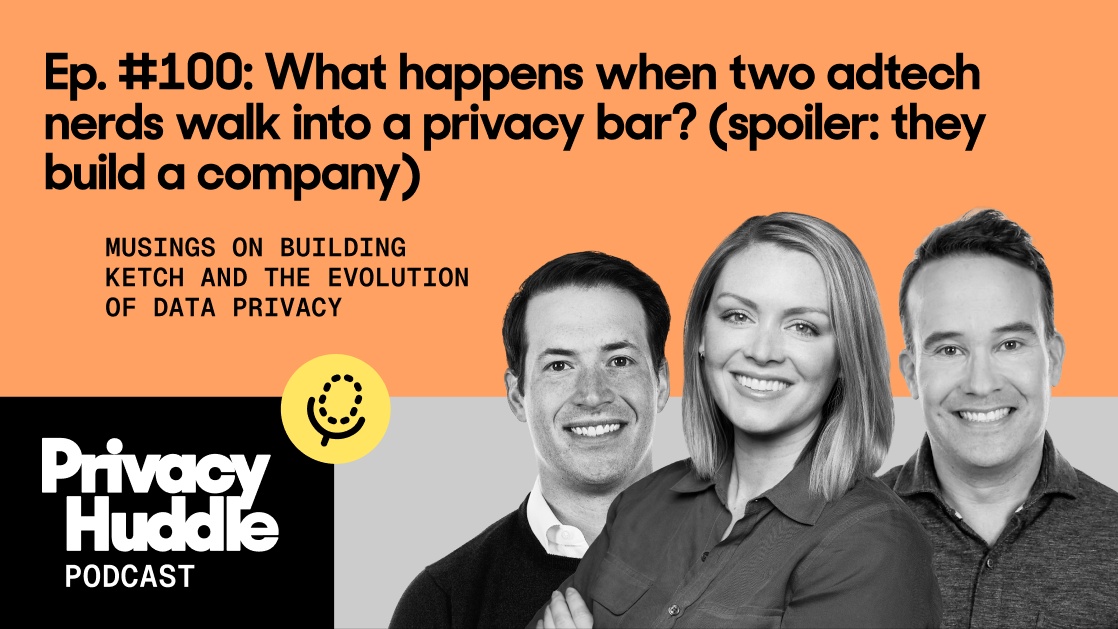
On the hundredth episode of The Privacy Huddle, in July 2026, Chavez and Ketch co-founder Maxwell Anderson revisited the company’s early ideas with host Colleen Barry. Some sophisticated proposals had been hard to sell. Orchestration, identity, and auditability had endured. The discussion let the people who made those bets laugh at their own earlier language.
Chavez also talked about permissioned data as a foundation for AI. It is a continuation of his concern with where information goes and what a business is entitled to do with it. New destinations for data create more places where the original agreement needs to hold. His ambition still requires the unglamorous work between a policy and a functioning system.
He has pursued a public version of that work through The Ethical Tech Project. In February 2022, the organization announced a Privacy Advisory Board with Chavez as chair, bringing together people from technology, academia, law, and policy. Its stated purpose included giving engineers concrete patterns and frameworks for privacy. The philosophical questions were being asked with implementation in view.
The founding advisory group included Jesper Andersen of Infoblox, Maritza Johnson of the University of San Diego’s Center for Digital Civil Society, and Harvard computer scientist James Mickens. Bringing those disciplines into the same conversation was part of the design. The group wanted to describe what people should be able to expect from companies handling their data, then make those expectations usable by the people building products. For Chavez, the route from an ethical commitment to an engineering pattern was a working agenda.
Another line leads back to Albuquerque. With his wife, Rosalyn Chen, and sister, Elena Chavez Quezada, he co-founded the Chavez Family Foundation. Its priorities connect education, immigration, and entrepreneurship. The foundation’s emphasis on opportunity carries the family argument forward: where someone begins should leave room for where they might go.
There is music alongside the mathematics. Chavez is a classically trained pianist who writes music and goes to live shows. Away from the corporate biography, that detail gives the working life another rhythm. It also makes the long partnership with Vaidya feel familiar: people keep coming back together to make something, learn what the audience responds to, and try again.
The Ketch story is still being written. Chavez’s April admission gives it an unusually useful point of departure. Experience had helped him recognize a real problem. Experience had not supplied a reliable clock. After all those years helping systems make better decisions, he is still learning the tempo of the people who buy them.
More conversations, fewer cookie banners
Follow Chavez’s writing, hear the interviews, and explore the work.