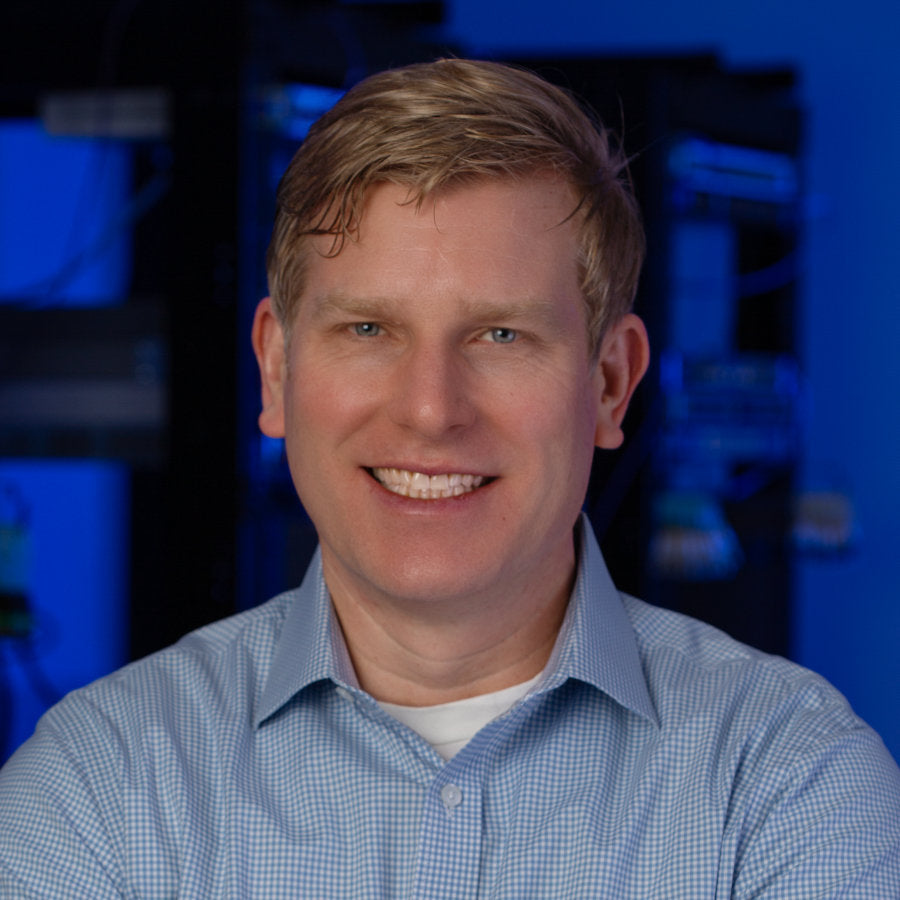
Wiring the World at the Speed of Light
When Proficium needed a CEO to navigate the AI data center gold rush, they didn't go looking for a startup founder or a Silicon Valley pedigree. They found Todd Swanson - a mechanical engineer from Wisconsin with an MIT MBA who had spent the better part of three decades learning, at granular depth, exactly how data moves through fiber. He took the job in August 2024. The timing was not accidental.
The backdrop matters. Mill Point Capital, a New York-based middle-market private equity firm, had just completed its acquisition of Proficium in May 2024 - a company that had been quietly building optical transceivers, fiber optic cables, and high-speed interconnects out of Union City, California since 2003. What Mill Point bought was a 21-year-old hardware maker sitting squarely in the path of the AI infrastructure boom. What they needed next was someone who actually understood the product.
Swanson understood the product. He had helped build the category.
"The demand for high-performance, low-latency connectivity is growing faster than ever. Proficium is uniquely positioned to deliver solutions that hyperscale and AI-driven networks need."
- Todd Swanson, CEO, ProficiumA Career Measured in Gigabits
Swanson started where many engineers of his generation did - inside Hewlett Packard's optoelectronics division, back when optical networking was still a technical frontier rather than a commodity. From there, he moved through Princeton Lightwave and Aegis Semiconductor, picking up the kind of product-level depth that can't be replicated with a course or a job title.
Then came Finisar.
The company became one of the world's largest manufacturers of fiber optic components and subsystems. Swanson joined and stayed - for more than 18 years. He held nearly every senior role the company had: Product Line Manager, Director of Marketing, Vice President of Sales and Marketing, EVP of Sales, Marketing, and R&D, Chief Operating Officer, and finally Co-CEO. In an industry where executives often skip rungs on the ladder, Swanson took each step. The result is an executive who can read a data sheet and read a balance sheet with equal fluency.
Career Ladder: 30+ Years in the Business of Light
Three Years Inside Intel's Photonics Lab
After Finisar, Swanson took a turn that surprised no one who follows optical networking closely. He joined Intel in August 2020 as Vice President and General Manager of Silicon Photonics - Intel's bet that it could embed optical interconnect technology directly into data center silicon at scale. The role was part product, part strategy: drive technical development in the Optical Compute Interconnect space while expanding Intel's footprint in data centers and service provider markets.
Silicon photonics represents the convergence of two industries Swanson had spent his career in - semiconductor manufacturing and fiber optic networking. At Intel, he was working at the junction. He left in September 2023. Eleven months later, he was at Proficium.
Education: B.S. Mechanical Engineering, University of Wisconsin — MBA, Massachusetts Institute of Technology (MIT). An engineer who can run a P&L. A business operator who still reads the specs.
What Proficium Actually Does
Proficium's business sounds narrow until you understand what it touches. The company designs, manufactures, and delivers optical transceivers, fiber optic cables, active optical cables (AOCs), direct-attach copper (DAC) cables, and active copper cables - the physical infrastructure that makes high-bandwidth networking possible inside hyperscale data centers and AI compute clusters.
Every time a company like Meta, Google, or Amazon adds GPU clusters to train AI models, those GPUs need to talk to each other - at extraordinary speed, with minimal latency, across distances measured in meters not miles. The cables and transceivers connecting them are Proficium's market. And that market is growing faster than nearly any other segment in hardware.
The 2024 Acquisition and the Leadership Reset
Mill Point Capital's acquisition of Proficium - announced March 27, 2024, closed May 7, 2024 - was financed by Brightwood Capital Advisors. Mill Point Partner Richard Summers called Proficium "an industry leader supporting the rapidly increasing demand for high-performance datacenter interconnect products." That's PE language for: we bought a company in the right sector at the right moment.
Proficium founder and President Dan Miranda stayed on. But the C-suite needed to scale. In August 2024, Proficium simultaneously hired Swanson as CEO and Brian Patton - a 30-year veteran who had spent 13 years as VP of Engineering at Approved Networks - as CTO. Two experienced operators, both in the same month. The message was clear: Proficium was moving from founder-led to growth-stage.
Miranda's public assessment of Swanson's first year was direct: it helped "position the company for long-term growth while reinforcing reputation for quality, speed, and engineering excellence." In a hardware company where trust is built on product reliability and delivery consistency, that's not a small thing to say.
When Mill Point Capital bought Proficium, they needed someone who understood optical networking at the component level and could run a business at scale. They found both in one person.
- YesPress Editorial1.6 Terabits Per Second: The Product That Says It All
In September 2025, Proficium announced the availability of its 1.6Tb/s optical transceivers - optimized for short-reach applications in hyperscale and AI data centers, supporting 200G-per-lane technology, and aligned with evolving Multi-Source Agreement (MSA) standards. The company expanded its laboratory with VIAVI ONE LabPro ONE-1600 testing equipment to validate performance at that speed.
A month later came another launch: the 400G QSFP-DD Universal Transceiver, the first in the industry to support both single-mode and multimode fiber in a single unit. Cross-platform compatibility at 400G. These two products, released in the first full year of Swanson's tenure, signal the direction he's taking the company: push into next-generation speeds, maintain OEM compatibility, and do it with manufacturing discipline.
Proficium's competitive position rests on three things that don't often coexist in hardware: engineering depth, OEM compatibility testing at scale, and same-day shipping from inventory. For a data center operator who needs a replacement transceiver to land tomorrow, that last point isn't a logistics detail. It's the product.
The Market He's Riding
AI infrastructure spending has created a version of demand that optical networking companies have rarely seen. Every GPU cluster built for training large language models requires high-bandwidth, low-latency interconnects between thousands of accelerators. The cables running between those GPUs aren't commodities - they're engineered to specific tolerances, tested against specific OEM platforms, and required to perform consistently at rack scale.
Proficium has been providing solutions to this market since 2019 - before most companies had "AI networking" in their vocabulary. Swanson joined with the market already moving. His job is to scale the infrastructure and the team fast enough to keep pace with demand that is growing faster than most hardware supply chains can accommodate.
The company has 58 employees, $14 million in annual revenue, and a physical address in Union City, California that has been in place for two decades. It's not a startup in a coworking space. It's a manufacturing and distribution operation with in-house performance testing laboratories, global and US-based manufacturing, and a product catalog spanning dozens of OEM compatibility profiles.
Technology Stack in the Field
What the Next Chapter Looks Like
Swanson is running a hardware company in the middle of a software-defined world - and making the argument, implicitly, that hardware still matters enormously. You can write all the AI software you want. At some point, the electrons - or rather, the photons - have to move. Faster. Farther. More reliably. At lower cost per bit.
That's the problem Swanson has been working on since the 1990s. The tools have changed. The physics hasn't. And the demand has never been higher.
Proficium's next challenge is scaling production and qualification capacity to meet the pace of AI data center build-outs, while maintaining the same-day shipping and OEM compatibility that define its value proposition. For a PE-backed company with a new leadership team and a 21-year operational foundation, that's an executable plan - not a pitch deck.
Todd Swanson has been at the fiber optics business long enough to know that every era of compute expansion has been accompanied by a corresponding demand for connectivity. The internet boom. The cloud era. Now AI. Each one needed more bandwidth than the last. Each one created winners in the companies that shipped on time, at spec, at scale.
He's betting Proficium is that company for this era. Given his track record, it would be unwise to bet against him.