Mike had a car battery, a young inventor, and an imperfect grasp of conference etiquette. At one computer gathering, the homemade robot took off into the audience. Tod Loofbourrow had built something that moved under its own power. Getting it to behave was evidently a separate assignment.
It is a good opening for a career in artificial intelligence: a machine does something unexpected, and a human has to work out what happens next. Loofbourrow went on to found Authoria, the talent software company that became part of PeopleFluent, and to lead digital advertising company ViralGains. The robot came first. So did the problem of turning enthusiasm into something another person could actually use.
His story has the usual executive nouns: companies, boards, acquisitions. The more revealing objects are smaller. A yellow writing pad. A college textbook. A rented apartment. Taken together, they describe someone who has kept finding practical ways into an unusually persistent fascination.
01 / THE FIRST MACHINEMike had other plans
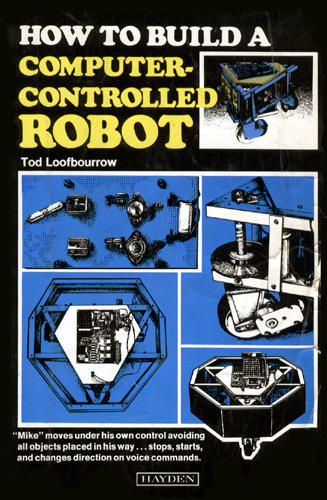
In 1976, the teenage Loofbourrow built Microtron, shortened to Mike, around a KIM-1 microcomputer. Aluminum, plywood, wheels, and a battery made computing physical. A program could produce a movement across a room. An instruction had consequences you could watch, and occasionally needed to get out of the way of.
The project reached readers of Interface Age in 1977. Then an editor from Hayden Books saw an opportunity to turn a young builder's experiment into instructions for other builders. In 1978, Hayden published How to Build a Computer-Controlled Robot, a 132-page manual. Loofbourrow was sixteen when the book appeared.
“I wrote it on yellow pads, and my mom typed it,” he recalled. The book sold 20,000 copies. A solitary-looking technical project had acquired a family production department, a publisher, and thousands of potential fellow experimenters. It is difficult to improve on that as an introduction to the usefulness of other people.
A manual also demands a kind of generosity. The author has to make the experiment legible to someone who was absent for the breakthroughs and mistakes. That habit of explanation would have a longer life than the particular electronics. Across software businesses and classrooms, Loofbourrow kept encountering people who needed an unfamiliar technology translated into something they could try.
02 / QUESTIONS AT WORKAn intelligence with an employee handbook
Harvard and Oxford followed. At Harvard, Loofbourrow later taught graduate courses on artificial intelligence and Internet commerce for seven years. His early interest was hardly concealed: his college admissions essay concerned Patrick Henry Winston's Artificial Intelligence. He has offered his own succinct character reference for that choice: “yes, I was a nerd.”
His consulting firm, Foundation Technologies, worked with large-company technology leaders on systems for organizing knowledge and applying rules. The setting had changed from a mobile robot to a business, but there was a recognizable engineering question underneath: how do you turn an instruction, a body of knowledge, or a decision into something software can handle?
Authoria, founded in 1997, gave that question a workplace address. The company built software for recruiting, performance, compensation, and talent management. These are consequential, unglamorous subjects. An employee wants an answer. A manager needs to make a decision. The elegance of the underlying system counts for little if neither can find what they need.
Loofbourrow was Authoria's founder, chairman, and CEO. Bedford Funding acquired the business in 2008 for a reported $63.1 million. Later that year, James J. McDevitt took over as CEO, with Loofbourrow serving as chairman. A company he had built was entering a chapter under different leadership.
In January 2010, Authoria combined with Peopleclick. The merged business adopted the PeopleFluent name in June 2011. That sequence gives Loofbourrow a specific place in PeopleFluent's history: founder of a predecessor company. It also restores something compressed corporate biographies tend to lose, the handoffs through which a business outgrows its original shape.
03 / THE NEXT CONVERSATIONThe advertisement that asks a question
ViralGains named Loofbourrow CEO in January 2015. He had already served on its board. The business had been founded in 2012, and his arrival was an appointment to lead an existing team. Board member and co-founder Kate Willett welcomed his experience and his interest in how video could connect brands with people.
With Dan Levin, the company's president and co-founder, Loofbourrow brought together two kinds of experience: advertising and media on Levin's side, AI and company building on his own. Their shared subject was the relationship between an advertisement and the person seeing it. An impression tells you that something appeared. A response can tell you a little more.
ViralGains' proposition makes room for that response inside the ad itself. A viewer can answer a question or express a preference. The experience can change accordingly. Its VoiceAlike technology uses AI to predict responses across a larger audience. The starting information is what the industry calls zero-party data: information a person intentionally chooses to provide.
- Ask a viewer a relevant question.
- Learn from the answer they choose to give.
- Adapt the experience and model audience patterns.
The human premise is pleasantly ordinary. If you would like to know what someone wants, a question is a reasonable place to begin. Making that work inside digital advertising requires software, modeling, and a business willing to change its habits. Courtesy, it turns out, can generate quite a technical specification.
By May 2024, Loofbourrow said ViralGains had served 112 of the Fortune 500 and 36 of the Fortune 100. He also described a less photogenic difficulty: getting advertisers to adopt unfamiliar practices takes time. The opportunity to change a market does not automatically make its participants impatient to be changed.
That mixture of conviction and practical friction runs through his public thinking about AI. In June 2025, he urged businesses to connect their plans to actual problems, usable data, and measurable results. He wanted leaders to examine where AI could help human creativity and judgment, and where working with others would get them to a useful result sooner.
04 / THE OTHER SIDE OF THE DESKBack in the classroom, beside the trophy
Since 2011, Loofbourrow has maintained an entrepreneur-in-residence association with MIT's Center for Digital Business. He has also judged student analytics work. It is a role with a useful change of perspective: the executive who once needed someone to take his experiment seriously now gets to inspect experiments presented by other people.
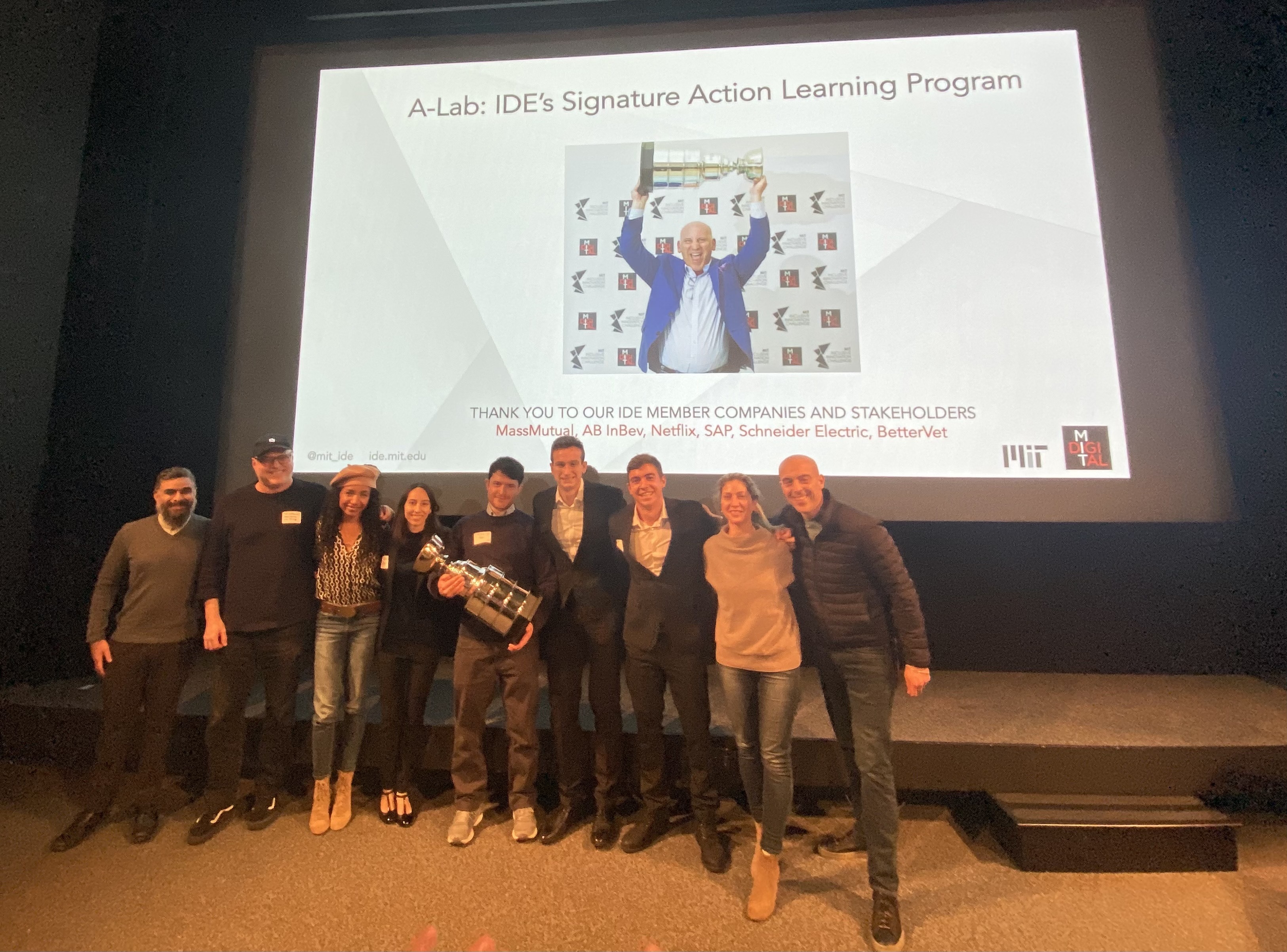
At the December 2022 Analytics Lab finals, he joined Yael Avidan and Renée Richardson Gosline as a guest judge. Students brought projects meant to address real organizational problems using analytics and machine learning. Their work had to survive contact with a question beyond the classroom: would these findings help anyone do something?
The photograph from that gathering has the usual ingredients of an academic celebration: a screen, a group arranged for the camera, a trophy that somebody must hold. It also places Loofbourrow in a setting that suits the career. People have made something, and other people are asking them to explain it.
05 / WHO GETS THE BENEFIT?A seat at the jobs argument
His involvement with Jobs for the Future brings a broader group into the conversation. The organization's 2024 annual report names him board chair. At its 2025 Horizons gathering in New Orleans, he moderated a panel called “AI and Jobs: Apocalypse or Abundance?” The title left the panelists a respectable amount of room for disagreement.
Andrew McAfee, Chris Perry, Scott Pulsipher, and Zanele Munyikwa joined the discussion. Loofbourrow described arguments for experimentation, for rethinking education, and for using AI to expand what people can accomplish at work. The gathering connected employers and educators with people working in philanthropy, investing, and entrepreneurship.
For someone whose career has crossed those boundaries, the question is concrete. A useful tool still needs a route into people's lives. Employers decide how work changes. Educators decide how people prepare. An entrepreneur can build software; the benefits depend on decisions made well beyond the product team.
06 / KEEP PADDLINGLeave room for a beginner
Loofbourrow's favorite superhero is Johnny Storm, the Human Torch. He connects the character with the feeling of a team working well and a customer making progress. It is a fairly exuberant answer from someone whose working vocabulary also includes data management. There is room for a little combustion beside the spreadsheets.
At ViralGains, that willingness to experiment became an AI Play Day. Employees had time to try new tools and show something they had made. One illustrated a children's book about Fiona the turkey. The exercise offered people outside technical roles an excuse to begin. It also put a modest test in front of a large subject: can you make something, examine it, and explain what you learned?
His stories about starting companies are less polished. He has recalled a rented apartment, a commute upstairs, and servers placed in an unused bathtub. He also talks about the value of a longstanding group of fellow CEOs who help one another think through hard decisions. Experience has given him people to consult as well as answers to offer.
“You can’t control it all, but you sure as heck can paddle.”
Tod Loofbourrow
The teenager with Mike could make a machine move, then teach other people how to build one. Decades later, Loofbourrow is still interested in that second part: what happens when another person gets the tools. The audience may have changed since the robot's impromptu charge. There are still good reasons to pay attention to where it is going.
Keep the conversation going
- ViralGains / his current company
- Tod Loofbourrow / personal profile
- LinkedIn / Tod Loofbourrow
- X / @todatmit
- Watch / I AM CEO interview
- Read / Is Your Business Ready For AI Or Just Chasing Hype?
- More writing / essays and commentary
- MIT / biography and related work
- Jobs for the Future / board biography
- Interview / building ViralGains, May 2024