In Timothy J. Klein’s family room, two engineers decided to start a company. Klein understood hardware. His friend David Snell understood software. Between them lay a problem familiar to anyone who has watched an expensive computer sit there, apparently considering its options: the data could not arrive quickly enough.
That decision became ATTO Technology in 1988. Its early product, SiliconDisk, used memory for storage, helping computers escape the delays of mechanical drives. The setting was domestic; the ambition was technical. A family room is a perfectly serviceable place to start a company, provided somebody eventually buys what leaves it.
Nearly four decades later, Klein remains ATTO’s president and CEO, and Snell remains its engineering chief. Their business has followed data through successive generations of computers, networks and storage. The long partnership offers an unusually concrete way to understand Klein: look at the work he keeps returning to, and at the people and institutions he has kept beside him.
Buffalo, with a detour through Phoenix
Klein was born in Buffalo and grew up in a working-class neighborhood. His father worked for United Airlines in baggage and fueling. As a boy, Klein delivered newspapers; later he washed dishes and cooked. He played tennis and collected stamps and coins. His education was paid for through work and student loans.
He began pre-engineering at Canisius College, then transferred to the University at Buffalo, earning his electrical engineering bachelor’s degree in 1984. Engineering gave him a professional route out of town. At Motorola in Phoenix, he worked on microprocessor emulators and circuit boards. He subsequently returned to Buffalo and joined Barrister Information Systems as a systems engineer.
Barrister developed minicomputers and software. Klein and Snell both worked there before ATTO. They came to their partnership with experience of systems that had to function as assembled machines, rather than as a collection of attractive specifications. That background matters when considering the business they chose: connections have consequences for everything attached to them.
University at Buffalo
with David Snell
UB Engineering Alumni Association
Entrepreneurial Champion Award
Storage, networking and archive connectivity
A fast disk needs somewhere to go
The founding observation was straightforward. Slow disks and storage subsystems could hold back an otherwise capable computer. Addressing that delay opened a business opportunity. ATTO’s early memory-based storage was followed by products that connected storage to the machines using it. The company’s territory widened along the route the data traveled.
In 1989, the founders entered the University at Buffalo’s technology incubator. It supplied access to engineers, testing facilities and office space. Eastman Kodak became an early OEM partner. The university’s account of the business also records customers including Apple, Siemens, 3M, Data General and Avid. A company formed by two specialists needed a much larger supporting cast to make its products useful.
The name was Klein’s choice, borrowed from the scientific prefix atto. An attosecond is one quintillionth of a second. It was a suitably small unit for a company preoccupied with delay. The name should not be mistaken for a product specification; even a confident engineer is entitled to a little poetry.
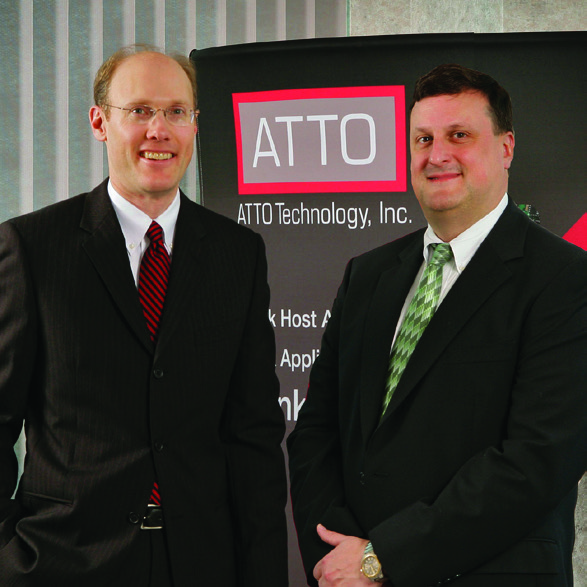
The partnership reaches beyond the board
ATTO’s product brochure describes a business spanning Fibre Channel, SAS, Ethernet, Thunderbolt and NVMe. These names belong to different ways of moving data between devices. The portfolio includes adapter cards, intelligent bridges, software and storage appliances. For Klein, running this business means working in an ecosystem where a component’s usefulness depends on its relationships with other components.
The NetApp partnership supplies a specific example. In 2019, ATTO’s FibreBridge 7600N became part of a new release of NetApp’s MetroCluster system, supporting continuous data availability. The bridge provided connections between NetApp storage and Fibre Channel. Klein described it as the third generation of their FibreBridge collaboration. Product history here is also relationship history: a partner returns, another generation is built, and the connection is tested again.
ATTO’s qualification work with workstation, server, storage and application vendors reflects the same practical requirement. A buyer has to assemble a working environment. The adapter must cooperate with the operating system, the application and the equipment at the other end. Compatibility is a rather dry word for the moment when a purchase finally earns its keep.
A simplified view of Klein’s working territory
Configuration and monitoring software helps manage the path.
When the audience saw the edit
Asked to remember a significant industry moment, Klein went back to an early NAB show and Avid’s first digital editing system. Editing had involved physically splicing tape. Here was a different way to work, and visitors were astonished. He recalled coding on the exhibition floor as the change was taking shape around them.
There is something useful about that memory. Klein locates the excitement in what people could suddenly do. The equipment mattered because the work changed. When he described ATTO at IBC in 2023, he used the plain phrase “we make the interconnections.” Those interconnections sit behind the editor’s experience, easily overlooked when everything runs smoothly and considerably harder to overlook when it stops.
At that same event, Klein noticed conversations about bringing some workloads back from the cloud to premises. He treated the shift as an interesting development within a changing market. His recollection of digital editing and his attention to storage choices come from the same professional vantage point: watching how people actually use the tools as the available tools change.
The engineer keeps an eye on the bill
Klein’s writing can be surprisingly resistant to the idea that newer equipment automatically settles a purchasing decision. In a 2021 article comparing SAS and NVMe storage, he weighed speed against capacity, management, cost and the disruption involved in changing an existing installation. His argument concerned the whole purchase, including the work required to make it function.
Read as a record of his thinking at the time, the article shows a vendor discussing the reasons a customer might retain an established technology. Technical comparisons age; the underlying questions remain useful. What does the workload need? How much change can the organization absorb? What will the surrounding infrastructure support? A fast device can arrive with a surprisingly large entourage.
By 2023, Klein was writing about managed storage latency for AI applications. Latency is the delay before data becomes available; controlling it helps systems respond predictably. His technical brief addressed adapters, network cards and storage appliances together. The original storage problem had acquired new applications, and he was still examining the route between available processing power and the data needed to use it.
Making the controls less demanding
The move toward simpler controls was visible in ATTO’s 2024 IBC plans. Its networking software used tuning profiles for storage from manufacturers including Avid, Dell and SNS. Those profiles let users optimize an Ethernet network without learning the networking theory behind every adjustment. The same exhibition paired a tape-connectivity bridge with a preview of Thunderbolt 5 adapters. Klein’s product agenda accommodated both the archive and the workstation, with software helping people manage the connections. For customers already working across several generations of equipment, that combination addressed the installation they had to run.
In July 2025, ATTO released ATTO360 Storage, bringing configuration, monitoring and tuning for its SAS, Fibre Channel and NVMe adapters into one interface. It combined more than 80 tuning parameters with automated profiles and analytics. Klein’s explanation focused on reducing the effort required to get useful performance from the equipment.
“Our customers need peak storage performance without complexity.”
Tim Klein, on the July 2025 release of ATTO360 Storage
There is a human concern inside that technical product brief. Somebody has to configure the system. Somebody has to diagnose the errors. The software promises a shorter route through those jobs, with centralized controls and preset profiles. Klein’s attention has extended from making the data move to making the controls more manageable for the person responsible.
In February 2026, ATTO and Qualstar announced certification of the XstreamCORE 8100T bridge with Qualstar’s Q-Series tape libraries. It connects SAS tape drives over standard Ethernet networks. Libraries can sit away from the primary computing space while remaining accessible through the network. For a founder associated with early solid-state storage, tape might seem an unexpected destination. His business gives it a practical place alongside newer technologies: another storage resource that customers need to reach.
A career with a return address
The University at Buffalo named Klein its engineering alumni association’s Engineer of the Year in 2006. He served on the engineering school’s Dean’s Advisory Council from 2005 to 2015. ATTO received the university’s Entrepreneurial Champion Award in 2014. These are distinct points in a relationship that began with his degree and continued through the incubator and the company’s growth.
His publicly stated priorities remain close to the everyday work of the company. Klein has described colleagues’ professional development and long service as particularly rewarding. He has also spoken about wanting ATTO to keep growing. The responsibility became more personal once employees depended on the business. A youthful engineering venture had acquired payroll, families and people with careers of their own.
Today, the official executive roster still pairs Klein with Snell, the hardware engineer and the software engineer who decided to work together. The family-room decision has lasted through changing interfaces and changing customer demands. Klein’s working life can be followed through those changes, from a memory-based disk to networked tape libraries and the software that manages adapters. Wherever the data is stored next, somebody will want it sooner. He has given that impatient somebody a considerable portion of his life.