A revealing word in Tim Klein's biography is a scientific prefix so small it almost disappears. Atto means 10-18. Klein chose it for the company he started in Buffalo with his friend David Snell in 1988. It was an engineer's name: precise, slightly mischievous and unconcerned with whether the rest of the room had brought a calculator.
The company itself would grow considerably larger than its name. ATTO Technology began as two people attacking a stubborn weakness in computers: the processors could work quickly, but slow disks and subsystems kept making the whole machine wait. Klein knew hardware. Snell knew software. Together they built a DRAM-based solid-state disk and discovered a durable operating idea. Big systems are often limited by the uncelebrated parts that connect them.
Klein has stayed with that idea for nearly four decades. Protocols arrived, matured and yielded to newer protocols. The company moved from early solid-state storage into host bus adapters, network interface cards, intelligent bridges, Thunderbolt adapters and management software. ATTO did not need to become the computer or the storage array. Its territory was the difficult middle, where a stalled byte can make expensive equipment feel strangely ordinary.
A paper route, a soldering iron and a useful pattern
Klein grew up near Buffalo in a blue-collar household, the second-oldest of four children. His father handled baggage and fueling work for United Airlines. His mother stayed home and, as Klein remembers it, took part in everything the children did. Work began early. He delivered newspapers as a child, then mowed lawns, raked leaves and shoveled snow. Later came restaurant shifts, first washing dishes and then cooking, plus several years working in a nursing home. Student loans and jobs helped pay for college.
Science, history and mathematics interested him at school. Personal computers were beginning to appear, and he wanted to understand them. He also conducted a bit of amateur career research: many CEOs of major companies seemed to have engineering backgrounds. Klein noticed the pattern and set his direction accordingly. It is a charmingly literal origin story for a future engineer-CEO. Find the data. Spot the correlation. Pick the curriculum.
He began with pre-engineering at Canisius College, attracted by the small classes, then transferred to the University at Buffalo. He earned a bachelor's degree in electrical engineering in 1984 and later began business and MBA coursework, putting it aside when the company demanded his attention. The formal management degree paused. The practical one had already started.
Motorola took him to Phoenix, where he worked on microprocessor emulators and circuit boards. Family pulled him back east after roughly three years. At Barrister Information Systems, a Buffalo company building computers for law offices, he designed next-generation processor hardware. There, close to the actual machinery and its actual delays, the opportunity sharpened.
One career, several generations of data
The first sale is still the one he remembers
When asked years later to name a memorable ATTO achievement, Klein did not choose a product launch, an international expansion or an award. He chose the first sale. It was proof that the founders could make something better, that somebody else could benefit and, crucially, that the somebody would pay real money. Every strategy document eventually hopes to become that moment.
The first sale turned an engineering opinion into a business.Tim Klein's defining company memory
Starting at 26 softened the perceived personal risk. If the company failed, Klein reasoned, he could start again. Hiring people changed the emotional mathematics. Payroll meant families, and the abstract romance of entrepreneurship acquired a due date. He became preoccupied with keeping business coming in and giving the company room to grow.
ATTO took the patient route. Klein says the privately owned company reinvested profits instead of building itself around venture capital or Wall Street. Growth came incrementally: more customers, more products, wider distribution. By 2006, the two-person startup described by the University at Buffalo employed more than 120 people and sold in 35 countries. In a 2023 interview, Klein said the company operated in more than 70 countries with roughly 70 employees and a portfolio spanning dozens of product lines.
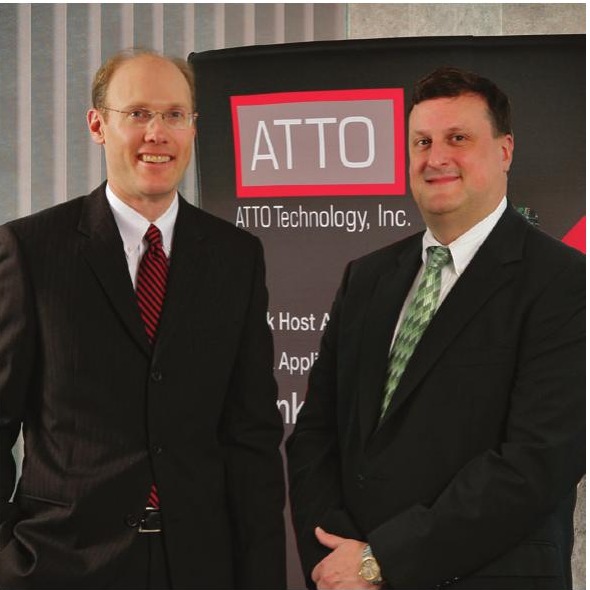
The partnership itself is easy to diagram. Klein specialized in hardware; Snell specialized in software. A fast device without intelligent control is merely an expensive object. Software without a capable physical path can only describe the traffic jam more elegantly. Their skills met at the interface.
does the work
moves the data
keeps the result
A career spent making the invisible part visible
At IBC in 2023, Klein offered a concise description of ATTO's place in the industry: “We don't make the computers and we don't make the storage, we make the interconnections.” The sentence is modest until a connection fails. Then the middle layer becomes the entire plot.
This is especially clear in media production, where enormous files must move predictably while an editor is waiting. Klein remembers an early NAB show when Avid's digital editing system appeared in a world accustomed to physically splicing tape. He and others were coding on the show floor. Visitors could scarcely believe what they were seeing. The interface had changed from scissors to software, but the magic depended on getting pictures and sound through the machine quickly enough.
ATTO followed those demands across generations. Fibre Channel carried shared storage traffic. SAS and SATA linked servers and drives. Ethernet became both general network and storage pathway. Thunderbolt brought serious bandwidth to desktop and mobile workstations. NVMe stripped away more delay. Each standard arrived with a technical dictionary and an enticing maximum speed. The engineering problem was to make performance steady in real work, not merely impressive on a laboratory benchmark.
That distinction now shapes Klein's language about latency. AI models, 8K video, databases and archival systems all produce different traffic patterns, but none enjoys waiting unpredictably. Peak speed may win the headline; managed latency lets a workflow remain usable. ATTO's products increasingly pair the card with software that tunes, watches and explains the system around it.
04 / Learning as infrastructureThe management style has changed because the company has
Klein does not present leadership as a fixed personal operating system. His management approach, he says, has changed with his maturity and with what ATTO needed. A team of senior experts can require a different touch from a younger group seeking guidance. Even teams inside the same company develop distinct personalities.
His resulting philosophy is to build learning teams, share what he knows and stay flexible enough to learn new things himself. The phrasing matters. Expertise moves in both directions. After decades in the same business, it would be easy to confuse duration with omniscience. Klein instead talks openly about the advice he discounted when young. Given one career decision to revise, he would have listened more carefully to experienced people. His punch line was self-aware: he had begun to sound like his father.
“Learn, learn, learn and never stop learning.”Tim Klein on reaching the C-suite
The local version of that idea has been unusually concrete. ATTO maintained internships and recruiting ties with the University at Buffalo, and company executives took part in engineering career programs. Klein served on the engineering school's Dean's Advisory Council. The university's alumni association named him Engineer of the Year in 2006. It recognized commercial success, but also a company feeding knowledge, jobs and attention back into the institution that trained him.
Klein finds the growth of colleagues particularly satisfying. Long tenures turned the company into what he described as a close-knit community. This is the other network in his story: not Fibre Channel or Ethernet, but the web of people whose livelihoods transformed a youthful bet into an adult responsibility.
05 / Still connectingThe protocols move on. The job remains.
ATTO's recent product cycle shows how far the original bottleneck has traveled. In 2025 the company introduced Thunderbolt 5 adapters for 64Gb Fibre Channel and 100Gb Ethernet, a quad-port 25GbE network card and a quad-port 64Gb Fibre Channel adapter. It launched ATTO360 Storage to configure, monitor and tune SAS, Fibre Channel and NVMe hardware from one interface. Support for macOS Tahoe followed. Early in 2026, the ATTO360 Storage and Networking suites gained expanded diagnostics, update detection and more control over device discovery.
At NAB Show 2026, Klein called connectivity the heartbeat of digital media production. It was a polished trade-show phrase, but it carried an old conviction. Creative tools advance only when the supporting path can keep pace. Archives become useful when old and new systems can speak. A workstation's theoretical speed matters less than its sustained speed during an actual deadline.
Klein once imagined the next ten years of ATTO with visible excitement. The aspiration was not a dramatic reinvention. It was continued growth, better products and the development of people around him. There is something fitting in that. His career did not come from predicting every interface. It came from choosing a layer worth understanding and continuing to understand it as everything attached to it changed.
The enduring founder lesson is not simply to go narrow. Narrow can become a cupboard. The trick is to choose a narrow place through which a widening world must pass. ATTO found that place between compute and storage. Klein gave it a name borrowed from the nearly unimaginably small, then spent a working life proving how consequential the middle can become.