The most important box in a video studio may be the one nobody puts in the shot. It sits between a workstation and a storage network, converting one protocol into another, smoothing an uneven stream of data and making sure the editor does not discover a dropped frame after the client has entered the room. ATTO Technology has occupied that awkward middle since 1988. It is a private, founder-led hardware company in Amherst, New York, with roughly 64 employees, a catalog dense with acronyms and a surprisingly simple job: get data from here to there on time.
ATTO does not make the Mac on the desk, the NetApp array in the machine room or the tape library holding the archive. It makes host bus adapters, Ethernet cards, Thunderbolt boxes, protocol bridges and the software that tunes and watches them. Customers range from small creative studios to broadcasters, hospitals, research institutions, government agencies, data centers and OEM engineering teams. All have the same expensive annoyance. Their compute may be fast and their storage may be capacious, yet the path between them can still become the slowest part of the system.
A business built around the bottleneck
Co-founders Timothy Klein and David Snell met as systems engineers at Barrister Information Systems. Klein had previously been a design engineer at Motorola; Snell became ATTO's technical chief. Their first product, released in 1989, was SiliconDisk, a SCSI-connected device that used RAM to escape the mechanical limits of disk drives. Kodak became an early OEM customer the following year. The protocols and port shapes changed, but the founding observation did not: storage performance is only useful when the rest of the workflow can reach it consistently.


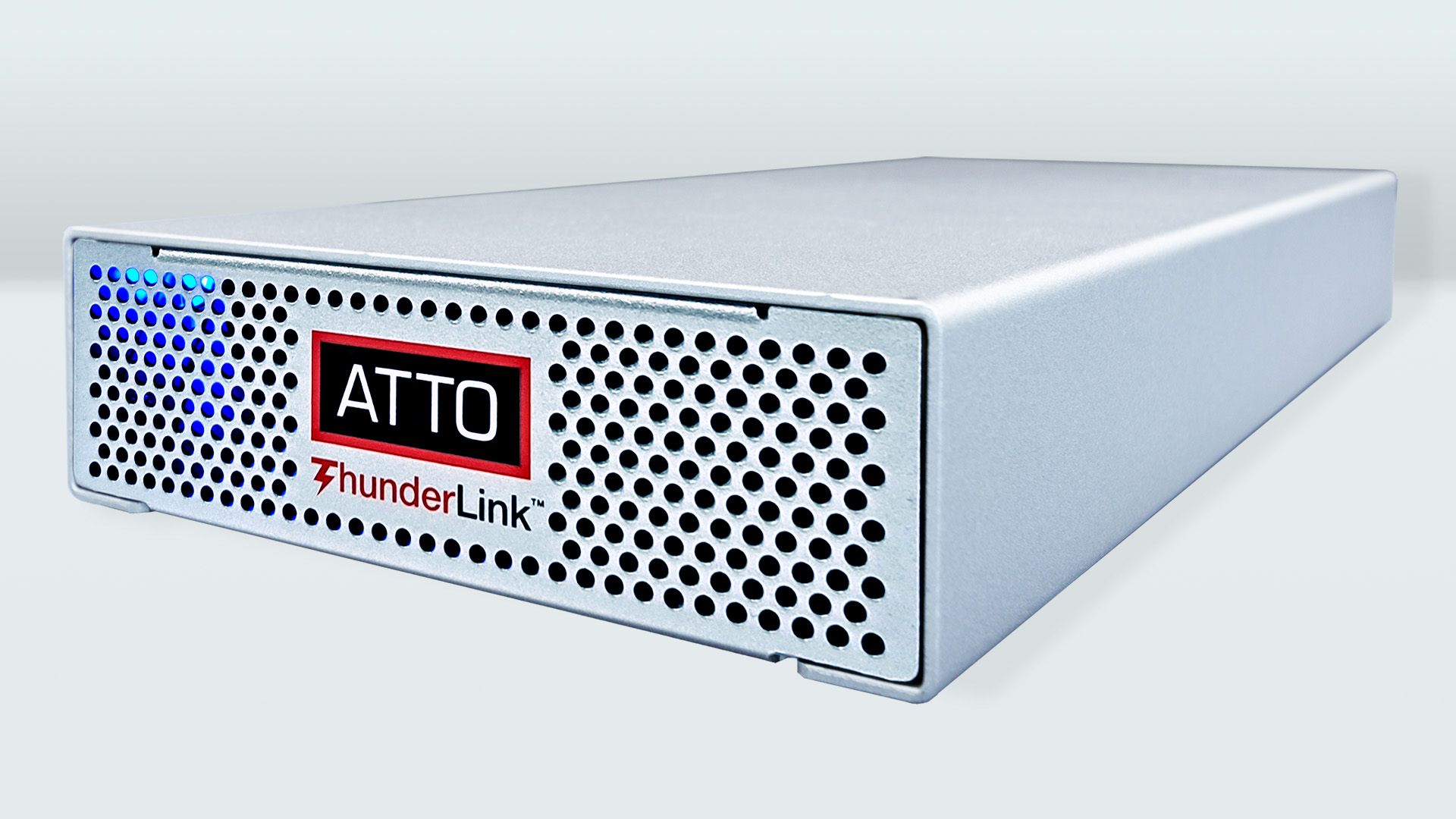
That continuity explains ATTO's peculiar breadth. Celerity cards connect servers to Fibre Channel storage. ExpressSAS adapters attach disks, tape and JBOD shelves. FastFrame cards handle Ethernet. ExpressNVM products manage dense NVMe setups. ThunderLink turns a Thunderbolt port on a laptop or workstation into enterprise Fibre Channel, SAS or Ethernet. XstreamCORE bridges make a directly attached device shareable across a network. ATTO360 software configures, monitors and tunes the hardware. The catalog looks fragmented until you notice that every product lives on the same line in the diagram.
The product is the middle. The payoff is making the two expensive ends behave like one system.
“Better infrastructure begins with a deeper understanding of how data moves through real-world environments.”ATTO's operating belief
The failure is usually inconsistency
Peak speed makes a handsome box label. Consistency makes a workflow. In an edit bay, a short latency spike can drop a frame even when average throughput looks fine. In a backup system, direct attachment can strand a tape library beside one server. In an AI cluster, network and storage overhead can leave costly processors waiting. ATTO's pitch is built around sustained data movement, controlled latency and drivers tuned for the operating system rather than a generic maximum on a test bench.
A healthcare case shows what failed first. A European public provider had disk-to-disk-to-tape backup, but its SAS tape library was confined to the primary data center. The arrangement could copy data; it could not create the geographic separation needed for serious disaster recovery. Growing medical records, compliance obligations and exposure to a local outage changed the calculation. The provider installed an XstreamCORE 8200T between SAS tape and an iSCSI Ethernet network, allowing authorized systems to reach an offsite library while preserving the tape investment.
That is ATTO's most copyable move: do not begin by replacing the customer's expensive old thing. Find the interface that traps it, then build a bridge to the environment the customer already knows. This works when the underlying storage still has useful capacity and life, the network can carry the workload, and the team values continuity more than a clean-sheet redesign. It works poorly when the legacy equipment itself is unreliable, when end-to-end encryption or cloud-native management demands a different architecture, or when bridge cost and operational complexity exceed the price of replacement.
What the customer actually buys
ATTO makes money from professional hardware sold through its online store, distributors, integrators, value-added resellers and OEM channels. It also works as an extension of manufacturers' design teams, supplying custom hardware, firmware, drivers, validation and long-term support. The direct store reveals the price ladder. In August 2026, legacy 8Gb Fibre Channel cards started at $395, a single-port 64Gb Celerity adapter listed for $3,995, a dual-port version for $4,995, and the ThunderLink 5102 connecting Thunderbolt 5 to dual 100Gb Ethernet listed for $2,695.
Selected public hardware prices
Those are not consumer accessory prices, because these are not consumer accessory failures. A stalled edit suite, missed backup window or underfed compute cluster can cost more than the card. ATTO therefore sells an assurance bundle: the physical connection, a driver for macOS, Windows, Linux or VMware, tuning software, partner qualification and someone who understands the whole path. ATTO360 Networking says it can apply as many as 70 adjustments with one click and includes profiles for systems from Avid, Autodesk, Dell, NetApp, Quantum and Rohde & Schwarz. Version 2.00.9, released in January 2026, added email alerts, automatic update detection, richer diagnostics and a local-only discovery option for secure environments.
The moat is a compatibility matrix
Broadcom's Emulex products and Marvell's QLogic line compete in Fibre Channel. Intel and NVIDIA offer formidable Ethernet hardware. Sonnet, HighPoint and others sell adapters around Macs and storage. A customer can also skip a bridge and buy a new networked storage system. ATTO's difference is not that rivals lack fast silicon. It is the accumulated, decidedly unphotogenic work of making hardware, firmware, drivers, switches, operating systems, applications and storage behave together.
The partnership list makes the strategy visible. ATTO has built for Macs for decades and now sells Thunderbolt 5 boxes capable of dual 64Gb Fibre Channel or dual 100Gb Ethernet. It has belonged to NetApp's alliance program since 2010, with bridges used in MetroCluster configurations. In February 2026, Qualstar certified the XstreamCORE 8100T across its Q-Series tape libraries, from Q8 through Q1000+, supporting LTO-8, LTO-9 and LTO-10. IBM demonstrated tape workflows with ATTO at SC25. AIC paired ExpressSAS with its servers and JBODs for HPC and AI.
This is also where ATTO fits in the market. It is smaller than the chip vendors and less visible than the storage brands, but it can move between them. Its roughly 64-person size lets engineers work directly with OEMs, while in-house design and manufacturing in Amherst support TAA-compliant products for government and defense buyers. The constraint is equally clear. This approach depends on specialized sales, patient qualification and customers whose downtime is genuinely expensive. It is a bad fit for commodity desktops, low-stakes home storage or teams happy to accept whatever adapter ships cheapest.
“Connectivity is really the heartbeat of digital media production.”Tim Klein, president and CEO
The 38-year lesson
ATTO's latest products are contemporary - Thunderbolt 5, 100Gb Ethernet, 64Gb Fibre Channel, NVMe fabrics and software that offers proactive advice. Yet its strategy is almost stubbornly old-fashioned. Keep the founders close to the product. Own a narrow technical problem. Manufacture where engineers can see the line. Validate beside larger partners. Help customers preserve useful infrastructure. Charge for the reduction in risk, not merely for the connector.
What another builder can steal
- Choose an expensive failure, not a fashionable category. Dropped frames and failed backups create budgets.
- Own the seam between systems. The integration layer accumulates knowledge each time the endpoints change.
- Package service into the product. Drivers, diagnostics, qualification and support make a card harder to substitute.
- Protect the customer's prior investment when it still works. A bridge can be easier to approve than a replacement.
- Know the boundary. If the old system is the failure, if the workload is not demanding or if a native replacement is cheaper, step aside.
There is a playful symmetry in the modern SiliconDisk. The 1989 original put RAM behind SCSI to beat disk latency. The current appliance puts RAM behind four 100Gb Ethernet ports and promises sustained bandwidth above 35 gigabytes per second with latency below 600 nanoseconds. The name disappeared into history and returned because the problem returned at a larger scale. Computers got faster. Data got bigger. The middle remained interesting.
That is the useful reading of ATTO. It is not a story about an overlooked connector becoming glamorous. The connector stays unglamorous. It is a story about how deep expertise in a stubborn layer can compound while everything around it changes. For 38 years, ATTO has sold the small box, the card and the driver that keep far more expensive machines from waiting on one another. Boring, in this corner of computing, is another word for working.