Consider the indignity of an expensive server waiting for its data. Its processors are ready. Its applications have work to do. Somewhere between the machine and the storage array, however, the conversation is taking longer than anyone would like. Computing has a peculiar habit of rewarding the conspicuous purchase while leaving the connecting parts to explain the disappointment.
Emulex built its business among those connecting parts. Its name is familiar to people who configure storage networks and almost invisible to everyone who depends on them. A host bus adapter, or HBA, does not require an audience. It requires a supported server, the right drivers, and a reliable route to storage. There is something rather pleasing about a technology business whose customers would prefer that its work attract no attention at all.
- Emulex connects enterprise servers to shared storage, chiefly through Fibre Channel adapters.
- Its route to customers runs through server makers and supported hardware configurations.
- Avago announced a roughly $606 million acquisition in 2015; the brand now belongs to Broadcom.
- Its present ambitions include encrypting the data travelling between servers and storage.
The card with the unfashionable job
An HBA sits inside a server and connects it to a storage area network, usually abbreviated to SAN. Think of a business application asking for a record held on shared storage. The request must leave the server, cross the network, reach the array and return. Emulex supplies hardware and software for that journey. The application gets the credit when the answer arrives promptly.
Fibre Channel is a network technology designed for storage traffic. It is distinct from an ordinary Ethernet connection, even when the cables and optical modules tempt the casual observer into treating them as cousins with interchangeable wardrobes. An enterprise choosing Fibre Channel is choosing a storage architecture, complete with switches, adapters, operational practices and compatibility requirements.
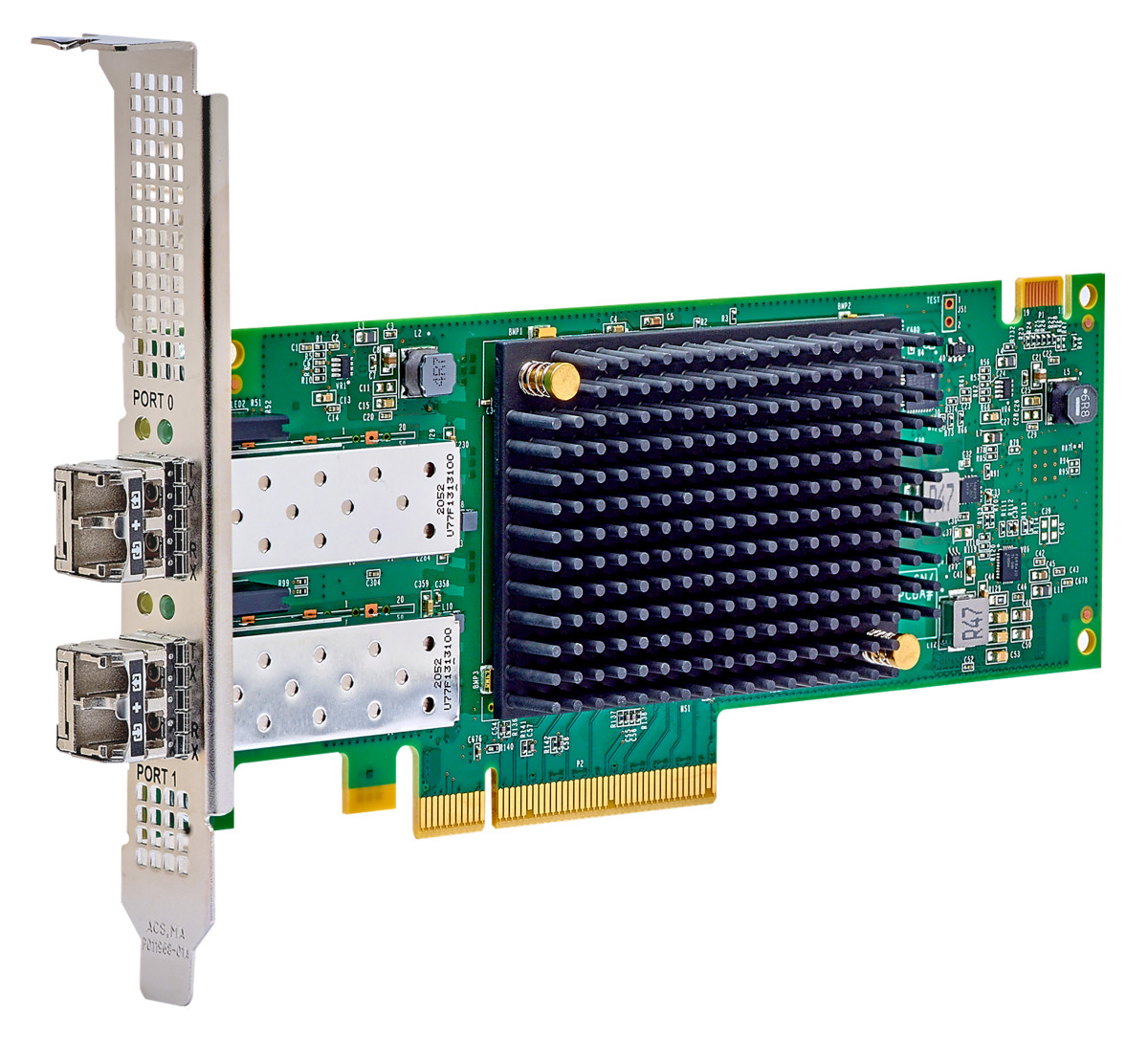
The LPe36002 is a dual-port 64G Fibre Channel adapter with a PCIe 4.0 server interface. Its practical territory includes virtualized environments, backups and applications whose storage traffic matters to their performance. NVMe over Fibre Channel lets compatible systems carry a newer storage protocol across this kind of network. The card is one element in the arrangement, rather than a complete storage system in a small box.
This explains why an adapter’s headline speed needs a little adult supervision. A 64G link offers capacity; it cannot promise that an application will finish twice as quickly. The workload, the array and the rest of the path determine whether that capacity is useful. Buying the number without examining the system is rather like widening the driveway and expecting the entire commute to improve.
Getting invited inside the server
Emulex’s commercial audience has two layers. Server and storage manufacturers qualify and integrate its components. Enterprise operators then buy those components, often as options in a familiar vendor’s catalogue. Historical customer lists included Dell, HP, IBM, Cisco, EMC and NetApp. Current HPE and Lenovo materials still identify Emulex adapter options.
The resulting business model is recognizably industrial: sell adapters and connectivity technology into other companies’ systems, backed by software, documentation and support. The end customer may order an HPE or Lenovo part number. Emulex has earned a place in the configuration before anyone opens the purchasing spreadsheet.
My reading of this position is that qualification forms part of the product’s value. The card must work with a particular server and operating system, survive firmware changes and participate in an established storage environment. Expertise here is spread across silicon, protocols, drivers and operations. A clever circuit without a dependable support path is an awkward thing to place beneath an important database.
A clever circuit without a dependable support path is an awkward thing to place beneath an important database.
From this profile
Marvell’s QLogic adapters are a direct alternative in Fibre Channel. Both suppliers appear in enterprise OEM materials. The meaningful comparison therefore includes supported configurations, management features, security and the particular workload. Ethernet storage architectures introduce another decision entirely: whether the organisation should use a different transport and operating model.
The expensive neighbour
The company’s roots reach back to the late 1970s, with Fred B. Cox as its founder. By 2013, Emulex was trying to occupy more of the network’s working life. Connecting traffic was one assignment. Recording and examining it offered another. Acquiring New Zealand-based Endace brought packet capture, network recording and analytics into the portfolio.
The strategic proposition was understandable. An operator needs data to move and needs evidence when it moves badly. Emulex’s annual filing recorded approximately $122.4 million in consideration for full Endace ownership. The combination created a separate Visibility segment alongside connectivity. The hoped-for relationship was technical; the cost was very much financial.
Then came a change of owner. In February 2015, Avago agreed to buy Emulex for $8 per share in cash, an announced transaction of approximately $606 million. Its chief executive, Hock Tan, described the appeal with useful precision: “Emulex’s connectivity business fits very well with Avago’s existing portfolio.” The emphasis was on connectivity.
The takeover closed in May. Avago subsequently reported selling Endace in October 2015 and recognising a $28 million loss on sale. Endace announced its management-led buyout in March 2016. The surviving Emulex brand became part of Broadcom’s portfolio; the network-recording company resumed an independent course.
Those events establish a portfolio reversal. They do not establish that packet capture was useless or identify a private moment when an executive changed their mind. The narrower lesson is more persuasive: businesses can address neighbouring customer problems and still end up under different owners. A technically sensible adjacency must also suit the organisation that pays to keep it.
A lock for the journey
Today, the company name “Emulex, an Avago Technologies Company” reads like a label preserved from that transition. The active product story sits at Broadcom. Alongside Fibre Channel connectivity, the newer SecureHBA families add hardware encryption for data in flight and session-based key management. SAN Manager supplies centralized, in-band visibility and management for adapters across the fabric.
The security problem is easy to picture. Encrypting information on a storage device protects it while it rests there. Data also travels. SecureHBAs address that moving interval between the server and storage, with cryptographic work handled by hardware. An end-to-end deployment needs compatible support at the relevant endpoints; buying one secure adapter does not magically convert an entire estate.
Emulex SecureHBAs shipped on OEM server platforms over the preceding year.
In March 2026, Broadcom reported that shipment figure and announced SecureHBA integration in Everpure’s FlashArray family. Its stated aim was end-to-end, post-quantum-safe in-flight encryption. The concern includes “harvest now, decrypt later”: capturing encrypted material today in the hope of decoding it with future capabilities. That is the vendor’s security proposition, rather than a prediction about when quantum computers will arrive.
Before ordering more horsepower
For an infrastructure team, the useful starting point is the application’s behaviour. Establish whether the storage path is constraining the workload, then compare supported configurations. Include optics, switch and array capabilities, driver versions, firmware and maintenance work in the budget. The purchase price of a card describes only part of what it costs to introduce it.
Compatibility can veto an otherwise attractive purchase. Broadcom’s April 2026 support notice says legacy Emulex OneConnect OCe14000 FCoE adapters are end-of-life and unsupported in ESXi 8.0. After an upgrade, the documented symptom is missing datastores. Here, software support can give way before the physical board does. A bargain becomes less amusing when its storage disappears from the hypervisor.
The lesson a product builder can borrow is to make integration and operation part of the offer. Give buyers clear qualification information, manageable upgrades and evidence relevant to their systems. Emulex’s niche makes that lesson unusually visible: its hardware enters the room under the server maker’s invitation, then stays useful by cooperating with everyone else’s equipment.
That approach has conditions. A Fibre Channel adapter helps where Fibre Channel belongs in the architecture and where storage connectivity matters to the workload. It offers little remedy for a slow application whose problem lies elsewhere. The enduring charm of Emulex is its narrow assignment: get the request to storage, bring the answer back, and leave the expensive server less time to contemplate its own importance.