A municipal data center has a surprisingly domestic list of enemies: water, heat, an unexpected visitor. In El Marqués, Mexico, officials wanted to watch several facilities without stationing someone beside every server rack. The shopping list included temperature, humidity, motion, access authorization, carbon dioxide and leaks. It was a practical problem disguised as a technology project. Someone needed to turn all those separate signals into one useful screen.
- RAD connects systems across generations. Its equipment carries older services over modern networks.
- Its buyers operate things people depend on. Telecom services, utilities, transport and government infrastructure.
- The product includes the handover. Gateways, monitoring, timing and support make migration manageable.
RAD, working through certified partner NEXTDATA, supplied sensors, a SecFlow gateway and a monitoring platform. Its January 2026 announcement says a live demonstration helped win the deal. Officials could see the required sensors working together and judge the dashboard’s everyday usability. The telling detail is the criterion: could their staff operate it? An impressive specification would have answered a different question.
“a solution that worked from day one”MARIO LOPEZ / EL MARQUÉS IT MANAGER
IN RAD’S PROJECT ANNOUNCEMENT
The equipment nobody wants to replace
That small municipal purchase opens a window onto RAD’s larger business. The company designs networking hardware and software for service providers and critical infrastructure operators. Its territory includes Carrier Ethernet access, industrial IoT gateways, network timing, management and the migration of older communications services. These are the joints between systems: the places where one generation of equipment must negotiate with another.
Consider TDM, or time division multiplexing. Operators still have customers and operational devices using services built around it. Switching the underlying transport to a packet network does not make those obligations disappear. RAD’s migration products carry legacy traffic over the replacement network. Megaplex aggregates multiple services; pluggable MiTOP modules transport E1/T1 or E3/T3 traffic. The old service can continue while its transport changes.
Conceptual migration path; implementation depends on the service.
The commercial logic is easy to understand. A functioning control system represents years of purchasing, integration and training. Replacing every endpoint adds work beyond buying a new network. RAD sells equipment, software and services that address that transition, directly and through distributors and integrators. RADpro covers design and rollout; RADcare covers support and training. Buyers are purchasing a route through an engineering project.
When the clock becomes a product
Speed is only one part of that project. Mobile networks need frequency and phase synchronization. RAD’s MiCLK puts a PTP grandmaster clock and GNSS timing into an SFP, the small module that plugs into networking equipment. It is an amusingly compact answer to a serious coordination problem. A network can deliver plenty of data and still require careful timing to perform its intended job.
In substations, RAD’s SecFlow gateways connect monitoring and control equipment over fiber and cellular networks. Its published architecture uses encrypted communications and can use LTE as backup when an optical link fails. Protocol support matters because grid equipment comes from different generations. Here, the useful innovation is the ability to bring those devices into a managed system without pretending they all speak the same language.
This puts RAD in overlapping markets with Ethernet access specialists such as Adtran/ADVA, broader networking vendors such as Cisco and Nokia, and industrial suppliers such as Siemens and Moxa. The relevant comparison depends on the deployment. RAD’s particular appeal is the combination of edge access, legacy transport, timing and operational connectivity. A buyer should compare the actual interfaces and service requirements, rather than the breadth of a vendor’s catalogue.
A railway buys the awkward details
On October 6, 2026, RAD announced an engagement with HBL Engineering for networking supporting Indian Railways’ KAVACH train protection deployment. RAD’s assignment includes customized industrial Layer 2 and Layer 3 networking and a management platform. HBL described requirements involving redundancy, railway standards, telecommunications certification and security compliance. Early prototypes went through laboratory trials. This was a purchasing decision with an unusually demanding checklist.
What can another company copy? Demonstrate the customer’s operating conditions, including installation and management. El Marqués responded to a usable monitoring workflow; HBL required a solution shaped around its architecture. Neither example supports buying from a feature list alone. For a different operator, incompatible interfaces, inadequate timing or an untested backup path could undo the benefit. Those are conditions to prove before a rollout.
Four hundred gigabits meet forty-five years
RAD is also moving toward newer traffic. In February 2026 it introduced ETX-2i-400G, a Carrier Ethernet demarcation and aggregation platform for data center interconnect and enterprise connectivity. It aggregates lower-rate links onto 400GbE while providing traffic management and service monitoring. The pitch connects directly to AI workloads: large datasets must travel between sites, and bandwidth needs to come with predictable service.
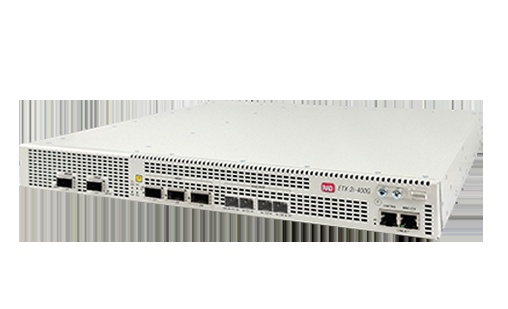
A March collaboration with Arqit adds quantum-safe key generation to RAD’s ETX platform. That announcement describes a security integration, rather than evidence of an invulnerable network. The more interesting continuity is organizational: the same company working on legacy transport is adding capacity and encryption for newer services. Infrastructure suppliers must keep several technological calendars open at once.
The long investment behind the small box
Brothers Yehuda and Zohar Zisapel founded RAD in 1981. Its early business manufactured miniature modems and adapters; it became the anchor of a group of independent technology companies. The brothers also supported technology education and the Technion. Yehuda composed classical music and lent rare instruments to musicians. Zohar collected art, some displayed in company offices. Their interests extended well beyond the circuit board.
Some costs are measurable. In 2014, RAD and Israel’s Office of the Chief Scientist announced a $32 million investment for a programmable-network R&D center in Beer Sheva. Longevity has also included retrenchment: CTech reported dozens of layoffs in 2019. Today, RAD’s careers page emphasizes internal development and notes that its R&D and Operations leaders began in junior roles.
The lesson for an infrastructure buyer is to map what must survive an upgrade before choosing its replacement. Start with the devices, protocols and services already in use. Then test the transition, including the ordinary dashboard someone will open on Monday morning. RAD’s business makes sense at that moment: when tomorrow’s network has to take responsibility for yesterday’s equipment.